Key Takeaways
- Build when a capability creates genuine competitive differentiation, and you can own it long-term.
- Buy when the capability is becoming standardised, and speed matters more than customisation.
- Choose hybrid when different layers of the AI stack need different ownership models, which is more common than a purely one-or-the-other answer.
- Evaluate total cost of ownership, governance, and integration complexity, not just the initial price tag. And make this decision use case by use case, not as a single company-wide policy.
As a CEO, you likely have two options at any given moment: build a custom AI solution in-house with engineers or buy an enterprise AI solution. Both look reasonable in a slide deck. The real cost of getting build vs buy AI wrong isn’t just the budget line; it’s spending a year building something already available off the shelf, or becoming dependent on a vendor that can’t support what the business needs eighteen months from now.
Eventually the case comes down to quite a lot more than your upfront costs. However, you must take the following into account: time to market, availability of labour, data sensitivity, customisation needs, scalability potential, ease of integration, future ownership. This guide outlines the steps business leaders can take to navigate AI buy vs build.
What Does “Build Vs. Buy AI” Actually Mean?
For the time being, “building AI” pretty much means building any sort of application consuming one or several foundation models via a public API; fine-tuning any of the existing models; rolling out your own custom RAG setup, or integrating with some AI Agents / Orchestration.
Meanwhile, “buying AI” encompasses SaaS AI tools, enterprise AI platforms, embedded AI features, industry-specific products, or managed AI services. In fact, there are three such options to choose from, not two.
The build vs. buy AI decision is not always limited to two options:
Building AI requires knowledge of how to design or integrate foundation models. We can build your AI using foundation model APIs, fine-tuning existing models, designing custom RAG systems or integrating AI agents and orchestration tools, which also allows your company to have more ownership of the system but at a higher expense of time, resources and technical capability.
When buying AI, we’re adopting off-the-shelf SaaS-based tools, enterprise AI platforms, or embedded AI functionality/managed services. That gives quick implementation, however at the risk of less flexibility and vendor dependence.
Other businesses take a hybrid strategy, mixing private data and logic with public models and/or infrastructure. Or even hire AI professionals to build for them much quicker, while also having them solve the know-how they are missing internally.
This will depend on your requirements for levels of control, customisation, speed of development and long-term ownership.
Build Vs. Buy Is an Ownership Decision
The wrong question is “can our engineering team build this?” Most competent engineering teams can build almost anything given enough time. The better questions are whether you should own this capability, what happens when the AI produces a wrong output, and whether you can still maintain and evaluate it three years from now, not just launch it. Build vs buy AI is really a decision about who owns the long-term responsibility for outcomes, not who’s technically capable of shipping a first version.
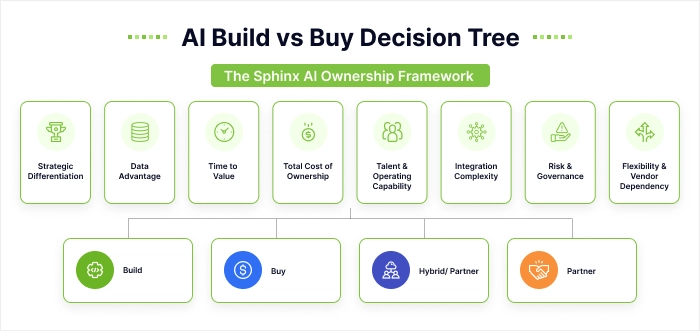
The Sphinx AI Ownership Framework
Score each candidate use case 1–5 across eight factors, then read the pattern rather than any single number:
| Dimension | Question |
| Strategic differentiation | Will this create a genuine competitive advantage? |
| Data advantage | Do you have proprietary, high-quality data competitors can’t easily replicate? |
| Time to value | How fast does the business need a measurable result? |
| Total cost of ownership | What does this actually cost over three years, not just at launch? |
| Talent & operating capability | Can you build, evaluate, secure, and maintain this ongoing? |
| Integration complexity | How deeply must this connect to proprietary workflows and systems? |
| Risk & governance | What’s the cost of an incorrect output or compliance failure? |
| Flexibility & vendor dependency | How much does roadmap control and portability matter here? |
High scores on differentiation, data advantage, and talent capability point toward build. High urgency on time-to-value with low differentiation points toward buy. High governance requirements paired with limited internal capability points toward hybrid or partner. This is a Sphinx Solutions strategic decision aid, not a scientifically validated formula; its value is making the comparison explicit instead of implicit, so a decision doesn’t quietly default to whichever option the loudest person in the room prefers.
A small point specific to proprietary data: having lots of data does not equate to having a data advantage. The data needs to be specific for the use case, usable and available, high quality, well governed and actually difficult to replicate; it is not alone going to outweigh the choice to build if the sheer volume is of an unfocused or off-the-shelf dataset.
When Should You Build AI?
Building tends to make sense when AI is core to your competitive advantage; it directly shapes your product or customer experience, not a supporting internal process.
It also fits where the workflow is inherently different from anything a general-purpose tool is able to handle, there is a data advantage as definition above, and the organization possesses (or is willing to build) the complete operating capability: AI engineers, data engineering, evaluation, security, and sustained monitoring – not just a team that ships the v1.
Building AI in-house where this operating capability doesn’t exist is one of the biggest risks to building AI internally: the launch succeeds, and the maintenance dies quietly weeks later.
When Should You Buy AI?
Buying tends to win when the use case isn’t a competitive differentiator; meeting summarisation, generic document assistance, developer productivity tools, and standard customer support workflows rarely justify custom builds. The advantages of buying an AI solution are speed to value, a market that has often already solved the problem well, and freeing internal talent for higher-value work instead of rebuilding commodity capability. The risk on this side is treating “buy” as a one-time purchase decision rather than an ongoing vendor relationship that needs the same governance rigour as anything built internally.
When is a Hybrid AI Strategy the Right Choice?
Most enterprise AI architectures are not purely built or bought. A hybrid AI strategy typically involves buying the underlying foundation models and infrastructure while building the proprietary application layer on top.
For example, businesses may buy foundation models while building their own data and knowledge layer, where much of their competitive advantage often exists. Orchestration might use existing vendor tools combined with custom business logic. However, the interface itself may be constructed or adapted to individual existing workflows.
They do this similarly to how they have internal AI policies and governance rules with third-party solutions in other categories that provide management, security, and compliance.
The general principle is simple: buy commodity AI infrastructure and build the layers where your proprietary data, business logic, and competitive advantage live.
What Could a “Wrong Test” Cause?
A point most buy Vs. build decisions overlook: when AI gets it wrong. First, classify how you intend to use it and let that classification, not a single overbearing metric, guide whether you should buy vs build and whether you actually want to own and control it.
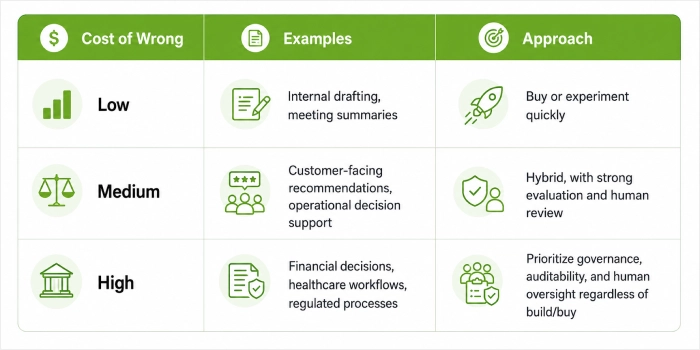
Just because a use case is “high-risk” doesn’t necessarily mean that you should “build everything”; but instead the governance/testing/supervision burden you face simply goes through the roof, whichever ownership model you employ. Regulated industries in particular should treat vendor accountability and auditability as selection criteria, not an afterthought.
Don’t Compare Just the Sticker Price
Building carries hidden costs beyond initial development like infrastructure, ongoing evaluation, security, retraining as models change, technical debt, and the opportunity cost of engineering time spent here instead of elsewhere.
Buying carries its own hidden costs: usage-based pricing that escalates with scale, integration and customisation work, vendor-driven roadmap dependency, and switching costs if you need to exit later.
Calculating build vs buy AI costs properly means modelling all of this over a three-year horizon, not comparing a license fee against a one-time development quote; see our AI ROI framework for the fuller cost-of-ownership methodology.
Decision Matrix for Build Vs. Buy AI
| Situation | Likely Direction | Why |
| Generic internal productivity assistant | Buy | Commodity capability, low differentiation |
| Highly specialised financial modelling workflow | Build or hybrid | Deep proprietary logic, high differentiation |
| Customer service automation | Hybrid | Buy the platform, build the knowledge and escalation logic |
| Regulated industry use case | Hybrid, governance-first | Ownership clarity matters more than build vs buy itself |
| Early-stage AI experimentation | Buy | Low commitment, fast learning, low cost of wrong |
| AI-powered feature inside your core product | Build | Direct competitive differentiation |
What are Common AI Build vs. Buy Mistakes That Enterprises Make?
- Building due to “feeling it strategic”, rather than for it being scored as such by the framework.
- Purchasing with no thought to how it will integrate, only to find out the tool can not easily merge with current processes.
- Comparing only upfront cost instead of three-year TCO.
- Treating either choice as a one-time implementation instead of an ongoing operational commitment.
- Ignoring the vendor exit strategy until you actually need one.
- Applying a single company-wide philosophy, “we build” or “we buy”; to every use case regardless of how differently they score.
Conclusion
You want to own the AI that matters for strategic advantage and acquire for everything else via the fast, cheap, or safe route. Build where the differentiators or long-term control are truly valuable. Buy where the capability is becoming a commodity. Use hybrid approaches where enterprise reality demands both speed and control at once, which is most of the time.
If your organisation is weighing this decision across several use cases at once, our Enterprise AI Adoption Framework and AI readiness assessment are good starting points before the build-vs-buy conversation even begins, and Sphinx Solutions can help assess specific use cases and design an ownership approach matched to your actual strategy, not a default.
FAQ’s:
Is it better to build or buy AI?
Neither is universally better; it depends on whether the use case creates competitive differentiation, how fast you need value, and whether you can operate and maintain the capability long-term. Most enterprises need both approaches across different use cases.
Should enterprises build their own AI?
Only where the capability is strategically differentiating, backed by a genuine data advantage, and supported by the talent to maintain it long-term. Building without that operating capability tends to succeed at launch and fail at maintenance.
Is buying AI cheaper than building AI?
Often cheaper upfront, but not always cheaper over three years once usage-based pricing, integration, and customisation costs are included; proper comparison requires a full total-cost-of-ownership model, not just the license price.
What is a hybrid AI strategy?
An approach that buys commodity infrastructure (models, cloud, tooling) while building the proprietary layer data, business logic, and workflow where the actual competitive advantage lives. It’s the most common pattern in practice, not a compromise choice.
How can enterprises avoid AI vendor lock-in?
By evaluating portability and exit costs before signing, keeping proprietary data and business logic in a layer you control, and treating vendor roadmap dependency as a scored factor in the decision, not an afterthought discovered during a renewal negotiation.
Should startups build or buy AI?
Startups generally should buy unless AI is the core product itself, since engineering capacity is scarce and speed to market usually matters more than ownership at an early stage.
Should large enterprises build their own AI models?
Rarely training foundation models from scratch, more commonly building the proprietary application and data layer on top of a bought or fine-tuned model, reserving full custom builds for genuinely differentiating capabilities.
How do I calculate the cost of building vs buying AI?
Model both options over a three-year horizon: build costs include talent, infrastructure, and maintenance; buy costs include licensing, usage fees, integration, and switching costs. Compare total cost of ownership, not the initial quote alone.
What is the best AI strategy for enterprises?
A portfolio approach: build, buy, hybrid, and partner used deliberately across different use cases based on differentiation, data advantage, and cost of wrong rather than one company-wide policy applied to everything.
What should regulated industries consider when choosing AI solutions?
Auditability, human oversight, and vendor accountability matter more than the build-or-buy choice itself; a high cost of wrong raises governance requirements regardless of which ownership model you pick.


 Shaili Gupta

 Ajay Wadne