

Artificial Intelligence (AI) is evolving the entire manufacturing industry in many ways with its high transformative capabilities. From optimizing efficiency to driving new innovations, AI is revolutionizing traditional manufacturing and production processes in a consistent manner.
AI in manufacturing mainly encompasses diverse use cases including factory automation, demand forecasting, quality control, supply chain optimization, predictive maintenance, and more. In this blog, we will explain different use cases and examples of AI trends in manufacturing. Let’s get started.
Importance of AI in Manufacturing Industry
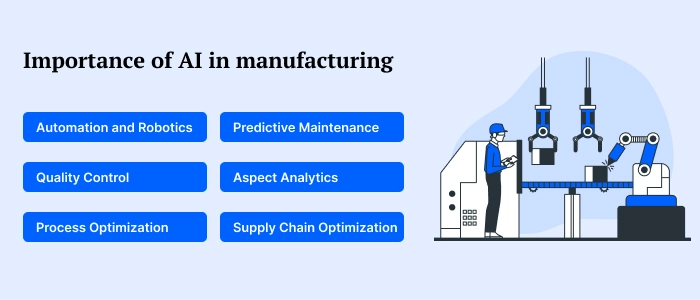
The integration of Artificial Intelligence into manufacturing has unlocked boundless possibilities and propelled modern industries towards massive advancements & efficiencies. As part of the Industry 4.0 revolution (4IR), AI combines automation, data-driven decision-making, and digital technologies to help manufacturers boost productivity and streamline operations. In the manufacturing industry, AI plays a prominent role in the following areas:
- Automation and Robotics
- Predictive Maintenance
- Quality Control
- Aspect Analytics
- Process Optimization
- Supply Chain Optimization
Benefits of Using AI in Manufacturing
The advanced AI integration in manufacturing brings a number of advantages that highly impact productivity and operational performance. Some of the most prominent benefits of implementing AI technology in manufacturing include:

Improved Efficiency:
- Automation of routine tasks: AI-based systems can smoothly automate mundane and repetitive tasks. In manufacturing, automation allows workers to concentrate on other complex tasks. This leads to improved productivity and high operational efficiency.
- Continuous operations: AI-based systems come with continuous working ability that significantly reduces downtime & optimizes production cycles. This leads to continuous and seamless manufacturing processes.
Enhanced Quality Control:
- Intelligent defect detection: AI-driven visual inspection can effectively analyze any product in real time and identify defects with high accuracy. This helps to enhance product quality and minimizes the risk of errors in production.
- Consistency: AI-powered solutions always ensure top-notch product quality and minimize the risk of human errors. This leads to continuous production with a high level of precision.
Predictive Maintenance:
- Reduced downtime: AI algorithms can thoroughly analyze information to predict and calculate equipment failures before occurring. This reduces unplanned downtime, improves proactive maintenance, and ensures continuous operations in manufacturing.
- Better equipment lifespan: Predictive maintenance in manufacturing firms significantly extends the machinery and equipment lifespan by identifying issues and resolving them thoroughly. The best preventive maintenance software complements this by ensuring that identified issues are addressed through scheduled maintenance, reducing the risk of unexpected failures and prolonging asset life.
Looking for AI Development Services?
Take your manufacturing business to the next level with our custom AI software development solutions.
Supply Chain Optimization:
- Thorough Data Analysis: By analyzing large datasets, AI gives real-time and thorough insights into supply chain operations. This allows manufacturers to minimize lead times, optimize inventory levels, and boost supply chain efficiency significantly.
- Adaptability: Artificial intelligence allows manufacturers to quickly adapt to the latest market trends and other external factors. This leads to an agile and responsive supply chain.
Process Optimization:
- Strategic decision-making: AI can effectively analyze manufacturing-related data and information to make strategic decisions and identify possibilities for seamless optimization.
- Sustainability: By minimizing environmental impact & resource waste, process optimization helps in promoting eco-friendly manufacturing and production. This leads to reduced energy consumption, refined production parameters, and streamlined workflows.
How is AI Used in Manufacturing?
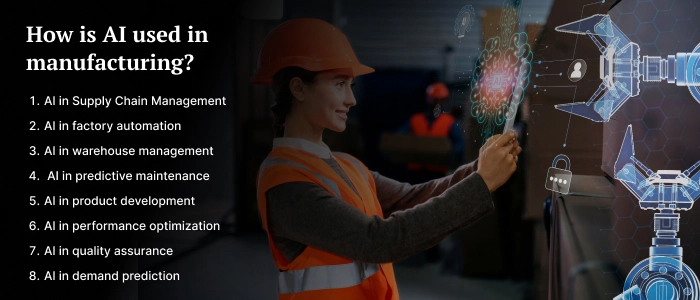
As the most emerging technology, AI development services are utilized in the manufacturing industry in many ways. Every use case plays a big role in transforming the way manufacturing companies work and manage their operations today. The top 8 artificial intelligence in manufacturing examples include:
AI in Supply Chain Management
Supply Chain Management is an integral part of manufacturing that deals with procurement systems, operations management, and logistics. By embracing the power of artificial intelligence, manufacturers are seamlessly optimizing their supply chain systems to achieve improvement in operational efficiency.
Moreover, AI also helps supply chain management with predictive analytics and real-time insights. Smart AI algorithms can effectively analyze data and market trends to manage inventory levels and reduce lead times. This leads to a more resilient and optimized supply chain.
AI in Factory Automation
The advancement of AI in manufacturing has significantly transformed the process of factory automation. In terms of productivity, efficiency, and cost-effectiveness, modern factories are experiencing a major shift with the power of AI and ML technologies. One of the prominent examples of AI/ML in manufacturing is robotic automation.
AI-driven industrial robots are designed with machine learning algorithms and computer vision. They can easily perform complex and repetitive tasks with high accuracy. These robots are employed for quality control inspections, assembly process management, and more. AI-integrated factory automation not only ensures better equipment performance but also minimizes industrial maintenance costs.
AI in Warehouse Management
AI technologies play a vital role in transforming the warehouse management system in the manufacturing industry. AI-driven solutions have significantly transformed the way any warehouse works. This leads to reduced warehouse management costs and improved efficiency. In a smart warehouse, AI algorithms can smoothly analyze sales data, evaluate market trends, and manage the latest stock levels to accurately predict demand patterns.
This allows warehouses to seamlessly optimize and manage their inventory levels and improve efficiency. When paired with an RFID warehouse inventory management system, AI can instantly verify stock locations, speed up cycle counts, and maintain real‑time visibility across all SKUs. Apart from that, artificial intelligence also improves the order fulfillment method in smart warehouses.
Struggling to Estimate Your AI Project Budget?
No worries! Get a detailed ai cost estimation in just a few clicks.
AI in Predictive Maintenance
AI-integrated predictive maintenance has emerged as a revolutionary force in manufacturing. By utilizing machine learning algorithms and advanced analytics, artificial intelligence allows manufacturers to efficiently track and monitor equipment failures, optimize maintenance schedules, and reduce downtime.
In addition, the predictive maintenance capabilities of artificial intelligence prevent expensive equipment breakdowns and other industrial maintenance expenses. Apart from that, AI-based predictive maintenance also helps manufacturers accurately manage maintenance schedules, and improve cost-effectiveness and operational efficiency.
AI in Product Development
In manufacturing, the process of new product development has experienced a massive transformation with the advancement of artificial intelligence. AI-integrated solutions have unlocked a number of innovative approaches that transform the way manufacturers develop and launch their new products to the market. In the product development process, AI developers help to analyze large datasets efficiently.
By utilizing AI/ML algorithms, today’s manufacturers can effectively collect insights from the latest market trends, competitor analysis, and consumer preferences. This allows them to make strategic decisions & design new products that perfectly align with the current market trends. By embracing the power of artificial intelligence, manufacturers can improve their competitive edge & introduce successful products to the market.
AI in Performance Optimization
In the manufacturing industry, performance optimization is one of the critical aspects and AI helps to revolutionize it significantly. By efficiently analyzing real-time sensor data, historical data, and other variables, artificial intelligence can accurately address patterns, make strategic and data-driven predictions, and detect errors. This allows manufacturers to effectively optimize, and manage their business operations, maximize industrial effectiveness, and reduce downtime.
Apart from that, AI-based applications enable manufacturing companies to enhance sustainability efforts, minimize waste, and optimize the rate of energy consumption.
AI system solutions can identify energy usage patterns and address areas of improvement efficiently. This leads to better cost savings and reduced environmental impact.
AI in Quality Assurance
In the manufacturing field, AI plays a very big role in transforming the quality assurance domain. By utilizing the power of AI/ML technologies, manufacturers are continuously evolving their approaches to quality control. This leads to high accuracy and consistent quality assurance. One of the prime examples of AI applications in quality assurance is AI-based visual inspection.
By using artificial intelligence, manufacturers employ computer vision algorithms to effectively analyze product videos and component images. These algorithms have the ability to address defects and deviations from industrial quality standards with high accuracy. Apart from that, AI technologies can also improve predictive quality assurance. AI algorithms are also able to detect trends and patterns that indicate manufacturing quality issues. This allows manufacturers to identify defects and take actions proactively.
AI in Demand Prediction
The application of AI in the manufacturing industry for demand prediction brings a number of advantages. Artificial intelligence allows manufacturers to make strategic decisions by analyzing market trends, sales information, market trends, etc. This leads to better production workflow and reduced risk of excess inventory and stock-outs.
Apart from that, the AI use case for industrial demand prediction allows manufacturers to enhance production planning as well as resource allocation. By predicting all demands accurately, manufacturing companies can easily manage production schedules, minimize costs, and reduce lead times related to underutilized resources or overproduction.
Want to Hire AI Developers?
With comprehensive AI software development, we help businesses build advanced AI systems efficiently.
AI Use Cases in Manufacturing
Cobots
Collaborative Robots or Cobots is an AI-driven transformation designed to work with human workers. By combining advanced AI with human insight, cobots are enhancing efficiency and safety in the factory. A seamless partnership between both boosts manufacturing processes and reduces human errors.
Sensors and cameras in cobots can sense their environment, enabling them to avoid collision, identify objects, and adjust to changes in the surroundings. They can learn through human demonstrations that predictive maintenance systems can monitor the health of cobots and predict potential failures.
Industries like automotive can assemble components, perform quality inspections, and assist in painting and welding. Sectors such as automotive can assemble parts, conduct quality checks on finished products, and help in painting and welding activities. Logistics and warehousing have the potential to automate functions such as picking, packing, and stacking dry pallets, thus saving on manpower.
Assembly Line Optimization
Assembly line optimization is one of the most impactful applications in the manufacturing business. Manufacturers can improve quality, minimize errors, and reduce downtime when AI is integrated into production lines to increase th productivity and profitability.
AI-powered sensors using machine learning algorithms can predict equipment failures to maintain the flow and function of assembly processes. Quality checks can be monitored and adjusted in real-time with immediate corrective actions. Adjustments in the speed of conveyors, the precision of robotic arms, production rates, etc., can decrease the risk of faulty products on the market.
Assembly line optimization using intelligent automations in the future of manufacturing can introduce smart systems that learn from production data and self-control issues.
Streamlined Paperwork
In traditional manufacturing processes, examples of paperwork include documentation for production schedules, supply chain management, quality control, compliance, and inventory management. The sector’s dependence on documentation particularly results in mistakes and ineffectiveness. However, AI is automating and digitizing the documentation flow. However, AI is automating and digitizing the documentation flow.
AI-powered tools with intelligent document search Natural Language Processing (NLP) can automatically extract information from invoices, purchase orders, shipping documents, etc, reducing manual work. They can automatically generate quality control reports that meet industry standards. It also analyses the supply chain data to identify inefficiencies and optimize logistics.
Order Management
Order management processes in manufacturing have always been manual and time-consuming. The hectic work involves tracking inventory, scheduling production and handling customer communications. This can lead to delays, inaccuracies, and customer dissatisfaction.
AI in manufacturing can automate order management processes such as production capacity, inventory level and shipping costs. The forecasting AI models can predict future demand, enabling the manufacturers to plan the inventory and production. Small routine tasks like order entry, confirmation and acknowledgement have made a huge difference in reducing manual work.
Siemens, a leader in advanced manufacturing, displays the usefulness of AI in order management processes. They use AI to predict demands, plan inventory, and reduce industrial waste. Also, adjusting the real-time production to meet orders makes them a smart manufacturer industry.
Connected Factories
Connected Factories with AI-powered manufacturing facilities are turning traditional factories into connected, intelligent spaces. It’s a new manufacturing era, revolutionizing how products are designed and delivered.
In connected factories, the health of machinery is checked, and data from sensors is identified for anomalies and inspected for defects. Complex tasks such as assembling the parts, packaging and material handling can optimize supply chain management for productivity.
A better example of a connected factory is the Siemens Amberg Electronics Plant in Germany. It combines IoT to create a fully automated production line with interconnected machines that share and analyze data. At each production stage, it improves the product quality and reduces waste by ensuring that errors are recognized soon.
Sphinx Solutions as Custom AI for Manufacturing Projects
Sphinx Solution is a leading IT service provider focusing on AI solutions for various industries. The workforce of 100+ skilled developers, designers and automation experts fulfils the norms of industry standards to build a successful AI solution. Serving 15+ industries with experts who analyze all the requirements, 500+ clients are happy with the customized automation solutions.
Sphinx Solutions is dedicated to improving efficiency, quality, and innovation for manufacturers by creating cutting-edge AI solutions that meet their specific requirements. Using the AI tools, the clients are assisted in processes that improve productivity, product refinement and significant cost reductions.
Additionally, Sphinx Solutions’ AI solutions enhance quality control, supply chain management, and workplace safety. With advanced image recognition and anomaly detection, AI-powered quality control identifies defects early, ensuring only top-quality products reach the market. Communication across connected factories provides actionable insights supporting faster, smarter decisions.
The solutions also prioritize worker safety, using AI to monitor environmental factors and equipment, automate safety checks, and alert supervisors to potential hazards, creating a safer, compliant workplace. Together, these capabilities drive manufacturing excellence and a future-ready operational environment.
Final Words
The applications of artificial intelligence in manufacturing have significantly transformed the way products are developed and delivered to consumers. From factory automation to quality control, AI shows its massive advancements in every aspect to improve efficiency and drive innovations.
Though some notable challenges like data security, workforce adaptation, and initial investment should be resolved, AI helps manufacturing processes in the long term. As we embrace the industrial revolutions, the advancements in AI capabilities will rapidly redefine the manufacturing industry by developing more sustainable, agile, and intelligent production processes. Are you planning to hire AI developers for your project? Talk to our experts today for complete guidance.
FAQ’s
How is AI being used in manufacturing?
AI technology is extensively used for several purposes in the manufacturing industry, from automating traditional processes to improving operational efficiency and productivity. Some of the notable areas in which artificial intelligence is being utilized include:
- Robotics and automation
- Quality control
- Predictive maintenance
- Process optimization
- Supply chain optimization
- Decision-making & data analytics
- Industrial safety & compliance
How does AI improve efficiency in manufacturing?
From data-driven decision making to predictive analytics, Artificial Intelligence plays a big role in increasing operational efficiency in the manufacturing industry. AI is mostly used to improve the following purposes:
- Automating repetitive tasks
- Improving predictive maintenance
- Enhancing defect detection & quality control
- Streamlining supply chain optimization
- Improving data-driven decision making
- Monitory industry safety and compliance
Why is AI good for manufacturing?
AI technology is extremely beneficial for the manufacturing and production industry as it helps to increase operational efficiency and revolutionize traditional processes. This leads to improved productivity and tangible outcomes. Here are some key reasons that highlight the importance of AI in manufacturing:
- Improves operational efficiency
- Enhances predictive maintenance
- Adaptability to current market changes
- Minimizing risks of manual errors
- Optimizing inventory management
- Improving demand forecasting
- Streamlining logistics operations


 Shaili Gupta


 Ajay Wadne
