
The arrival of the Metaverse defined the 2020s, which followed the 2010s with an explosion of social media and smartphone applications. The Metaverse originated with science fiction concepts as a digital cosmos in which humans might work, play, shop, and socialise in immersive virtual environments.
A titanic tussle to conquer this futuristic space is brewing, with internet titans such as Meta (the new name of Facebook) plunging billions into its evolution alongside Microsoft, Google, Apple, and NVIDIA.
The Metaverse is a word that has gone past trendy. Just look at the statistics: Bloomberg says that by 2024, the worldwide Metaverse economy might burgeon to $800 billion, with gaming, virtual real estate, e-commerce, and entertainment as the major players.
With Gartner forecasting that by 2026, 30% of the world’s businesses will have products and services ready for the Metaverse, the shift toward virtual business ecosystems is clearly inevitable.
But avatars and futuristic cities are not the only things attracting real money to the virtual world; money flowing into virtual worlds is doing so successfully! Prices for virtual land shot past $500 million in 2022, and experts suggest that Metaverse-associated industries could generate upwards of $5 trillion in contributions to the world economy by 2030.
Ten years ago, few could have predicted that companies would meet in 3D virtual bedrooms, purchase digital clothes for avatars, or invest in NFT-based real estate; now, Nike, Gucci, and Hyundai have all started working on metaverse experiences to attract the next-generation consumer.
As technology continues to evolve, companies are competing to find the right development partners to bring their immersive Metaverse initiatives to life: training simulations driven by VR, virtual assistants powered by AI, decentralised economies built on blockchain, or hyper-realistic gaming experiences.
The postulates assist organisations in navigating this uncertain environment, which led us to consider establishing a list of the Top Metaverse Development Companies in 2026. These companies are genuinely marching ahead and bringing forth the Metaverse, supported by thorough research, industry experience, and performance in practice.
Understanding The Metaverse in 2026
Have you ever fantasised about working in a towering virtual skyscraper, taking an evening run through breathtaking digital scenery, or relaxing in your living room for an actual concert?
Welcome to Metaverse 2026, a land where summers merge into an uninterrupted immersive experience. What used to be pure science fiction is now an intensely honest and growing digital world where virtual and augmented experiences have taken the front seat in social and professional interactions.
The Metaverse is shaping a paradigm shift in how we interact with our immediate world. We’re entering another dimension where your avatar is equally as important as your physical self, and lines, borders, or territories do not limit experiences.
According to industry experts, the Metaverse is expected to have more than one billion active users by 2026, demonstrating its rapid expansion and appeal.
Consider how social media and mobile apps have changed our lives in the last decade. The Metaverse is anticipated to produce the same effect. Bloomberg predicts it might generate $800 billion in revenue by 2024.
With a surge in virtual commerce, gaming, live events, education, and other forms of connection, this growing market opportunity is expected to expand even further in the future years.
From Virtual Reality to Metaverse Reality
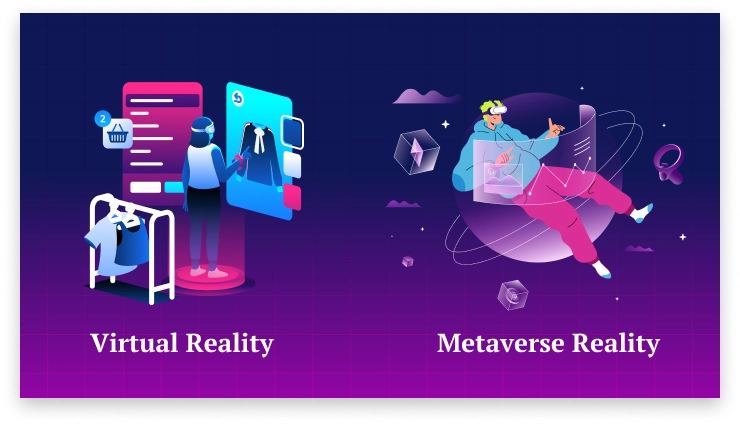
Equipped with the Metaverse, which in essence comprises VR, AR, Blockchain, and AI, these technologies have long since transcended their rustic beginnings.
VR goggles today are cheaper and technologically superior. AR, on the other hand, has moved past novelty apps like Snapchat filters and is adding value to many different technologies and industries.
Blockchain then features security, ownership, and decentralisation to allow this transparent trading of assets such as virtual real estate and digital art by the users.
In the year 2026, the Metaverse will serve as an access into which one can pull one thing from a virtual business meeting in one room to an immersive game experience in another while carrying his/her digital identity and assets.
The Metaverse opens unlimited avenues for connection and growth, including experiences such as attending a conference hosted by a top CEO, investing in virtual real estate, and working with teams across the globe in real-time.
Check Out Related Posts
Key Trends Shaping the Metaverse Development Companies
The Metaverse is no longer ephemeral. It is the digital gold rush, and all the top IT entrepreneurs are gagging to make their claims. What was once considered a far-fetched sci-fi idea has evolved into a thriving economy, with McKinsey noting a $5 trillion GDP by 2030.
Organisations from many industries, such as gaming, e-commerce, healthcare, and education, are ready to provide immersive virtual experiences. The Metaverse development companies are at the forefront of this change.
With advancements in AI and blockchain, extended reality (XR), and decentralised economies, the companies championing this cause are- ever-changing. New technologies, shifting user behaviours, and evolving business models.
AI-Powered Virtual Worlds
Forget about static, pre-programmed surroundings; AI is now the Metaverse’s backbone. Machine learning allows for dynamic, ever-changing virtual settings, from intelligent NPCs to AI-driven world-building.
Imagine a Metaverse metropolis that evolves in real-time, with AI tailoring experiences based on user behaviour, like how Netflix recommends shows or Amazon promotes products.
Blockchain and Decentralized
In 2026, the Metaverse is no longer controlled by a handful of corporate giants. Thanks to blockchain technology, NFTs, and DAOs (Decentralized Autonomous Organizations), users have actual ownership of digital assets.
Whether it’s virtual land, fashion, or businesses, blockchain ensures transparency, security, and accurate digital autonomy. With over $2 billion in NFT-based real estate transactions recorded in 2024 alone, decentralised economies are becoming the backbone of metaverse commerce.
Hyper-Realistic XR Experiences
Remember when Virtual Reality was simply a cumbersome headset with pixelated graphics? Those days are long gone. Advanced developments in AR, VR, and MR are rendering Metaverse experiences real beyond distinction.
Apple, Meta, and Sony manufacture XR headsets that are light and high-resolution and provide complete sensory immersion. The headgear comes with various whacky accessories, such as haptic gloves for feeling objects and brain-computer interfaces that act upon thoughts.
Check Out Related Posts
Rise of a Metaverse-as-a-Service (MaaS)
Not every organisation has the resources to create a Metaverse from scratch. Metaverse-as-a-Service (MaaS) enables organisations to rent, customise, and deploy Metaverse solutions without doing any heavy lifting.
MaaS is democratising the Metaverse in the same way that cloud computing did for software development, allowing marketers, influencers, and organisations to create bespoke virtual worlds easily.
Digital Twins
Not every organisation has the resources to create a Metaverse from scratch. Metaverse-as-a-Service (MaaS) enables organisations to rent, customise, and deploy Metaverse solutions without doing any heavy lifting.
MaaS is democratising the Metaverse in the same way that cloud computing did for software development, allowing marketers, influencers, and organisations to create bespoke virtual worlds easily.
5G & Edge Computing
Speed and low latency are two great necessities in the Metaverse, and 5G and edge computing are promising to be the two most effective aids. Since global adoption of 5G is anticipated to hit 4.5 billion by 2026, slow VR experiences and lagging virtual worlds are becoming passing memories.
This paradigm includes all kinds of smooth, real-time interactions, whether you’re in a virtual concert, trading digital assets, or collaborating in 3D space.
Comparison of the Leading Metaverse Developers
Though the title suggests that the Metaverse is almost here, several shades of grey lie between reality and imagination. While big tech companies like Meta, Microsoft, and Google are investing billions in their metaverse empires, it is actually the development companies that build virtual worlds.
Metaverse construction involves significant programs that are entirely different. Each developer would, one way or another, bring some specialised skills or perspective to bear) – be it technology, exceptional industry knowledge, or fast responsiveness to trends. Some are focused on games and entertainment, while others are exploring enterprise solutions or social networks.
When you look at the top Metaverse developers, you will notice a variety of specialities. Some companies specialise in producing immersive virtual worlds with spectacular visuals and interactive experiences, while others work to build secure blockchain-based infrastructures for decentralised environments. Some are pioneering AI, while others are experimenting with VR and AR to create cutting-edge experiences.
Let’s take a closer look at the players that are making waves:
Meta (Facebook)
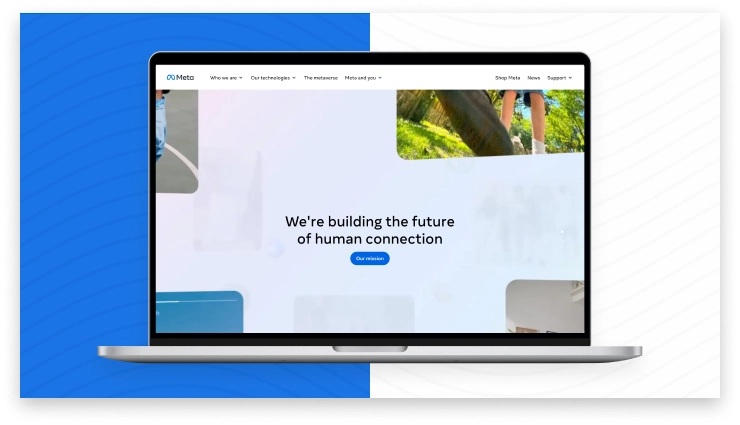
Meta is arguably the most well-known name in the Metaverse race. With billions of active users on Facebook, Instagram, and WhatsApp, it has the user base and resources to create an absolutely integrated Metaverse experience.
Meta is all about social connectedness, blurring the lines between the digital and physical worlds through virtual events, social spaces, immersive gaming, and shopping experiences.
What sets them apart:
- Massive existing user base.
- Deep pockets for R&D and infrastructure.
- Integration with the Facebook network for a seamless social experience.
Microsoft
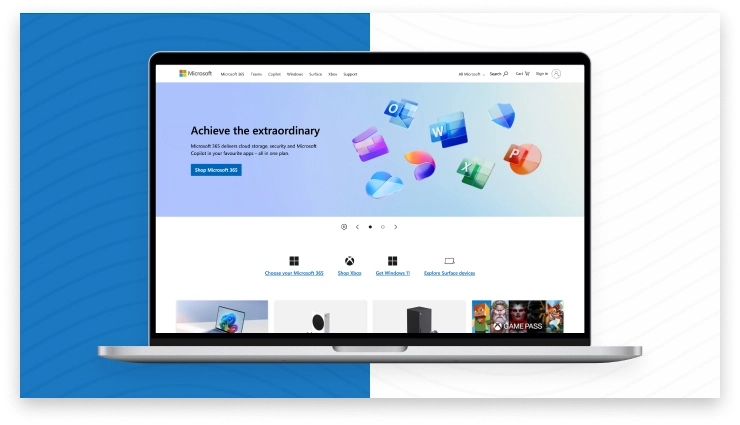
The software bells are rung for enterprise whenever Microsoft chooses to speak. Microsoft is already spearheading a change in the workplace Metaverse, where applications abound, such as virtual training and digital collaboration, in regards to HoloLens and Azure Cloud.
Microsoft is focussing on exploiting its cloud computing infrastructure to provide scalable Metaverse solutions for areas such as healthcare, manufacturing, and education.
What sets them apart:
- Enterprise-focused Metaverse solutions.
- Deep integration with Azure Cloud and Microsoft Teams.
- Strong experience in XR (Mixed Reality).
Decentraland
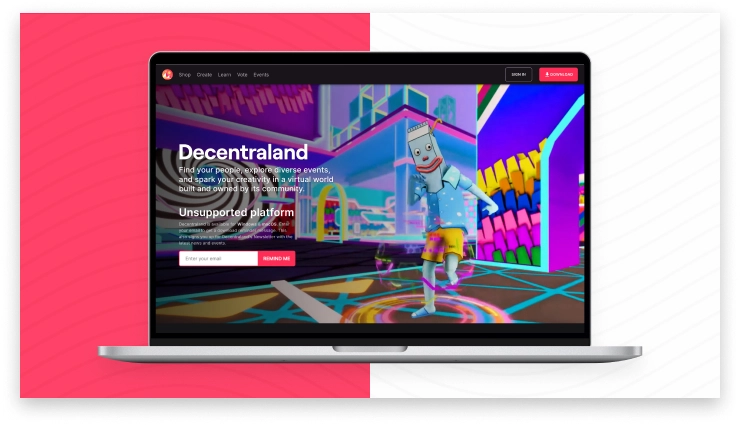
Decentraland, the other end of the spectrum and the first mover towards decentralised virtual worlds, enables users to purchase, sell, and build on virtual land powered by the blockchain.
The company’s decentralisation is regarded as particularly important, making it a pioneer in creating a Metaverse where users, not corporations, control the system. Through its marketplace and NFT ecosystem, Decentraland is expanding beyond games to include virtual commerce, events, and even art.
What sets them apart:
- Blockchain-powered decentralised virtual worlds.
- Focus on user autonomy and NFT integration.
- A thriving virtual economy.
Epic Games (Unreal Engine)
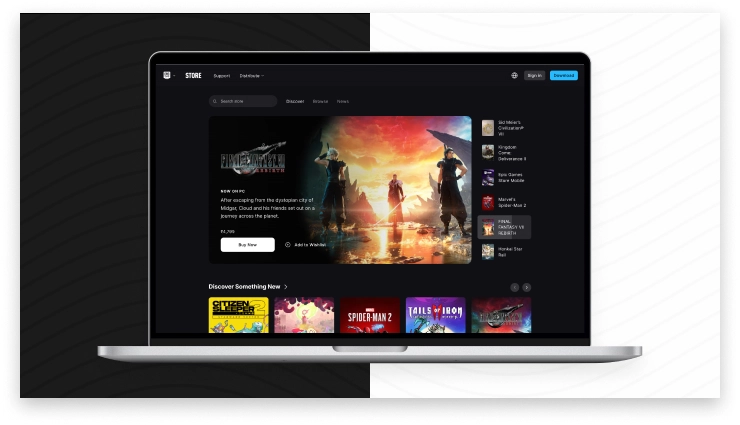
Epic Games, the maker of Fortnite, rewrote the book on the Metaverse gaming world. Now, they are entering the Metaverse. Epic creates very realistic virtual worlds with its advanced 3D engine, the Unreal Engine.
Epic Games’ game-making prowess and immersive technology are creating an environment where gamers, developers, and artists collaborate to create the next level of virtual experiences.
What sets them apart:
- Leading the path for high-quality gaming and digital experiences.
- Unreal Engine is the foundation of numerous Metaverse applications.
- Immersive and photorealistic virtual worlds.
How These Companies are Transforming Industries
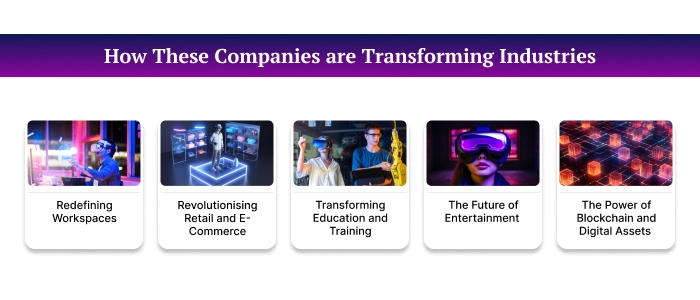
Swapping virtual real estate for a blockchain economy, the Metaverse is no longer a pipe dream; it is a breathing ecosystem that is changing industries in ways we couldn’t even imagine.
It is altering our working, playing, and socialising habits. These forward-thinking Metaverse development companies are spearheading the movement, and their ideas are the foundation for a brand-new world.
Check Out Related Posts
Redefining Workspaces
The rise of remote work has gained popularity in the past few years, and with the Metaverse, it has gained new popularity altogether. Apart from the Metaverse, virtual offices have been another realm for gathering, collaboration, and a 3D representation of activities, dependent on their simulation of other fundamental activities.
Seventy-five percent of industry decision-makers are convinced that the Metaverse will be a usable commercial area by 2030. The three Metaverse providers, Microsoft, Meta, and Decentraland, are wooing enterprises into using these advanced technologies to make work more productive and fun.
Meeting applications in the Metaverse eliminate geographical barriers and circumvent cultural boundaries, ensuring their value to teams collaborating worldwide.
Revolutionising Retail and E-Commerce
The shopping experience is about to get a lot more fun. The Metaverse has drastically changed the retail landscape. Imagine stepping into a virtual store, trying on clothes with a digital avatar that matches your body type, and even attending live product releases.
Nike and Gucci have already opened virtual shops, where their clients can shop in a 3D world and create digital treasures using NFTs.
Companies now can access global markets 24/7 and reach customers who would never enter a physical store, which is tangible. The stats are on the businesses’ side: 58% of consumers are willing to try buying in the Metaverse, and retail sales in the Metaverse are expected to produce approximately $1 trillion by 2030.
The Metaverse is an ideal platform for cultivating novel, creative consumer interactions. It can help businesses increase brand loyalty and create highly personalised experiences.
Transforming Education and Training
When it comes to learning, the Metaverse is more than just an improvement; it is revolutionising the process. Consider a medical student performing surgery in a virtual operating room or a pilot flying a real-time simulation of a plane in a virtual sky.
The Metaverse enables users to enter hyper-realistic training scenarios where they can acquire new skills in a secure, immersive environment free of the risks associated with traditional approaches.
The Future of Entertainment
If you believe gaming is the only business affected by the Metaverse, think again. These companies are pioneering new types of entertainment that blur the distinction between virtual and real.
Metaversian opportunities have opened up for immersive concerts, live theatre, and athletic events so that attendees can enjoy them from the comfort of their homes. This is not some exaggerated possibility far into the future.
Live concerts held by artists like Travis Scott and Ariana Grande have already drawn millions of followers into the Metaverse to relish extraordinary live performances across mind-boggling 3D terrains.
In fact, fans are no longer mere spectators; instead, they are participating in the action, interacting with their favourite artists, exploring virtual worlds, and buying limited-edition digital collectables, such as South Moon Under.
Check Out Related Posts
The Power of Blockchain and Digital Assets
The Metaverse is also causing a significant shift in how we perceive ownership and worth. Because of blockchain technology, digital assets such as NFTs are becoming a new type of currency. Virtual real estate is currently purchased and sold in the same manner as tangible property.
Others are making noticeable progress, such as Decentraland and The Sandbox. These platforms engage users in trading, owning, and developing virtual land, creating decentralised economies that entirely alter existing frameworks of property rights and asset management.
In 2022, the virtual real estate industry was valued at $500 million and expected to reach $1 billion by 2026. This gold rush with digital trinkets seeks to cater to corporations, artists, and investors who are hunting for the next big thing for the blockchain. These companies are returning power to people by allowing them to engage in open, decentralised, and secure economic systems.
Challenges of Metaverse Development
The Metaverse, once the treasured domain of a rich science fiction imagination, now stands on the cusp of being the next digital frontier. A land where people can work, play, shop, and socialise and be able to own virtual real estate sounds like a total bliss.
It will present enormous technological, ethical, and economic challenges, testing humankind’s creativity during its creation.
Nevertheless, the work of building a functioning and unified Metaverse remains enormous, given the vast investments tech majors like Meta, Microsoft, and Google have made in this digital utopia.
Bloomberg estimates that the economy of the Metaverse enterprise solutions could be worth $800 billion by 2024, but the truth is that very little has been firmly established. Barriers to the technological landscape, coupled with safeguarding privacy, are among the many goads developers have to overcome to enable the Metaverse actually to touch our lives.
What are some of the significant challenges in the way of a Metaverse revolution, and how are things looking for this grand ambition?
Hardware and Infrastructure Limitations
No matter how exciting the Metaverse seems, the hardware required to experience it truly isn’t available yet. VR headsets are now big, pricey, and not widely used. While firms such as Apple, Meta, and Sony compete to produce slimmer, more accessible devices, mainstream adoption remains a significant hurdle.
Moreover, the advanced Internet infrastructure required for a fully immersive Metaverse is not globally available. For real-time, high-quality virtual interaction, nobody has easy access to high-speed 5G or fibre-optic networks.
Without the necessary hardware and Internet conditions, Metaverse may have a few select people, while billions would have been shut out from the new digital world.
Lack of Interoperability
Purchasing a digital outfit for your Decentraland avatar and not being able to wear it in Horizon Worlds: this is the working condition for most Metaverse platforms at the moment, functioning like isolated islands from one another rather than a unified universe.
A critical condition for the Metaverse to succeed fully is that users must be able to transition fluidly across virtual worlds while retaining their avatars, assets, and experiences. Unfortunately, several corporations have developed schemes to lock up their closed ecosystems, so this ideal remains distant.
Privacy & Security Concerns
As exciting as the Metaverse sounds, it also raises serious concerns about privacy, security, and digital identity.
- Data Privacy Risks: Firms recording your eye movements, gestures, and even brain impulses in virtual reality! Companies are collecting more biometric and behavioural data as the days go by, causing concerns about personal data monitoring and exploitation.
- Cybercrime & Fraud: The Metaverse is growing in scope with NFTs and digital real estate, thereby attracting cyber criminals. Lack of strong security measures may so result in hacking, identity theft, and fraud using virtual assets gaining wide prevalence.
- Harassment and Misinformation: Similar to social media, virtual worlds can lead to bullying, harassment, and bogus news. A 2023 survey discovered that more than 60% of female users experienced harassment in virtual places.
Accessibility and Inclusivity
While IT experts talk about the Metaverse’s limitless possibilities, they frequently forget one key issue: not everyone has access to the essential equipment.
Almost 3 billion people globally still lack basic internet access. If the Metaverse is constructed without regard for equality, it risks increasing the digital divide and becoming a luxury reserved for the wealthy and technologically competent.
People with disabilities should be able to enter the Metaverse using tools such as voice navigation, customised devices, and AI-powered features.
Need expert metaverse development guidance?
Find top metaverse development company
Conclusion
The Metaverse has transformed into a digital reality with swift changes affecting industries, economies, and human relations. As tech giants and creators race to build thoroughly immersive virtual experiences, concerns such as hardware limitations, interoperability, privacy issues, and accessibility remain huge hurdles between what is and what could be for the promise.
This will have a profound impact on how businesses and customers interact. Thus, the Metaverse will transform the work sphere, entertainment, commerce, and social interaction. Instead, it will create a future where the physical and digital realms coexist seamlessly.
FAQ’s:
- How long does it typically take to develop an app?
A. The timeline for app development varies depending on the complexity, features, and platform. A simple app could take 3-6 months, whilst more complicated applications with advanced features could take 9-12 months or longer. Agile development and iterative testing can assist accelerate the process.
- What is the average cost of metaverse development?
A. Metaverse development expenses are determined by aspects such as complexity, 3D environments, blockchain integration, and artificial intelligence capabilities. A basic virtual area can start at $30,000, while a fully immersive metaverse platform with unique features can cost $100,000 to several million dollars.
- What industries can benefit from metaverse development?
A. Industries like as gaming, real estate, retail, healthcare, education, entertainment, and corporate training can use the Metaverse to improve user engagement, virtual collaboration, and immersive experiences. Businesses can use it for marketing, customer service, and digital asset trading.
- How long does it typically take to develop a metaverse application?
A. The scope and characteristics of a metaverse application determine how to develop it. A simple metaverse experience might take 6-12 months, whereas a large-scale, highly participatory platform that incorporates blockchain, AI, and AR/VR could take 1-3 years. Agile development can help you optimise your timelines.


 Ajay Wadne


