Think about what most people do when they wake up: they check their phones. Nearly every aspect of daily life now revolves around mobile apps, from ordering food and booking cabs to learning new skills and managing money. They have evolved from communication tools into the quiet infrastructure of modern living.
And for brands? Mobile apps are no longer a “nice-to-have.” They are the front door to your business.
Consider how you interact with your favourite brands today compared to ten years ago. You’re not typing URLs into a browser or waiting for a sluggish webpage to load. You tap an icon, and within seconds, you’re browsing, buying, booking, or chatting all from the device that’s practically glued to your hand. That shift didn’t happen by accident. It happened because smart businesses figured out that meeting customers where they already are is the best move you can make. And right now, customers are on their phones.
What started as a perk: “hey, we have an app!”, has become a baseline expectation. Whether you run an e-commerce store, a healthcare platform, a fintech service, or a local business with an ambitious growth plan, your app is often the primary relationship your customers have with your brand.
For startups, a well-built mobile application can be the entire business model. Uber, Duolingo, and Robinhood wouldn’t exist in their current form without their apps. For established companies, mobile is the channel that deepens loyalty, unlocks new revenue streams, and keeps the brand relevant in a world that moves fast and forgives slowly.
This is why more businesses, from bootstrapped founders to global enterprises, are treating mobile app development as a core strategic investment, not a side project. And it’s exactly why choosing the right mobile app development company has shifted from a vendor decision to a boardroom one.
Behind every smooth, intuitive experience is a structured process covering research, design, development, testing, and continuous improvement after launch. That process is called the mobile app development lifecycle, and understanding it is one of the most valuable things any founder or business leader can do before committing a single rupee to development. Every stage matter; skip or rush one, and you’ll feel it later through bugs, poor reviews, or an app users abandon after a single session.
This guide walks you through all of it. You’ll come away with a clear picture of what modern mobile app development truly demands, and why the right mobile app development company can be the difference between an app that fades into obscurity and one that genuinely transforms how customers experience your brand.
What is Mobile App Development?
Building, testing, and maintaining apps intended to run on tablets, cellphones, and other mobile devices is known as mobile app development. Based on the target market and corporate goals, these programs may be produced for Android, iOS, or both.
Unlike conventional software development, mobile development requires careful thought on operating systems, screen sizes, device compatibility, performance optimisation, and user experience. While offering an intuitive and interesting user experience, developers have to make certain the program runs flawlessly on many devices.
Usually, a professional mobile app development business provides a selection of services spanning the whole development lifecycle from concept validation and UI/UX design to development, testing, and post-launch support.
Why Businesses Are Investing in Mobile App Development?
Your phone seems to be an extension of yourself for a good reason; companies are aware of this. Among more than 7 billion mobile phone users worldwide, mobile apps have emerged as one of the most direct, personal, and effective ways for a business to engage with its audience. Not through a commercial they would scroll past, not via an email they may ignore, but rather through an icon seated right on their home screen, ready when they need it.
What, therefore, motivates companies to make significant investments in the creation of mobile apps? A few things stand out.
Accessibility that works around your customer’s life, not the other way around
People now organise their lives around business hours. If it fits them, they want to explore, reserve, pay, and receive help at 11 pm on a Tuesday. A mobile application makes that feasible. It eliminates the disconnect between your client and what they need, and that kind of effortless access directly relates to increased involvement and better happiness ratings.
A brand presence that never goes offline
Every app icon on a person’s phone is a little, ongoing reminder that your company is still there. Unlike a website they have to go searching for, your app is on their device, visible on the morning scroll, easy on the commute, available during the purchase impulse, really. Familiarity develops from that steady presence, and trust grows out of that familiarity.
Data that actually helps you improve
Among the most underappreciated benefits of having a mobile app is what goes on behind the curtains. Each tap, scroll, and session tells you something about your users’ preferences and how they think. When handled appropriately, that behavioural data enables companies to personalise experiences, adjust their products, and make product decisions based on actual usage rather than guesswork.
A direct line that no algorithm can cut off
Social media reach can tank overnight. Ad costs keep climbing. But a push notification to someone who has already downloaded your app? That’s a direct, algorithm-free line to a customer who already chose you. That kind of owned communication channel is becoming increasingly valuable as businesses look for ways to reduce their dependence on third-party platforms.
These aren’t just theoretical benefits; they’re why businesses across retail, healthcare, finance, logistics, and entertainment are actively partnering with custom mobile app development companies to build digital products that go beyond functionality and actually create experiences worth returning to. The brands seeing the biggest returns aren’t just building apps. They’re building habits.
The Shift Has Already Happened, and Has Your Brand Kept Up?
Here’s a number that might surprise you, 64% of consumers now say they prefer using a brand’s mobile app over its website. Not just “okay” with it, they prefer it. In the past year alone, app session durations have increased by more than 330%. People are using applications for longer than ever before, so every second they spend using yours is a chance to increase income, foster brand relationships, and foster loyalty.
Gen Z, arguably the most digitally native generation alive, doesn’t just use apps. They expect experiences. They want customisation that makes the app seem to know them, rapid loading times, easy navigation, and an intuitive user experience. Apart from irritating consumers, a sluggish experience pushes them to your rival’s app.
For this reason, it is imperative to start right away with the best mobile app development company. Better indicators of the distinction between a generic app and a well-designed one than features are retention rates, reviews, and revenue.
What are the Types of Mobile App Development?
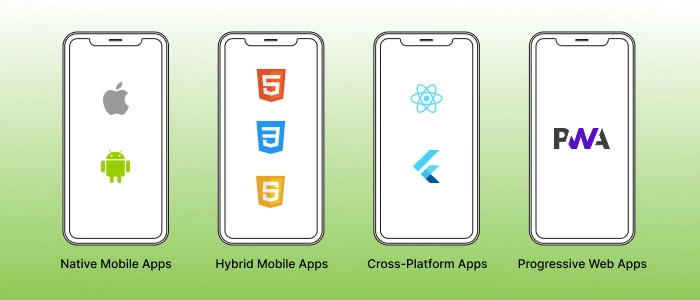
Not all apps are constructed equally; honestly, that’s a positive. Depending on your objectives, budget, and desired experience, there are several different development techniques to choose from. Knowing the distinction could save you time, money, and post-launch problems.
Native Mobile Apps
Native apps are only compatible with the iOS and Android operating systems. Usually coded in Swift, iOS apps are built using Kotlin. Because they are designed from the ground up for a single platform, native apps offer the finest performance and security and are fully integrated with device hardware, including the camera, GPS, accelerometer, and biometric sensors.
If your product needs to be fast, have smooth animations, or make heavy use of device capabilities, native is usually the best choice (think mobile games, augmented reality experiences, or real-time financial solutions). The trade-off is cost; building and maintaining two distinct codebases requires time and money.
Hybrid Mobile Apps
Hybrid apps fall in between web and native. Built with web technologies like HTML, CSS, and JavaScript, then encased in a native shell that enables them to operate on iOS as well as Android from a single codebase.
Once you construct and send everywhere, which lowers development expenses and speeds deadlines, the appeal is evident. Hybrid fits content-driven applications, internal tools, or companies needing to send rapidly without sacrificing too much on experience. Performance has traditionally been the trade-off; although contemporary hybrid architectures have greatly closed that divide.
Cross-Platform Apps
Cross-platform development has developed into a very strong choice over the course of the past few years. Frameworks like React Native and Flutter enable developers to create shared code that converts into nearly native experiences on Android as well as iOS.
Supported by Google, Flutter produces its own UI components for perfect pixel-perfect consistency on many devices. Backed by Meta, React Native links JavaScript to native elements for a feel almost impossible to differentiate from a completely native app. Cross-platform development offers the best balance of quality, speed, and cost for most consumer-facing goods; hence, it is now standard practice among several mobile app development companies and product teams.
Progressive Web Apps
PWAs should be included in any open discussion regarding mobile development, but they are frequently disregarded. A website that functions similarly to a mobile app is called a Progressive Web App. It doesn’t need to be downloaded from the App Store; users may use it offline, add it to their home screen, access it via a browser, and receive push notifications.
PWAs are available on almost every device, quick to create, and simple to update. While they may not be the best option for every product, they may be a clever and surprisingly effective way for companies to increase their mobile reach without incurring the costs associated with a complete native or cross-platform design.
What is the Mobile App Development Lifecycle?
The mobile app development lifecycle explains how an idea jotted on a napkin becomes something millions of people utilise daily.
Essentially, the itinerary development teams use to introduce a mobile application from idea to beyond, the lifecycle is It is not a straight line or a one-time thing. It is a chain of deliberate, linked steps wherein each builds on the previous one to guarantee that the final product truly works, is aesthetically pleasing, and addresses a genuine need for real people.
One of the most frequent causes apps fail is not because the concept was bad, but rather because the implementation lacked structure, missing steps, rushing through them, or seeing the process as a formality. Teams stay aligned, expensive errors are decreased, and companies have the best possible opportunity to launch something they’re proud of when a disciplined lifecycle is followed.
The following is how that phase of development really looks, step by step:
Key Stages of Mobile App Development Lifecycle
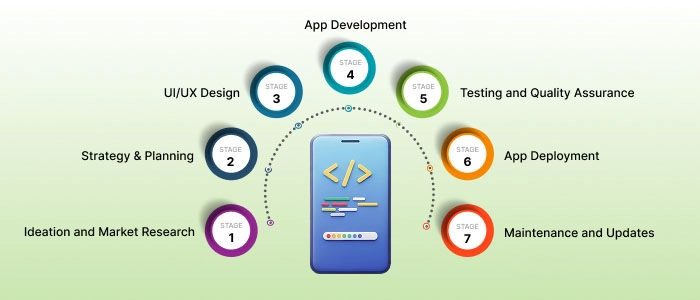
Ideation and Market Research
Every excellent program begins with an idea. Not every idea qualifies for an app; the quicker you categorise yours, the better.
The purpose of the ideation and study phase is this. Before starting to write a line of code or create a single screen, teams investigate the market to determine what is already there, what is absent, and whether their intended product has real demand.
This calls for investigating the advantages and disadvantages of competing apps as well as the problems often brought up by consumers in their reviews. It calls for talking with prospective consumers rather than speculating what they need. It means looking at market trends, identifying gaps, and stress-testing the core concept against real-world demand.
Good research at this stage doesn’t just validate an idea. It shapes it. Many of the best product decisions happen here, long before development begins, when changes are still cheap and fast to make.
Strategy & Planning
Once the concept is validated, it’s time to get specific. The planning phase is where big ideas get translated into concrete decisions and where a lot of projects quietly set themselves up for either success or failure.
This phase is rather wide-ranging. Teams establish the feature set of the application, giving priority to what has to be in the initial release as opposed to what can come later. They define the intended audience precisely, including the specific behaviours, needs, and suffering points the app is meant to solve, not just those between 18 and 35.
Here too, decisions about technology are made. The programme will run on which platform? Either iOS, Android, or both? Which development strategy is most suited: native, cross-platform, or hybrid? The backend infrastructure presents itself thus: What third-party services or APIs must be combined?
During this phase, a budget and realistic project schedule are also set up. An expertly created app can have problems mid-development if resources run dry or scope creep sets in without them.
UI/UX Design
This is the stage when the app’s visual design starts to grow, hence one of the most important components of the entire lifecycle. Good design aims to create something that looks great; rather, it aims to make the app appear effortless, natural, and maybe enjoyable.
Usually, beginning things off are wireframes, low-fidelity layouts that reveal the structure of each screen without going into visual specifics. Wireframes help to answer questions like: Where is navigation found? What exactly is the onboarding process? How many steps should a user take to check from the home screen as few as possible?
Follow wireframes for interactive prototypes replicating the real app experience. Prototypes help to obtain relevant stakeholder and test user input, early assumption testing, early UX problem identification, and difficult development.
After comes the visual design layer, which includes icons, colour palettes, typeface, spacing, and all the elements that make an app seem sharp and brand-consistent. The objective has always been to produce a design that anyone may simply understand and explore without instruction or a manual.
Design and development might not always follow a perfectly linear order. Designers and developers often collaborate in parallel on many contemporary teams to ensure that what’s being developed may actually be produced as planned.
App Development
Once the designs are approved, actual engineering work starts. This is the phase most people visualise when considering app development; it is where the product really comes to life.
Development usually consists of two parallel workstreams: frontend and backend.
All the user interacts with screens, animations, transitions, buttons, and forms, front-end development comprises. Behind-the-scenes backend development’s databases, APIs, server-side logic, and infrastructure propel everything.
Most contemporary development teams build, review, and fine-tune particular features in brief, focused cycles usually one to two weeks long. By keeping progress visible, this agile method lets course corrections along the way and prevents the terrible situation of spending months creating anything just to realise at the end that it doesn’t quite work as planned.
Usually, at this stage, third-party integrations include payment gateways, analytics tools, mapping services, authentication mechanisms, and anything else the app has to operate as a full product. Every integration increases complexity; careful planning in the early phases pays off so very much here.
Testing and Quality Assurance
Every program has defects before launch, regardless of the skills of the development team. The testing phase exists to find them before real users do.
Quality assurance is far more comprehensive than most people outside the industry realise. It includes functional testing, by means of which every element that is supposed to operate is examined. covers performance testing, which assesses how the program acts under load, on slow network connections, and across several device settings.
It addresses security testing, which seeks vulnerabilities that could expose user information. also includes usability testing, where real people are seated in front of the app to see how they truly utilise it, therefore exposing problems that no quantity of technical testing would notice.
Given the wide range of devices, screen sizes, and OS versions available, Android apps in particular benefit from compatibility testing. On a mid-range phone from three years ago, an app that seems faultless on a flagship phone can crash totally; your prospective users could be largely on that very phone.
Testing is not a one-time process at the conclusion of development. QA is continuous over the construction on well-managed teams, with automated test suites catching regressions every time fresh code is added. Ship something that works dependably for every user, not only under perfect conditions.
App Deployment
The software is finally set for public use after months of testing and development. It is not; the system is prepared for public use after months of testing and development. Still, clicking the publication button isn’t quite that simple.
To assist relevant users in finding an app when it launches on Google Play or the Apple App Store, an app must have eye-catching descriptions, well-selected keywords, screenshots, preview movies, and metadata on its thorough store listings. Failure to adhere to the review processes of either platform or its compliance requirements could result in rejection or delays.
Rather than opening everything simultaneously, many teams use a staged release. Beginning with a small audience, then, means keeping an eye out for unforeseen issues and progressively increasing the launch as confidence builds. For any pests that avoid testing, it is a sensible approach to limit their burst radius.
App Store Optimisation (ASO) is also part of this stage, making sure the listing is structured in a way that maximises visibility and conversion. A great app that nobody can find is still a missed opportunity.
Maintenance and Updates
Launch day is often treated as the finish line. In reality, it’s closer to the starting gun.
Once an app is live, the real feedback starts rolling in. Users encounter edge cases that testing didn’t surface. New devices get released.
Changes in the functioning of some characteristics result from operating system updates. Competitors introduce fresh capabilities that increase user standards. Identified security flaws require immediate patching.
Regular maintenance prevents an app from getting antiquated and untrustworthy. Regular bug fixes, performance upgrades, compatibility updates for new OS versions, and a steady cadence of new features based on what consumers are really requesting are all results of that.
Companies that see their apps as living products rather than completed deliverables are the ones that create long-term consumer loyalty. An application that keeps growing better over time sends a very plain signal: this company is listening; users see.
What are the Trends Shaping Mobile App Development Now?

The mobile app landscape does not stay steady for long. What two years ago seemed fresh is today regular. For companies wanting to stay relevant, watching these trends is crucial.
Here’s what’s fueling the next wave of mobile innovation through 2025 and beyond.
AI-Powered Personalisation
Netflix already knows what you want to see before you even finish scrolling. Spotify somehow creates a playlist ideally matched to your emotions. Always sharpening what each user wants next, not accidents, these are machine learning models instructed on millions of behavioural cues.
This ability is no longer limited to billion-dollar engineering teams, so what has changed?
Even mid-sized organisations may now include smart personalisation into their products via modern mobile app creation services and accessible artificial intelligence APIs, adaptive onboarding flows, context-aware recommendations, and dynamic material that adapts to how consumers actually behave. Better retain, interact longer, and feel truly made for the person instead of the crowd in apps that personalise effectively.
5G-Enabled Experiences
For years, ambitious app features were bottlenecked by network limitations. 5G removes that ceiling. Features that were previously considered experimental are now commercially feasible for common applications, thanks to speeds of up to 10 gigabits per second and almost zero latency.
High-definition real-time video consultations, live augmented reality try-ons, and smooth multiplayer activities are no longer limited by connection quality. For businesses investing in mobile app development today, 5G isn’t just a speed upgrade; it’s an invitation to rethink what their app can actually do.
Super Apps
WeChat, Grab, and PayPal figured it out early: users don’t want to juggle five apps when one can handle everything. Browse, book, pay, and chat all without exiting any single setting. The West is quickly catching up; companies with large mobile audiences are investigating how to include related services, minimise exit causes for customers, and develop the type of daily-habit stickiness no advertising campaign can create.
IoT Integration
Your smartphone already controls your car, fitness tracker, front door, and thermostat. By letting customers enter, grab whatever they need, and exit as the software stealthfully finishes the purchase, Amazon Go went one step further. As more physical settings become connected, the smartphone app will serve as the principal interface between a brand and its clients in the real world. That’s a level of presence no website can replicate.
Security-First Development
Along with credential stuffing, insecure APIs, and reverse-engineered binaries, mobile app attacks are increasing. The traditional method of locking on security at the end of a project just lacks legitimacy.
Treating security as a core tenet, the best custom mobile app development businesses now offer end-to-end encryption, zero-trust architecture, biometric authentication, and ongoing vulnerability scanning incorporated throughout the development process from day one, not checked at the finish line.
With regulations like GDPR and India’s DPDP Act tightening requirements, the legal and reputational cost of getting this wrong has never been higher. Users trust you with their data. Build like it.
These trends are shaping product decisions right now, across companies of every size. The businesses that build with this future in mind will look prescient.
Those who are not will be catching up.
What Separates Good Mobile Apps From Great Ones?
Hundreds of thousands of applications are released each year, and most of them vanish in a few months. This is reality. Not because the concepts were poor, but rather because the implementation was.
Solid uses rest on three main pillars:
- Performance: Quick, dependable, flawless over a wide range of network settings and devices.
- User Experience: Designs that reflect the brand’s essence, simple procedures, and user-friendly interfaces.
- Regular updates, post-launch monitoring, real user feedback loops, and continual improvement will help you stay fresh.
This is precisely why companies serious about expansion select a custom mobile app development firm instead of compromising with basic templates or overseas teams without involvement in the results. Investing in quality at every stage of the mobile app creation cycle results in review, retention, and income payout.
Why Choose Sphinx Solutions for Mobile App Development?
Headquartered in Pune, India, Sphinx Solutions is a top provider of mobile app and software development services. Established in 2010, the company specialises in providing unique digital solutions, including blockchain applications, mobile app development, bespoke software creation, AI development, and IoT solutions.
Sphinx Solutions has provided more than 1500 digital solutions to clients in different sectors, including healthcare, fintech, retail, and logistics, thanks to a group of talented developers, designers, and tech specialists. The company specialises in developing scalable, user-focused solutions that speed up digital transformation and assist companies in achieving long-term success.
Many development firms are offering to create your next fantastic app. The majority will tell you exactly what you want to hear and present you with a polished portfolio. So how can you determine who you can truly trust?
At Sphinx Solutions, we’d rather show you than tell you.
Years of experience across industries
We’ve worked with startups building their first MVP and enterprises modernising legacy platforms. That range matters because the challenges each faces are fundamentally different, and we know how to navigate both without applying a one-size-fits-all approach.
Full-lifecycle capability under one roof
We cover everything in-house: strategy, UI/UX design, development, QA, deployment, and post-launch support. No disconnected vendors, no knowledge lost in handoffs. One accountable team from day one to long after launch.
Built for experience, not just functionality
Any team can implement a feature list. What sets us apart is building apps that actually feel right to use, fast, intuitive, and designed around how real users behave, not how we assume they might.
Transparent process, no surprises
We work in structured sprints with clear milestones and honest communication throughout. If something changes, you’ll know early, not after it’s already become a problem.
A partner, not just a vendor
A vendor delivers and moves on. We stay invested, flagging things you might have missed, bringing ideas to the table, and treating your app’s success as a direct reflection of our own work.
Whether you’re a startup with a bold idea or an established brand looking for a dependable mobile app development agency to take your digital experience further, Sphinx Solutions is the team that shows up and builds things worth building.
Conclusion
The way consumers find, interact with, and remain loyal to brands has fundamentally changed, and mobile applications are at the centre of that transformation. Originally a simple addition, businesses now use the main vehicle by which they establish genuine, long-lasting ties with their consumers. That is not a trend that’s easing off. Should anything, the expectations for mobile experiences are only increasing.
Developing an app that truly belongs on someone’s phone calls more than just good intentions. One needs a well-planned process, deliberate design, technical depth, and a team that remains dedicated far beyond launch day. Every phase of the mobile app creation cycle has a purpose, and the companies that honour that process are the ones whose products users really rely on.
At Sphinx Solutions, that is the standard we hold ourselves to with every project we take on. Because at the end of the day, a great mobile app isn’t just a digital product, it’s a promise to your users that you’re worth their time, their attention, and a permanent spot on their home screen.
FAQ’s:
- What is mobile app development?
Mobile app development is the process of creating programs meant for tablets and mobile phones. It spans everything from the original concept and UI design to coding, device-wide testing, and platform release on Android or iOS. It calls for both technical competence and a thorough grasp of what the end user really requires.
- How to choose a mobile app development company?
Start by looking at their portfolio; it tells you more than any sales pitch will. Read client reviews, check their industry experience, and notice whether they ask the right questions about your business before jumping to solutions. A reliable company will understand your goals, follow a structured process, and remain reachable long after launch.
- How to choose the best mobile app development company?
Look beyond technical skills. The best companies communicate honestly, deliver on time, and treat post-launch support as part of the job rather than an afterthought. A strong track record combined with genuine transparency is usually a better indicator than a polished proposal alone.
- What is the best mobile app development platform?
It depends on your project. Native platforms like iOS and Android deliver the best performance and deeper device integration. Cross-platform frameworks like Flutter or React Native are a strong choice when the budget or timeline requires reaching both platforms simultaneously without building everything twice.
- How to outsource mobile app development?
Get clear on what you want to build, core features, target users, and a realistic budget. before approaching any agency. Research teams with relevant experience, review past work, and pay attention to how they communicate early on. How an agency behaves before the contract is signed usually reflects exactly how they’ll behave during the project.


 Anand Mahajan

 Souradeep Kundu

 Shivraj Dhaygude