
Despite the trend that technology and fintech have always evolved hand in hand, the current transformation appears to be of a different nature. Devices which merely assist in decision-making are being phased out in favour of those which can operate, adjust, and acquire knowledge independently.
The transformation is being propelled by agentic AI, a kind of AI which is architecturally designed to function as an independent agent rather than a mere passive tool. The change in fintech, a sector that is heavily reliant on speed, accuracy, and trust, is at the core of the shift that is retooled to alter the modus operandi of the financial services industry.
According to McKinsey, financial institutions that effectively adopt advanced AI could unlock up to $1 trillion in additional value annually through improved productivity, risk management, and customer experience. What makes agentic AI different is its ability to go beyond predictions.
Instead of simply flagging risks or suggesting actions, agentic AI systems can plan next steps, trigger workflows, and adjust decisions in real time, all while operating within defined regulatory and business boundaries. This makes agentic AI in fintech especially relevant at a time when financial ecosystems are growing more complex and interconnected.
“The future of finance will belong to systems that can think, act, and learn responsibly at scale,” said Satya Nadella, CEO of Microsoft, while speaking about autonomous AI systems. His words encapsulate the direction fintech is taking: towards intelligence that works tirelessly to accomplish predetermined goals rather than waiting for directions.
Tired of slow, error-prone fintech processes?
Agentic AI streamlines decisions instantly
Practically speaking, agentic AI is already having an impact on how fintech companies handle financing, payments, fraud detection, and consumer interaction. An agentic system can monitor transaction behaviour, assess risk patterns, communicate with other systems, and take corrective action without manual intervention.
This shift is also driving demand for agentic AI development services, as fintech firms look for reliable agentic AI development companies capable of building compliant, secure, and scalable solutions. As agentic AI software development matures, it is becoming clear that this technology is not just another innovation layer it represents a fundamental change in how financial intelligence is designed and deployed.
Understanding Agentic AI in the Context of Fintech
AI systems that are intended to function as autonomous agents, as opposed to passive instruments, are referred to as “agentic AI.” This refers to AI in financial services that can watch a situation, determine what needs to be done, act across systems, and learn from the result without constantly requiring human input.
Agentic AI functions with intent and autonomy, which makes it particularly pertinent for fast-paced finance situations, in contrast to classical automation or predictive AI, which adheres to set rules or makes recommendations.
What makes agentic AI in fintech different is the nature of financial systems themselves. Fintech platforms deal with continuous data streams, transactions, market movements, customer behaviour, and compliance signals, all happening in real time.
At a functional level, autonomous AI agents work by combining multiple capabilities:
- They perceive their environment through structured and unstructured data
- They reason using models, rules, and context
- The act of triggering workflows or system-level changes
- The learner learn from feedback using reinforcement mechanisms
This orchestration allows agentic AI software development to move beyond dashboards and alerts into end-to-end decision execution. Many fintech teams formalize this transition through an agentic ai course that focuses on building agents for real business workflows. For fintech companies, this is a major shift from human-led intervention to machine-led coordination with human oversight.
Fintech is a natural fit for agentic intelligence because it already operates at the intersection of technology, regulation, and trust. As digital payments, lending, and embedded finance scale globally, manual decision-making becomes increasingly unsustainable.
This is why demand for agentic AI development services is rising, particularly among fintech firms seeking scalable, compliant systems. A capable agentic AI development company does not just build models; it designs agents that understand financial context, respect regulatory constraints, and adapt continuously.
In this sense, agentic AI for software development is not about replacing people, but about enabling financial systems to function intelligently at a modern scale.
Why Fintech is Entering the Agentic AI Era Now?
Real-time digital finance has become the norm, not the exception
Global fintech systems now operate on a 24/7 basis. Instant payments, digital wallets, and real-time lending decisions have surged, with global real-time payment volumes crossing 195 billion transactions in 2023 (BIS). In such high-speed environments, traditional systems that only analyse data fall short. Real-time intelligence is now operational rather than theoretical thanks to agentic AI, which enables fintech platforms to not only identify occurrences but also take prompt action.
Modern financial ecosystems are increasingly complex and interconnected
Today’s fintech platforms rely on multiple APIs, third-party services, banking partners, and compliance systems. Each transaction may touch identity verification tools, fraud engines, payment rails, and reporting systems. Managing this complexity with fixed rules is inefficient. Agentic AI in fintech excels here because autonomous agents can coordinate across systems, adapt to changing conditions, and maintain continuity without constant human intervention.
Traditional automation cannot keep up with dynamic financial behaviour
Rule-based automation works well in very predictable situations; yet, it falls short when consumer behaviour, fraud patterns, or market circumstances shift. Once rules fail, manual fixes are required, slowing operations. Agentic AI systems, on the other hand, are built to learn from results and change their behaviour; thus, they are much more resilient in rapidly changing financial environments.
Predictive AI stops at insights, creating decision bottlenecks
Predictive models can identify risks or opportunities, but they usually stop at recommendations. According to Deloitte, nearly 60% of decision delays in financial services occur after insights are generated. Agentic AI closes this gap by transforming insights into executed actions, reducing dependency on manual handoffs and approvals.
Regulatory pressure demands smarter, traceable decision-making
Rigorous compliance systems governing AML, KYC, and data security need be followed by fintech firms. Agentic artificial intelligence systems could be built to operate within legal constraints while retaining audit trails and explainability. This has increased demand for specialised agentic AI development services that balance autonomy with accountability.
Fintech scale requires autonomy, not just intelligence
The expansion of fintech platforms makes it increasingly expensive and risky in terms of errors to scale human decision, making. Consequently, there is a growing demand for agentic AI software development, in which autonomous systems execute routine, high-volume decisions, and humans maintain strategic oversight. A capable agentic AI development company focuses on building these systems responsibly, not replacing people but enabling smarter scale.
How Agentic AI Changes Decision-Making in Financial Systems?
The traditional pattern of decision-making in financial systems has been consistent over the years: data is analysed, insights are generated, and humans decide what action to take. Although this model was effective in slower, more controlled environments, it is finding it difficult to keep up with the real-time fintech landscape of today.
With the rise of digital payments, instant lending, and embedded finance, financial decisions have to be made within milliseconds. This is where agentic AI introduces a meaningful shift from systems that suggest actions to systems that can take action responsibly and independently.
What truly sets agentic AI apart is its ability to learn continuously. Traditional models often rely on scheduled updates and historical data. Agentic systems, however, operate in adaptive decision loops, learning from outcomes in near real time.
This allows fintech platforms to respond faster to new fraud patterns, shifting customer behaviour, or changing market conditions without waiting for manual recalibration. This capability has become a major focus area in agentic AI software development, especially for fintech firms operating at scale.
Key Ways Agentic AI Transforms Financial Decision-Making:
- From rule-based logic to goal-driven autonomy
Agentic AI systems decide actions based on goals like risk reduction, compliance, or customer experience rather than fixed rules that might fail in complex scenarios.
- Real-time execution instead of delayed action
Research from PwC shows that delayed decisions can cost financial institutions up to 30% in lost efficiency and value. Agentic AI reduces this gap by acting immediately once confidence thresholds are met.
- Continuous learning through feedback loops
Each decision is returned to the system, allowing it to improve future decisions. This enables smarter responses over time without constant human intervention.
- Coordinated decisions across systems
Agentic AI is capable of handling complex interconnected workflowspayments, fraud checks, compliance, as well as customer notificationsthus maintaining the financial ecosystem’s consistency and enabling it to be speedy.
- Human oversight remains central
Despite increased autonomy, humans still define goals, set boundaries, and review exceptions. Leading agentic AI development companies design systems that balance autonomy with accountability.
As fintech continues to scale, decision-making itself is becoming a competitive advantage. Agentic AI development services are increasingly sought after not just to build smarter models, but to create systems capable of acting with speed, context, and responsibility. In this way, agentic AI for software development is reshaping how financial institutions think about intelligence, not as a support tool, but as a core operational capability.
What are the Key Fintech Use Cases Powered by Agentic AI?
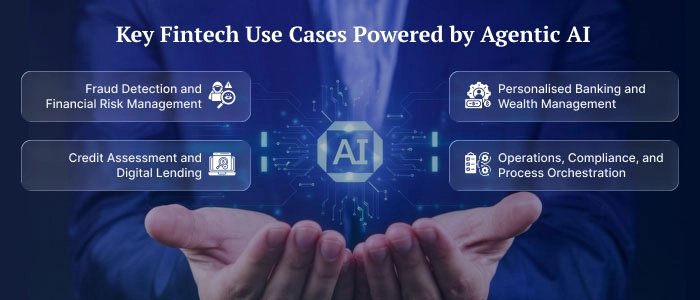
Fintech platforms today must make thousands of decisions every second securely, accurately, and in real time. This is where agentic AI in fintech stands out. Agentic systems are designed to act on insights, coordinating decisions across many financial processes, rather than merely stopping at analysis. Because of this, financial businesses are increasingly using agentic AI development services to handle scalability without compromising compliance or trust.
- Fraud Detection and Financial Risk Management
Juniper Research estimates that payment fraud losses will surpass $360 billion globally in 2028. Rapid answers, monitoring of transactions, halting of suspect behaviour, beginning of verification procedures, and instant risk model updates all characterise agentic AI systems. This minimises needless inconveniences for legitimate users while lowering fraud.
- Credit Assessment and Digital Lending
Speed and accuracy are crucial in digital lending. Agentic AI facilitates more flexible credit decisions as it examines various data points and modifies risk assessments dynamically. Consequently, there is a swift loan approval, accurate risk pricing, and identification of repayment issues at an early stage, which are the main reasons for the increased investment in agentic AI software development for fintech lenders.
- Personalised Banking and Wealth Management
Customers expect financial services tailored to their needs. Agentic AI helps deliver this by tracking behaviour patterns and suggesting timely actions, such as saving recommendations or portfolio adjustments. Unlike static recommendation engines, agentic systems adapt continuously, improving relevance and customer engagement.
Many fintech platforms are now integrating AI-driven interactive tools such as personalised calculators, risk assessment quizzes, and financial recommendation engines to enhance user engagement.
- Operations, Compliance, and Process Orchestration
Fintech processes include complicated workflows throughout KYC, AML, reporting, and audits. Agentic AI can coordinate these processes automatically, identify compliance risks early, and maintain clear audit trails. This capability is a key reason fintech firms partner with experienced agentic AI development companies.
All things considered, agentic AI for software development is assisting fintech in transitioning from reactive systems to intelligent, autonomous operations where choices are made more quickly, intelligently, and in accordance with both corporate objectives and legal requirements.
What are the Technology Foundations Behind Agentic AI in Fintech?
Intelligent models and strong system design are the foundation of agentic AI in fintech, which enables software to think, learn, and act on its own. Agentic systems, in contrast to traditional automation, are built to pursue objectives, make choices, and modify their behaviours in response to real-time feedback. Because of this, solid technological underpinnings are necessary for dependable agentic AI development in financial settings.
Agentic AI is fundamentally based on networked technologies that facilitate comprehension, learning, and implementation within intricate banking systems.
Key Technologies Powering Agentic AI in Fintech
Large Language Models and Reasoning Engines
Large language models support agentic artificial intelligence in grasping financial data, client interactions, and regulatory language. Built above these models, reasoning engines help the system to decompose aims into more manageable, sensible steps, thereby enabling more ordered and understandable decision-making. This capability is central to modern agentic AI software development.
Reinforcement Learning and Feedback Loops
By offering ongoing feedback, reinforcement learning helps agentic systems become better. These systems improve their capacity to handle dynamic fintech activities, including risk assessment, process optimisation, and exception management, without the need for continual human interaction by tracking results and modifying behaviour.
APIs, Cloud Infrastructure, and System Orchestration
Fintech systems connect payment gateways, compliance tools, and banking systems using APIs. These links are used by agentic AI to conduct coordinated activities across several systems. The function of an expert agentic AI development business is particularly crucial because cloud infrastructure offers scalability and reliability, while orchestration layers guarantee that operations stay controlled and compliant.
Together, these technologies form the foundation of agentic artificial intelligence in finance, allowing intelligent systems capable of supporting complex financial activities at scale, autonomous yet regulated, adaptive yet secure.
What are the Challenges of Agentic AI in Finance?
Although agentic artificial intelligence provides improved decision-making and more independence, fintech companies cannot afford to disregard the fresh problems it presents. Permitting software to operate freely in the very controlled, trust-based financial sector raises real concerns about ethics, transparency, and control. Accepting these challenges is essential for responsible agentic artificial intelligence growth and long-term acceptance.
Data Privacy and Security Concerns
Continuous access to sensitive financial information like transaction logs, credit profiles, and consumer behaviour is needed by agentic AI solutions. They are, therefore, appealing targets for cyberattacks. Due in large part to the value of the data involved, the banking sector continues to be one of the most targeted areas for data breaches, according to international cybersecurity reports.
For any agentic AI development company, ensuring strong encryption, access controls, and secure data pipelines is not optional; it’s foundational.
Explainability and Regulatory Accountability
Financial authorities want companies to fully describe the decision-making process, especially in areas like credit approval, fraud detection, and risk rating. However, agentic AI systems often rely on complex models that make decisions via several internal processes.
This creates a challenge: if an autonomous system denies a loan or flags a transaction, banks must still be able to explain why. Lack of explainability can slow down the adoption of agentic AI development services, particularly in tightly regulated markets.
Ethical Use of Autonomous Financial Systems
The more autonomous agentic AI advances, the more difficult it is to overlook ethical concerns. Who is accountable if an AI agent makes a biased decision or acts in a way that affects a customer? Without enough safeguards, autonomous systems may accidentally propagate bias or prioritise efficiency above justice.
This is why human oversight remains critical. Ethical frameworks, governance policies, and clear escalation paths are essential components of responsible agentic AI software development in finance.
What is the Future of Fintech and Banking in an Agentic AI World?
The future of fintech and banking is shifting towards systems that do more than just assess data; they act on it. Agentic AI is a leap from passive intelligence to autonomous decision-making, allowing software agents to plan, execute, and adapt financial activities in real time. For banks, fintech firms, and customers alike, this change is about changing how financial services are designed and provided, rather than replacing humans.
As agentic AI in fintech matures, the industry is likely to become faster, more customised, and far more sensitive to real-world financial conduct.
What Changes for Banks, Fintech Firms, and Users?
Agentic AI will redefine positions throughout the financial ecosystem by taking over complicated, ongoing decision responsibilities that were previously handled by teams or rigid workflows.
- For banks, agentic AI systems can autonomously monitor risk exposure, manage liquidity positions, and respond to market changes without waiting for manual intervention. This allows institutions to move from reactive operations to proactive financial management.
- Financial institutions may develop smarter goods that constantly adjust to user behaviour, legislative changes, and market trends, all without the need for regular reprogramming using agentic AI development.
- Users will find their experience to be more fluid. Financial apps may automatically rebalance investments, optimise savings, or flag potential issues before customers even notice them.
Industry studies suggest that financial institutions using advanced AI-driven automation can reduce operational decision time by over 30%, highlighting why many organisations are investing in agentic AI development services.
How Agentic AI May Redefine Financial Products?
Traditional financial products are static by design. In an agentic AI world, products become dynamic, goal-oriented, and context-aware.
- Loan products may modify repayment terms automatically in response to real-time income patterns.
- Rather than rebalancing on a fixed timetable, investment portfolios may do it constantly.
- Insurance and credit products may evolve into living systems that adapt as customer risk profiles change.
This shift is driving demand for agentic AI software development, where financial products behave more like intelligent assistants than fixed services.
Preparing for a More Autonomous Financial Ecosystem
- Preparation becomes essential when autonomy grows. Banks and fintech companies must revisit their system architecture, governance, and oversight.
- Human-in-the-loop models will still be needed for high-impact decision-making.
- Explicit accountability measures will be necessary to align autonomous acts with regulatory requirements.
- Working with a seasoned agentic AI development firm will help guarantee that systems are safe, comprehensible, and in line with corporate objectives.
In the long run, the future of fintech will not be defined by how much autonomy AI has, but by how responsibly that autonomy is designed. Agentic AI for software development in finance represents a shift toward systems that are not only intelligent but also trustworthy, adaptive, and built for long-term resilience.
Struggling with scaling fintech operations?
Agentic AI scales operations effortlessly
Conclusion
Agentic AI represents a significant change in the way financial systems function and develop. It allows banks and fintech platforms to shift towards goal-driven, adaptive decision-making that can react instantly to changes in the real world, in contrast to traditional automation.
Agentic AI in fintech provides a useful solution to manage this complexity while enhancing accuracy, speed, and user experience as digital banking becomes increasingly rapid, intricate, and linked.
Looking ahead, the real value of agentic intelligence will depend on how responsibly it is designed and deployed. Financial institutions working with the right agentic AI development company and trusted agentic AI development services can build systems that balance autonomy with human oversight, regulatory compliance, and ethical use.
Rather than replacing people, agentic AI for software development will support smarter decisions, resilient operations, and more personalised financial products, setting the foundation for a more intelligent and trustworthy fintech ecosystem.
FAQ’s:
1. What is agentic AI in fintech?
Agentic AI in fintech refers to autonomous AI systems that can make decisions, take actions, and adapt to changing financial conditions without constant human input, while working within defined goals and rules.
2. How is agentic AI different from traditional AI in financial systems?
Traditional AI follows fixed rules or predictions, whereas agentic AI can plan, learn, and act continuously, making it better suited for dynamic financial environments like real-time payments and risk management.
3. Can agentic AI be safely used in regulated financial environments?
Yes, when designed with strong governance, audit trails, and human oversight, agentic AI can operate safely while meeting regulatory and compliance requirements in fintech and banking.
4. What fintech areas benefit most from agentic AI?
Fraud detection, digital lending, personalised banking, and operational automation gain the most value, as agentic AI can respond quickly to changing data and user behaviour.
5. How can fintech companies start adopting agentic AI?
Fintech firms can begin by partnering with an experienced agentic AI development company to build controlled pilot systems that gradually scale with proper compliance and security checks.



 Souradeep Kundu

 Shivraj Dhaygude