Key Takeaways
- RPA in banking automates repetitive banking tasks, helping financial institutions improve operational efficiency, reduce manual work, and deliver faster services.
- RPA in banking enhances customer experience by speeding up account opening, KYC verification, loan processing, and customer support operations.
- AI, OCR, and machine learning integration make RPA solutions smarter by improving fraud detection, compliance monitoring, and data processing accuracy.
- Banks using RPA development services can reduce operational costs, minimize human errors, and maintain better regulatory compliance across processes.
- RPA solutions help banks modernize legacy systems, increase productivity, and support digital transformation initiatives for long-term business growth.
The banking industry is already known for its slow processes and long queues, but introducing RPA in banking is undergoing a digital revolution. Robotic Process Automation, or RPA, is the well-known term behind this transformation. RPA solutions in banking is at the forefront of streamlining banking operations and enhancing customer experiences.
RPA market value is projected at $54.57 billion by 2032, though banks are increasingly aligning to the RPA in banking services. According to a report by Deloitte, around 70% of banks have globally adopted RPA to automate daily tasks for bankers, such as data entry, compliance checks, etc.
As demand for digital services grows, banks face rising compliance needs, with 2021 fines nearing $10 billion, driving them to adopt right RPA solutions. Beyond compliance, RPA in banking offers many more services, including seamless customer experience, account openings, loan applications, and customer inquiries in record time. Hence, 78% of the banks have enhanced customer experience by reducing process time.
This blog will dig deeper into how RPA in banking has benefits and use cases with applications in the real world. But first, let’s unfold the meaning of RPA.
Curious About How RPA Services Can Boost Your Efficiency?
Use Our ROI Calculator to See the Benefits for Yourself!
What is RPA?

What is RPA? to understand RPA, imagine having a robot to do your boring, repetitive tasks. Likewise, RPA is a form of software that allows specific processes typically performed by humans on digital systems to be accomplished without complex programming.
It is taken over by “bots” or software robots to mimic human interactions with computer applications, such as clicking buttons, filling forms, and copying data. This only makes a powerful tool for streamlining business processes, increasing efficiency, and reducing errors.
RPA in Banking
RPA has been advantageous to banks and their employees in the recent past by eliminating repetitive tasks more efficiently and quickly. It operates by interacting with the system applications and performing the tasks the way humans do.
With RPA implementation, banks and financial institutions can enhance their process efficiency by 50-60%, lower error rates and reprioritize the employees to engage in better customer-centric activities.
Here’s a breakdown of the tasks by RPA that will give a basic understanding of the workflow of the RPA in the banking sector:
Bot Execution Engine
The core component of RPA in banking is that it automates scripts and executes the programmed tasks. The bot execution engine interacts with applications directly, performing tasks like data extraction, calculations, and form submissions without touching backend systems. RPA bots can pull and integrate from multiple sources like databases, spreadsheets, and web applications and put them directly in the core banking application system.
Development Studio
The development studio is where RPA bots are created and customized according to the requirements. Developers use it to design workflow, define task sequences, and set up decision rules. RPA bots can use API integration for automation without much-needed coding knowledge to scrape screens faster.
Check Out Related Posts
Control Room/Orchestrator
RPA bots follow predefined rules in the command center. The control room (orchestrator) manages, monitors, and schedules routine tasks. It also helps compliance by providing logging, auditing, and user management to ensure that all actions are secure and can be traced easily.
User Interface (UI) Integration
The task of RPA in banking is to mimic human interaction with the applications. Banks use RPA to connect many legacy systems and databases without the need for major integration projects. With UI-level integration, bots navigate through elements and enter data and exact information for seamless data flow. RPA isn’t just about streamlining back-end operations—it’s also about enhancing customer convenience. For example, several banks are now leveraging these technologies to allow customers to print checks at home, reducing the need for in-person visits and making routine transactions even more accessible.
Optical Character Recognition
RPA in banking integrates OCR to read text from scanned documents, PDFs, or images and convert them into digital data. For processes like KYC (Know Your Customer) verifications, the integration of OCR can help streamline data entry, reducing human errors.
AI and Machine Learning Integration
Integrating AI and ML with RPA in banking enhances the process of dealing with more complex decision-making tasks. AI-powered RPA bots can categorize customers, respond to their queries, detect fraudulent transactions, and analyze trends. Machine learning allows RPA to learn from historical data and improve over time while being responsive to complex processes in banking.
RPA in banking automates mundane tasks with a workflow using the above-mentioned integrations. Further in the blog, let us get familiar with the advantages of RPA in the banking sector.
Manual banking processes lead to delays and increased operational costs.
Automate workflows with RPA to boost efficiency and reduce errors.
Benefits of RPA in Reshaping the Banking Sector

RPA in banking is a boon to the banking sector resources as automation processes can handle tedious, repetitive tasks. This allows a lot of time allocation for creative and strategic work to be focused on. Here are some key benefits of RPA in the banking sector:
Speed and Efficiency
RPA in banking automates time-consuming and rule-based tasks like quickly processing large volumes of transactions, reducing task completion times from hours to minutes. This makes the process efficient and also speeds up the process, allowing banks to deliver faster customer service. A PAM solution can further enhance security by ensuring that privileged access to critical systems is controlled and monitored during these automated tasks.
Accurate and Reduced Errors
Manual work always has the chance of errors during data entry or compliance checks that can cause repetition of tasks. The approximation of human errors increases and can also cause compliance errors. Therefore, RPA bots follow strict rules, ensuring accuracy and consistency in loan processing, customer onboarding, and regulatory reporting.
Cost Savings
A major chunk is associated with labour costs in banking, including operational costs. By automating the routine tasks, RPA bots work 24/7 once deployed without any breaks. This allows banks to reallocate their resources to more strategic and high-value tasks that require human decision-making.
Check Out Related Posts
Customer Experience
RPA handles tasks like KYC checks, document verification, and account opening, which help banks provide a smoother, faster client experience. Customer queries regarding account balances, transaction history or loan eligibility can be handled instantly by RPA Bot, which gathers and presents all the information without delays.
Compliance Monitoring
RPA in banking have bots that have been programmed to follow compliance rules precisely, ensuring that processes adhere to regulatory standards. As compliance is crucial in banking, bots can automatically log and audit every action for banks to track paths. This approach helps banks manage risk and avoid penalties.
Data Security
RPA enhances data security by automating transaction monitoring and customer data verification processes. Automating several tasks can reduce the risk of data breaches or unauthorized access. Also, RPA tools have data encryption and access control mechanisms, so the confidential data remains secure.
Use Cases of RPA in Banking
Opening a world of possibilities by working 24*7 on tedious tasks without a break and strengthening customer service, RPA in banking is where technology meets efficiency. The use cases of RPA will showcase how banks streamline operations, improve accuracy, and elevate customer experiences to new heights.
Automated Loan Processing
RPA in banking can frequently streamline lengthy and complex operations. RPA can rapidly process loan applications, reducing turnaround times. Automating data entry and verification reduces errors and ensures loan approvals. Once loans are approved and funded, platforms like Bryt Software automate the servicing phase, tracking payments, managing borrower communications, and generating compliance reports throughout the loan lifecycle
Fortifying Fraud Defense
RPA in banking assists in reporting suspicious activity and continuously monitoring transactions for irregularities. Analysing vast amounts of data can identify patterns leading to fraudulent behaviour. So, the automated responses to the fraud alerts can minimize losses and protect customer’s assets.
Check Out Related Posts
Navigating the Compliance Regulatory
Compliance with financial guidelines and regulations is an important part of banking. RPA has the authority to generate complex regulatory reports, ensuring compliance. It minimizes the risk of human errors and potential penalties. Automated monitoring of regulatory changes helps the bank to stay ahead and avoid costly fines.
Seamless Customer Onboarding
Customer onboarding is the first touchpoint in the banking journey, and every customer deserves a smooth onboarding process. RPA in banking can automate the KYC process, reducing the manual paperwork. This speeds up the process without any risks of mistakes and helps prevent fraud and identity theft, which is common in the banking industry.
Automated Transactions Processing
Making payments manually can be tiresome and susceptible to errors. The banking industry requires zero error tasks to avoid financial losses. RPA in banking can process payments faster, improving cash flow. Automated reconciliation and settlement minimize errors. It can also implement security measures to protect payment data and prevent cyberattacks.
Mortgage Application Processing
Mortgage is equal to many documents and loads of verified paperwork. RPA in banking can lessen the burden of manual paperwork activities by making it digital. Document verification can be done without errors and delays, speeding up the process of approvals and disbursements. By timely updates and efficient processing, RPA can improve customer satisfaction.
In the current technology trend, RPA is bound to play a more pronounced role in determining the future of banking.
Curious About How RPA Services Can Boost Your Efficiency?
Use Our ROI Calculator to See the Benefits for Yourself!
RPA in Banking: Real-World Examples
Here are some real-world examples of RPA in the banking sector that can help justify the above-mentioned benefits and use cases:
JP-Morgan Chase
JP Morgan Chase faced the challenge of reviewing loan agreements and contracts every year, which took 3,60,000 work hours when done manually. The bank created a smart robot called COiN (contract intelligence) to review the documents in seconds. It buries the employees of repetitive tasks to focus more on important work, like helping customers and making strategic decisions.
HSBC
Opening a new bank account involves countless forms and documents and a long waiting time to activate the account. HSBC, one of the largest banks, streamlined the process faster and easier. A robotic assistant handles the paperwork by processing the application, verifying the document and opening an account in just a few hours. Also, the robots handle international import and export trade faster and hassle-free.
Bank of America
Bank of America has taken advantage of RPA in banking for payment processing. Robots can analyse millions of transactions every day, looking for anything suspicious. If something unusual is spotted, like an unexpected withdrawal, they flag it for human review, helping the bank to keep track of its customer’s financial safety.
Wells Fargo

For closing a bank account, every step has to be followed and wait for it to be processed. Wells Fargo, a major name in the banking industry, wanted to make this process easier for their customers. The robots introduced can quickly review the account, check for pending transactions, and process the account closure within a few minutes.
These are just a few examples of the top-ranked banks implementing RPA in banking to transform their operations. We can expect a more innovative approach to banking problems as technology advances.
Check Out Related Posts
Barriers to RPA Adoption in Banking
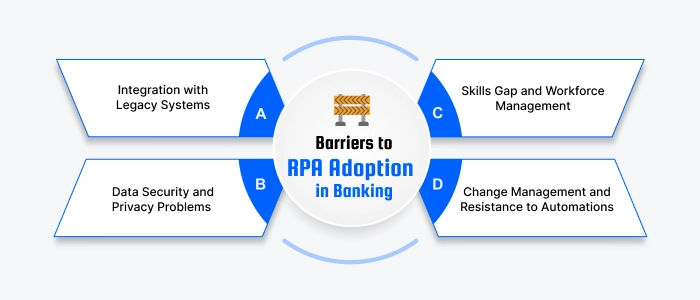
Implementing such an automated solution is a big task for the banks and bankers. While adopting RPA in banking, banks address several challenges that can hinder the process. A look through these challenges and how to outcome them will break the barriers of RPA in banking.
Integration with Legacy Systems
Older systems in banks often don’t work well with new RPA tools. As legacy systems have been outdated and incompatible, integration of RPA can be costly and complex.
Special connectors like API development and middleware can help bridge the gap between old and new systems with smooth data flow.
Data Security and Privacy Problems
Banks are hubs that handle very sensitive financial information, so protecting them from data breaches is essential.
RPA in banking holds strong security measures like data encryption, access controls, and security compliance, such as GDPR, to safeguard data.
Skills Gap and Workforce Management
Many bank employees may not have the technical skills to work with RPA as it is much needed to manage and operate RPA solutions effectively.
To solve this problem, training programs can be held for existing employees, or hiring skilled RPA experts can help.
Change Management and Resistance to Automations
Some people may fear losing their jobs or changing their work. The fear of job displacement to traditional workflow can resist the automation of RPA in banking.
Explaining the benefits of RPA and offering reassurances about job roles involving employees in the process can help reduce resistance and improve acceptance.
After unlocking all the benefits of RPA and knowing the nitty-gritty of the solutions, choosing a right RPA development company that provides well-known RPA solutions is important. Sphinx Solutions has been at the forefront of providing RPA solutions to the banks.
Check Out Related Posts
Implementation of RPA in Banking By Sphinx Solutions
Sphinx Solutions is a leading IT services provider with end-to-end RPA solutions for smart business operations. By cherishing the knowledge of Robotic Process Automation in the banking sector, they have engineered great ideas with the best RPA developers.
Custom RPA solutions from Sphinx Solutions help businesses streamline operations, cut down on tedious work, save money on labour, and save time. With 15+ years of expertise in the IT industry, we have experienced RPA developers who analyse your business and recommend a strategy accordingly. Completing 500+ projects with around 350+ happy clients is the benchmark of successful RPA implementations.
With the help of industry experts, RPA solutions can be designed to create RPA bots to reduce the volume of repetitive work and automate business processes. Numerous RPA toolsets can be employed, namely Automation Anywhere, Blue Prism, UiPath, azure automation services, Logic Apps, etc.
why to choose Sphinx Solutions as your RPA solutions provider:
Efficiency: Eliminating redundancy and performing tasks where a lot of time is spent performing them can be very beneficial in accelerating some processes, thus saving time and resources. For instance, with RPA taking care of basic work, people will have more time for strategic work, enhancing productivity and cutting operational costs.
Accuracy: With RPA, human inaccuracies are reduced or virtually non-existent. This implies that activities like data entry, process transactions, report creation, and many others are done more accurately. Consequently, this leads to properly retaining clean data, which is very important in decision-making and operations.
Customer Experience: The customer experience is enhanced as RPA reduces wait times and response duration to inquisitive instances. This results in a higher level of contentment and customer allegiance.
Compliance: RPA enables management of all aspects of compliance by automating compliance checks, which minimizes errors and helps the organization stay on the right side of the law lest it face penalties or legal complications.
Scalability: The RPA solutions from Sphinx Solutions are highly flexible, thus allowing it to fit easily with changes in business processes. As the business expands, RPA can grow and cater for additional processes and increased work with minimal increase in resource investment.
Inefficient processes are slowing down your bank’s operations and customer service.
Streamline workflows with cutting-edge RPA solutions for banking efficiency.
Conclusion
The benefits of RPA in banking are that it can drive significant growth and innovation in banks. As RPA solutions continue to be adopted, they are poised to stay ahead in an increasingly competitive market, offering seamless services while ensuring compliance and security.
FAQ’s:
What is the role of RPA in banking?
The primary goal of implementing RPA in the banking sector is to help with the execution of repetitive banking activities. Robotic Process Automation (RPA) assists institutions such as banks and financial services in increasing their efficiency by actively engaging their clients in real time and leveraging the benefits of robots.
How is RPA used in finance?
RPA helps to consolidate data from specific systems or documents, reducing the human business processes associated with compliance reporting. ML takes a step further by determining which data an auditor may need to review, retrieving it, and putting it in a handy location for faster decision-making.
Which is the best RPA tool?
The best RPA tool depends on business needs:
- UiPath is user-friendly and scalable for complex automations,
- Automation Anywhere is strong in AI-driven automation.
- Blue Prism offers top security for regulated sectors.
- Microsoft Power Automate is cost-effective within the Microsoft ecosystem.
- Kofax excels in document processing for industries needing OCR capabilities.


 Ajay Wadne