RPA solutions today are increasingly becoming the decisive tool for businesses looking to be more agile and innovative. Automating routine work maximizes productivity and reduces costs, as employees can channel their energies into strategic initiatives. In our latest blog, we will be talking about the best practices and challenges in the recent advancements of RPA services as we move forward into 2024.
What Are RPA Solutions?
RPA solutions imply the use of a software bot to automate rule-based tasks in application flows. The kind of technology can then be applied in sectors such as banking to healthcare, leading to increased speed as well as accuracy for business processes with a resultant decline in human intervention.
See What Our RPA Services Can Do for You!
Try Our RPA ROI Calculator to Get a Clear Picture of the Value We Can Bring to Your Business.
Benefits of RPA Solutions

- Increased Efficiency: RPA solutions imply the use of a software bot to automate rule-based tasks in application flows. The kind of technology can then be applied in sectors such as banking to healthcare, leading to increased speed as well as accuracy for business processes with a resultant decline in human intervention.
- Cost Savings: Automated routine processes will eliminate labor costs since more resources are left to be used on strategic projects. Businesses will reduce the need for intervention and can allocate and invest funds in innovation and growth initiatives toward business.
- Enhanced Accuracy: Bots perform tasks on set rules, which reduce the chances of human error to a great extent, thereby allowing greater integrity of data. It thus ensures that decisions are taken on proper information, thereby enhancing overall operational effectiveness.
- Scalability: RPA solutions can scale up to changing businesses, meaning that changes in a business can be implemented with no significant amount of capital investment. That way, companies can always increase the efforts of automation while the demand changes, optimally making use of the available resources.
- Improved Employee Satisfaction: By removing repetitive and routine work from staff, RPA makes time for doing meaningful tasks to raise employee satisfaction. It increases morale and can even lead to creativity and innovation in the workforce.
Read More Related Blogs
Challenges in Implementing RPA Solutions
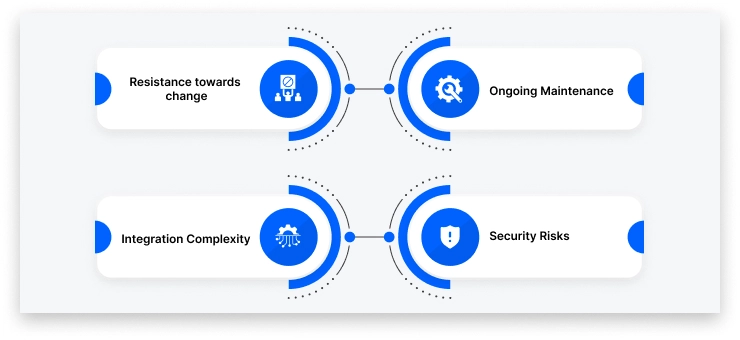
While the advantages of RPA solutions are compelling, challenges do exist:
Resistance towards change
Employees can be apprehensive about the loss of jobs due to automation, and such a feeling may create resistance toward its implementation. The management must communicate the benefits of RPA; for example, enhancement of productivity and enrichment of roles, so that these apprehensions are reduced and a positive attitude is generated.
Integration Complexity
integration complexity remains a challenge with legacy systems, as RPA technologies are not easily automatable. Issues concerning legacy systems often require more work and knowledge than initially anticipated and thus take much time to adopt.
Ongoing Maintenance
RPA solutions require constant monitoring and maintenance to keep them working efficiently and effectively. Constant maintenance can become an active siphon of resources and attention if not well-controlled by management.
Security Risks
With automated processes of sensitive material comes the growing need to have great cyber security preventive measures against and/or responding to breaches. Organizations must, therefore, invest in security protocols suited to protecting data but also dealing with regulations to get people to trust automated systems.
Get an accurate estimate for RPA implementation with our easy-to-use tool.
Key Factors to Consider When Choosing an RPA Vendor
When we compare vendors for Robotic Process Automation, the RPA tool should be easy to use and not less than all the features you need. Here are some important key factors to look into before making a choice:
- Ease of Use: A tool that’s easy to navigate makes a huge difference. If the interface is straightforward, your team will be more likely to adopt it without frustration, speeding up the learning process and boosting productivity right from the start.
- Customization: Every business is unique, and therefore, your RPA solution must be custom-fit for your distinctive workflows. With customizability comes the assurance that the tool matches just what you need and grows with your business.
- Capabilities: Ensure that the tool can support the complexity of your processes. It would be important to evaluate how well it does in performing specific tasks to be sure it can indeed meet your business requirements for automation efficiently.
- Scalability: Your RPA solution should be scalable for your business. Test if the tool allows you to manage multiple bots at the same time. This is particularly relevant given the growth of your organization and the need for more automation.
- Cloud Integration: Cloud-based solutions can make a huge difference in scalability and offer more flexibility than an on-premise solution. Ensure that your provider offers cloud integration so you can scale easily as your needs may change in the future.
Read More Related Blogs
- Integration Capabilities: The RPA tool should integrate seamlessly with your existing systems. Verify whether it harmonizes well with your customer relationship management (CRM) and enterprise resource planning (ERP) systems, ensuring seamless workflows. In addition, teams that handle training and knowledge sharing may benefit from tools like a free AI PDF to video converter, which makes it easier to transform documentation into engaging video guides with platforms such as Synthesia.
- Legacy Systems: If it is an old system, check whether the RPA tool will communicate with them or not. This is a significant consideration for making a smooth transition into automation without considerable cost.
- Support and Training: Good support and training ensure that the rollout is a success. A good vendor means you should be able to receive good customer service quickly if you ever need to resolve an issue that arises.
- Training materials and programs: Ensure that the vendor offers sufficient training materials and programs. This support will enable your team to be capable with the RPA tool, to fully exploit the capabilities. You can also make training and review sessions more efficient by using Happy Scribe’s video summarizer to quickly capture the key points from recorded sessions.
- Cost: You need to understand the total cost of ownership when selecting a solution for RPA. It’s worthwhile exploring not just what the licensing costs are up front, but what ongoing costs you’re going to incur to fully understand your investment.
- Licensing Fees: Again, be aware of all costs, especially because some vendors have complex pricing models. It helps if you get your vendor in front of these details upfront to pre-budget you and avoid being surprised down the line.
- Implementation Costs: This involves the setup and configuration of the RPA tool. Professional service or consultancy fees may be included in this.
- Maintenance Costs: Watch out for any costs repeatedly that would creep into expenses concerning the maintenance, supporting, or updating of the tool. Remember these well because they might add up quickly over time.
Automating complex workflows can be time-consuming and resource-intensive.
Our RPA solutions streamline processes, saving time and reducing costs.
Latest Developments in RPA Solutions (2024)

As we progress through 2024, several key trends and developments are shaping the landscape of RPA solutions:
Integration of AI and Machine Learning
Integrating RPA with artificial intelligence and machine learning further boosts the capabilities of automating processes. Intelligent automation allows for bots in the analysis of data in real-time and instant action; this, therefore, gives way to smarter and more efficient processes that can evolve with changing conditions and have a chance to get better with time.
Enhanced Focus on Cybersecurity
The performing of sensitive tasks is becoming more automated, and the need for cybersecurity in business RPA implementations has seen a surge. Businesses are investing in encryption and access controls and strengthening their security protocols to avoid leakage of data and hence breaches, which otherwise would have occurred.
Cloud-Based RPA Solutions
It is increasingly moving towards cloud-based RPA. Organizations will have much more flexibility and scalability. Updating and integrating processes with other applications becomes simpler while the burden of on-premise infrastructure is reduced. Businesses can quickly adapt to market demands.
No-Code and Low-Code Automation
The rise of no-code and low-code platforms is democratizing access to RPA. With easy-to-use tools, even non-technical users can easily create automated workflows, often by leveraging an application development platform, leading to faster deployments of automation solutions and subsequently driving innovation across departments within organizations.
RPA as a Service (RPAaaS)
RPAaaS is growing increasingly popular, by which organizations can subscribe to RPA solutions. In other words, it virtually reduces the upfront costs, thus making automation more accessible to businesses of all sizes, and companies may scale their automation efforts according to their changing needs without massive capital investment.
Read More Related Blogs
Comparison of RPA Solutions
Here’s a comparison of some of the leading RPA solutions currently available
| RPA Solution | Key Features | Best For | Scalability | Integration |
|---|---|---|---|---|
| Microsoft Power Automate | Seamless Microsoft integration | Small to medium businesses | High | Microsoft suite |
| Blue Prism | Security-Focused, enterprise-grade | Large Enterprises | High | Custom Integrations |
| Automation | Strong Analytics, user-friendly | Large organisations | Very high | APIs and Legacy Systems |
| UiPath | AI integration | Enterprises and SMEs | High | Wide Range of Application |
Trends Shaping the Future of RPA for 2026 & Beyond
Robotic Process Automation has gone from a niche tech to a boardroom buzzword in just a few years. Big banks and tech giants are no longer using it; industries like education, automotive, retail, and sales are also jumping on board.
But here’s the thing: RPA still has some growing pains while adoption is rising. Let’s break down the issues and, more importantly, what’s being done to fix them.
No Code RPA: Making Automation Easier
One of the biggest hurdles with RPA is that you need to code to make bots work. And let’s be honest: not everyone is a developer, nor do they want to be. No code RPA is a blessing; it is a canvas for automation like drag, drop, and done.
The simplest idea is to make RPA so easy that anyone can build a bot. Like Excel revolutionised the finance world, no-code RPA could become the next big unlock for white-collar productivity.
Start-ups and big enterprises are already moving fast in this space. Some tools can now automate workflows by recording your screen and clicking through tasks. If you wish to know more about this, the complete guides and platforms list the best no-code RPA tools.
So, next time there’s a discussion on the need for a development team to automate something, just smile because we have better options.
Process Mining: Teaching Bots What to Do
Before a bot can automate a task, it must understand it. Most companies don’t have neatly documented workflows or updated process maps.
Process mining is like giving RPA x-ray vision. By analysing logs, videos, and user activity, process mining tools can reverse-engineer how tasks are done and help RPA developers automate them more accurately and quickly.
If you’re shadowing an employee and watching exactly how they complete a task, except it’s software doing it at scale. This tech is still evolving, but it’s already cutting down the time needed for pilot runs and making automation more plug-and-play.
RPA Marketplaces like App Store for Bots
Every company has different workflows, RPA software, and document formats. No single RPA tool can cover everything out of the box.
RPA marketplaces are platforms where you can find pre-built RPA automation modules, plugins, and even AI tools to power up your bots. It’s as simple as downloading an app from the App Store for your company’s operations.
AI-powered tools for document handling, like extracting data from invoices, contracts, or forms. Instead of building this from scratch, developers can grab a pre-trained model from the marketplace and plug it in.
These marketplaces also open doors for developers. If you’re a coder, you can build and share tools for RPA platforms.
Cognitive Automation is like Giving Bots a Brain
Regular RPA bots excel at rule-based tasks like copying and pasting files and filling out forms. But when things get fuzzy, like reading handwriting, understanding language, or making decisions, they need a little help.
Cognitive automation is helpful by blending RPA with AI, machine learning, OCR and NLP bots. They can:
- Read messy handwriting on forms or IDs.
- Understand emails and respond automatically.
- Work alongside chatbots to provide complete customer support.
It’s different between a robot following instructions and one understanding what you’re saying.
Open Source RPA, Automation Without Price Tag
As RPA adoption grows, there will be a natural push toward open-source solutions, just as we’ve seen with web development, databases, and cloud tools.
Open-source RPA means:
- More transparency – you can see exactly what the bot’s doing
- Lower cost – you only pay for services, not licenses
- Faster innovation – the community builds, shares, and improves together
Already, new startups are building free-to-use RPA platforms, and big companies are starting to notice. Open source could be the key to making RPA accessible to smaller businesses and teams that don’t have a six-figure automation budget.
Why Choose Sphinx Solution as an RPA solution
At Sphinx Solutions, we develop strong RPA technology that streamlines operations to improve customer engagement. Such innovative automation tools will enhance efficiency and deliver superior service, and clients can rely on getting timely, accurate responses.
Key Benefits of Sphinx Solutions for RPA:
- Seamless integration: Sphinx Solutions integrates well with the existing systems; hence it does not cause much disruption and will provide your system with a smooth transition into automation. Compatibility ensures quicker deployment and immediate operational benefits.
- Quicker Response Time: Automated customer support tasks provided by Sphinx Solutions take little time to respond to compared to manual ones. Hence, an issue gets resolved sooner for the customer query and high degrees of satisfaction and loyalty are produced.
- Improved Accuracy: The use of automation with Sphinx Solutions minimizes the element of human error when data is being input and processed. This higher level of accuracy ensures that your customers receive reliable information, leading to trust and confidence in your services.
- Actionable Insights: Companies at Sphinx Solutions were utilizing advanced analytics to provide deep insights concerning the behavior of customers. So, businesses could tailor their offerings to increase engagement and retention.
- Dedicated Support: Since we’re leaders in RPA, Sphinx Solutions pledges dedicated support to its clients through their entire RPA journey. Our devoted experts will be with you every step of the way, ensuring that you realize maximum benefits from automation, achieve successful implementation and continuously improve your choice.
Tedious, repetitive tasks are holding your team back from higher productivity.
Automate processes seamlessly with RPA solutions tailored to your needs.
Summing Up
RPA solutions are transforming operations and saving costs for businesses seeking further efficiency and quality. As we go through 2024, it is critical to remain current with emerging trends and developments that can help organizations unlock automation in the best way possible.
This is where you understand both the challenge and the benefits the RPA solutions introduce for your business, and you are always better placed to navigate in the right direction. If you’re considering implementing RPA solutions, then this is the right time to discuss and see how they can help your organization thrive and achieve better operational efficiency.
FAQs
1. What would be the RPA Solution for the business?
An RPA solution is just a software product that simulates the processing of repetitive rule-based tasks across several applications, leading to an improvement in the efficiency levels of the organization while minimizing manual errors.
2. What are the Three Types of RPA?
There are three types of RPA: Attended Automation, which relies on humans to activate, Unattended Automation, which operates independently, and Hybrid Automation, which applies both the attended and unattended approaches.
3. How is RPA Cost Calculated?
RPA costs are typically calculated based on initial setup, licensing fees, maintenance, and ongoing operational expenses. To accurately assess your potential savings, use our Sphinx Solutions ROI Cost Calculator, which compares automation costs against labor savings and efficiency gains to help you make informed decisions.


 Ajay Wadne