

Globally, the healthcare apps are accelerating at a fast pace, and so is the mobile app development. Considering the continuous advancement of healthcare mobile apps, it is evident that it has brought a huge improvement in the healthcare sector.
Health-related mobile apps manage the user’s experience efficiently. Some mHealth apps help clinicians to prepare more accurate documents, complete records, improve productivity, access information, and communicate findings & treatments to improve patient care.
Want to Hire Professional App Developers?
Turn your business idea into a success story with our top-notch healthcare app development services.
As mHealth is making healthcare accessible in remote and isolated areas in less time, we all deserve a one-roof solution to track our health. Also, as the awareness for a healthy lifestyle is increasing, the demand for monitoring vital health signs is increasing.
Shortcuts: ✂️
Market scenario
According to researchandmarkets, the global mobile health app market is projected to reach US$ 102.35 billion by 2023, growing at a CAGR of 29.30% during 5 years.
mHealth is efficiently supporting medical professionals in the management and documentation of complete records. It is reducing error rates and improving health outcomes while reducing the overall costs. The report says that North America dominates the global mobile health app market due to an increase in chronic disease management. China and India are showing huge growth among other Asia Pacific countries.
Looking for Custom Healthcare Mobile App Development Solutions?
We help you streamline your business processes with our next-gen app development services.
Research by Accenture in the US shows that the mobile and tablet use for health management has increased from 36% in 2016 to 46% in 2018 along with increased use of wearable technology.
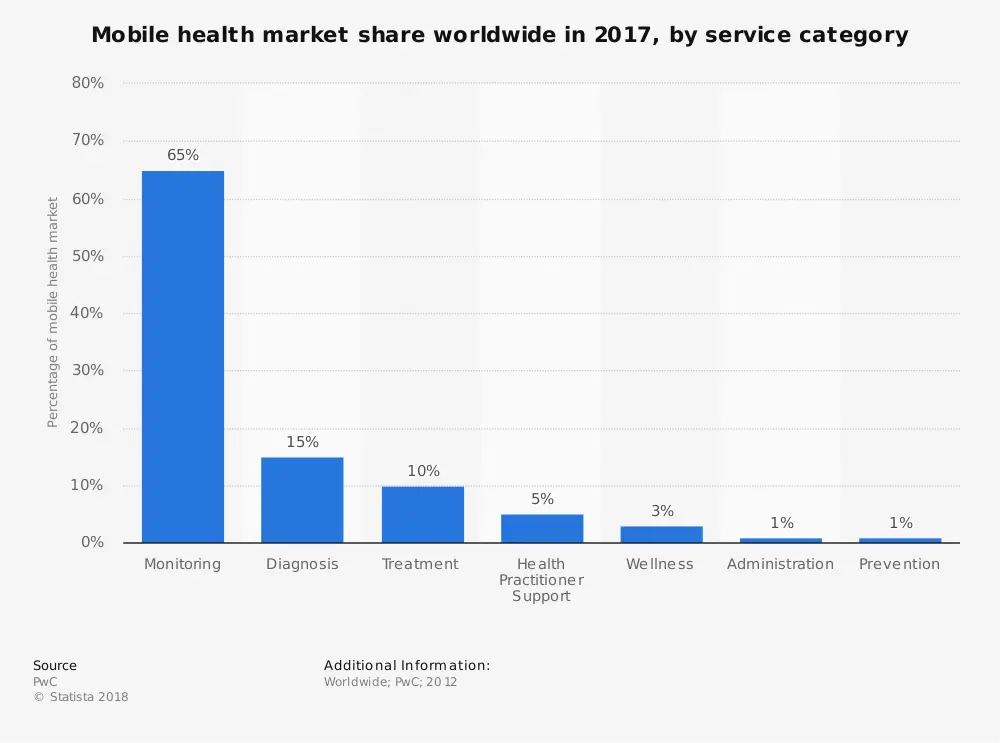
Another survey by Statista shows that “Monitoring” the health issue is projected to account for 65% of the mobile health market share in 2017.
Major Benefits of Healthcare Mobile Apps in The Medical Industry
- Healthcare apps enable easy and immediate access in remote areas
- Support doctors and medical staff in data gathering
- Scope for establishing new business models and opportunities
- Reduces the risk of incorrect diagnosis
- Significant reduction in medical expenses
- Patient can take ownership of their health record
Healthcare apps help users with lots of facilities like easily getting an appointment fixed with the desired doctor, interacting with the doctors, and checking the availability of medical reports in a shorter time span.

Challenges in Developing Healthcare Mobile Apps
Adopting a forward-thinking perspective on a health-related app is vital for the sustainability of hospitals and clinics. It is essential to note that this transformation is not a simple task. The challenges in developing mHealth apps can occur from both internal and external sources.
- Developing the app as per HIPAA rules and regulations
HIPAA stands for Health Insurance Portability and Accountability Act, which protects all individually identifiable health information. This law regulates the way information is stored and shared over the mHealth app. Therefore, before embarking on your project, you should conduct some research and hire a mobile developer who possesses HIPAA regulation knowledge.
However, not every healthcare-related app complies with the HIPAA guidelines. There are some exemptions for some apps that offer general information about healthcare. For example, some healthcare apps help users to tack regular exercise regime, record weight or manage diet plans etc. HIPPA guidelines are not mandatory for these kinds of apps.
- Patient data privacy
Healthcare mobile app development teams often face privacy challenges as they have all the direct access to personal health information. There is a rising concern about the data being used without the patient’s consent. So, collecting the data is a major concern in the healthcare industry.
- Complexity in integration
Modern apps face challenges while integrating with the existing systems of hospitals or clinics as most of them still operate using outdated technology. It is expected you build an app which is easy to use on both ends- healthcare providers as well as patients.
- Transparency in patient engagement
If your app fails to enhance the experience of the users through vital information while doing interaction, it dooms the purpose. To engage the patient, you need to provide them with transparent information. Also, on the other hand, the doctor should have the data that they deem necessary for the interaction with the patient.
- Ease of use
Most of the applications in the market have complex user navigation. Even connecting wearable devices with the mHealth app becomes a hectic task. The challenge here is to make integration, usage, and interpretation easier for the users. Therefore, you must pay attention to the user experience.
Want to Know Your Healthcare Mobile App Development Cost?
Get detail budget estimation in just few clicks
Key Benefits of Healthcare Apps in The Industry
Healthcare applications have significantly evolved the entire sector by offering several benefits for both patients and healthcare service providers. Some of the important benefits of advanced healthcare applications include:
1. Accessible Healthcare: Mobile applications allow individuals to access healthcare solutions anywhere. This is ideal for patients with limited mobility and living in remote locations. This leads to increased access to healthcare.
2. Convenience: For example, services that offer Ozempic prescriptions online allow users to consult with licensed healthcare providers and receive medically approved weight management medications, all facilitated by secure mobile platforms. Such integrations demonstrate how digital health solutions provide timely access to important treatments without traditional barriers. Patients can make appointments, order prescription refills, access medical records, and connect with healthcare experts through healthcare applications. This makes patient care more convenient.
3. Telemedicine & Remote Monitoring: Healthcare applications streamline the remote monitoring process of several healthcare metrics like heart rates, glucose levels, blood pressure, etc. These apps also facilitate telemedicine, which allows patients to virtually consult with medical experts. These are useful for routine checkups and other tasks. Leading Telemedicine app development company provide end-to-end services for creating high-quality healthcare apps.
4. Remote Monitoring and Telemedicine: Healthcare apps facilitate remote monitoring of patients’ health metrics such as blood pressure, heart rate, and glucose levels. They also support telemedicine consultations, allowing patients to consult with doctors virtually, which is especially useful for follow-up visits and routine check-ups. These platforms have particularly transformed access to specialized treatments, enabling patients to obtain prescriptions for medications like phentermine online through secure virtual consultations with licensed healthcare providers.
5. Improved Patient Engagement: With custom healthcare applications, patients can easily access health tracking systems, personalized health recommendations, medication reminders, and other resources.
6. Improved Workflow for Medical Providers: Medical apps facilitate administrative tasks for healthcare institutions like EHR (electronic health record) management, appointment billing, scheduling, etc. Mental health clinics use therapy management software to digitize intake assessments, auto-populate treatment plans, process Medicaid/M]edicare billing, and conduct video sessions with end-to-end encryption. This leads to enhanced healthcare efficiency and minimized administrative burdens.
7. Health Data Management: Mobile applications help in sharing healthcare information and securing storage. It promotes interoperability between several healthcare systems & enhances communication among healthcare service providers.
8. Health Behavior Tracking: The healthcare tracking feature allows patients to monitor their health behaviors like exercise, mobile apps, sleep patterns, diet, etc. This feature helps them make the right decisions about their health conditions and lifestyle effectively.
9. Medication Adherence: Healthcare applications also send notifications and medication reminders about drugs and their side effects. This improves treatment outcomes and medication adherence.
- Other benefits of healthcare apps include
- Highly convenient and immediate access
- Support medical experts and doctors in data collection
- Scope for making new business opportunities & models
- Minimizes risk of inappropriate diagnosis
- Reduction in unwanted healthcare expenses
- Complete ownership of health record
Healthcare apps help users with lots of facilities like easily getting an appointment fixed with the desired doctor, interacting with the doctors, and checking the availability of the medical reports in a shorter time span.
Check out our portfolio page and know how we helped clients with custom app development solutions
Prime Features in Healthcare Applications
In the modern healthcare industry, medical applications are playing a big role in revolutionizing almost every aspect, like patient care, medical administration, etc. Adding new features and functionalities to healthy apps significantly upgrades user experience & app performance.
1. AI/ML Technology
Artificial intelligence & machine learning are both technologies that transform several areas of healthcare. Modern healthcare apps leverage AI algorithms to detect medical patterns, aid in quick diagnosis, analyze huge amounts of information, etc.
As a result, healthcare providers quickly modify patient care to meet specific needs. The report says that the AI-integrated healthcare systems eliminate approximately. 20% of medical experts’ time is spent on other administrative activities. Some of the major applications of AI-powered healthcare systems include:
- Diagnosis: AI technology processes huge amounts of healthcare information & works with healthcare providers to provide precise and quick diagnoses.
- Medical Imaging: AI technology helps medical experts analyze advanced medical images, including ultrasounds, CT scans, X-rays, etc. It also addresses issues in these images quickly.
- Prescription: Artificial Intelligence helps healthcare providers in making e-prescriptions in the most effective way for their patients.
- Patient records: Artificial intelligence analyzes the large amount of patient information collected by EHS or electronic health systems. This analysis brings high accuracy in predicting several diseases & finding treatment options for patients.
2. Blockchain
Blockchain is a very popular technology that enables secure transactions between two different parties. This is a digital ledger used by medical service providers to store healthcare records. Moreover, blockchain also enables patients to check their medical data with doctors or healthcare experts without any risk of security vulnerabilities.
3. Real-time Healthcare Tracking
New features and functionalities in healthcare apps include real-time health tracking. This means that healthcare apps can track all activities and vital statistics continuously. It will help patients understand lifestyle changes & enhance overall health.
4. IoT Technologies:
The Internet of Things, or IoT, allows for communication and information sharing between devices. For instance, a healthcare app must be designed to track healthcare activities significantly. Apart from that, IoT-integrated technologies also enable healthcare monitoring & quick data access in real-time. This results in improved healthcare operations and enhanced patient care.
Want to Know Your Healthcare Mobile App Development Cost?
Get detail budget estimation in just few clicks
Tips for Booming mHealth Apps
- While taking calls, our sales reps found that prospects are often confused about which type of mHealth app they want to build. Let me guide you with some popular types of mHealth apps, so, that you can suitably find a solution for an existing problem.
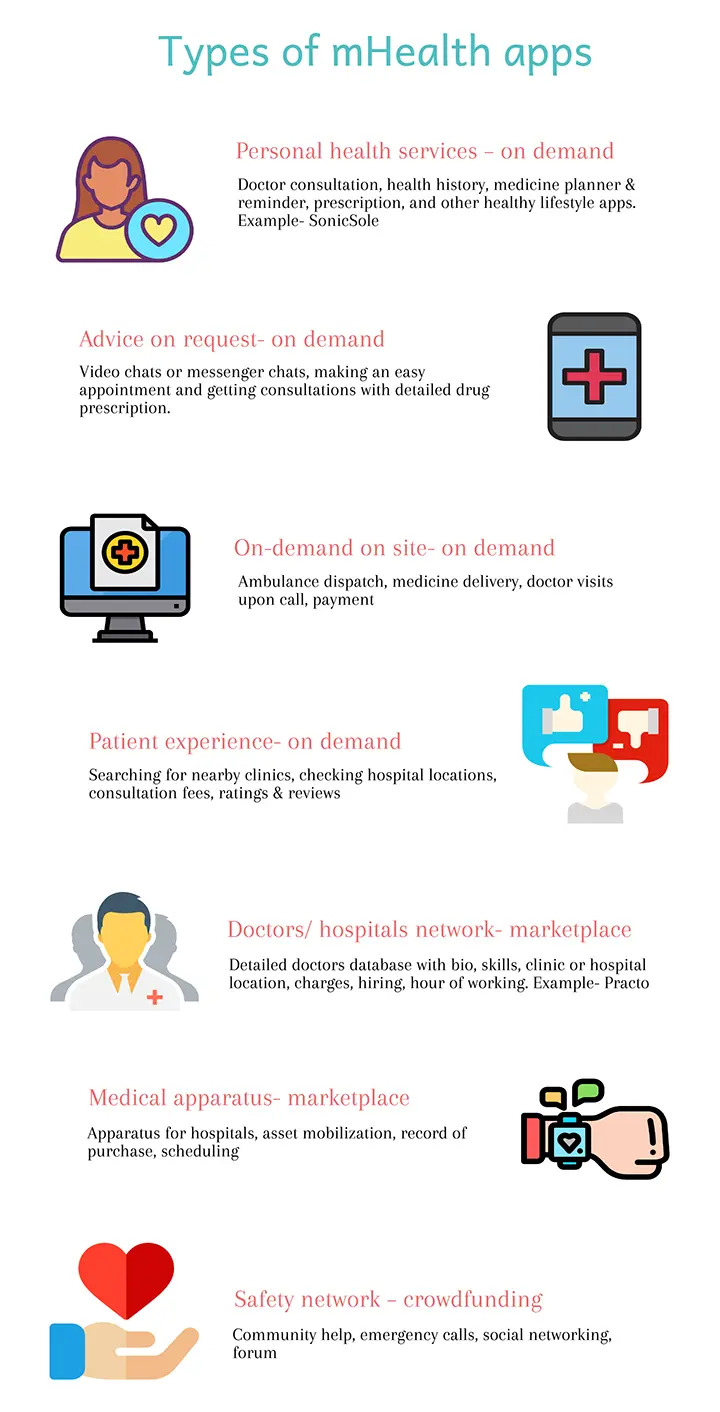
- The clearer you are about the target problem, the easier it becomes to find the target group. Before you talk to any healthcare mobile app development team, it is vital to identify the target audience you want to serve. For example, a fitness app like SonicSole (built by Sphinx Solutions) works seamlessly for fitness freaks. It also helps you to optimize your app’s value for target segments of the market.
- Let your app be as user-friendly as possible with room to grow. For instance, EHR (Electronic Health Record) app requires extra features for improved functionality. Also, if you are developing a lifestyle app, it needs simple functionalities so that different users can utilize it with ease. Remember, a simple and scalable app will ensure a sustainable solution.
- Trending technology integration is highly desirable on your mHealth app. Innovations like AI and blockchain are expected to make your application more advanced and highly efficient. Scrutinize which features of these technologies can fit your app for the best outcomes.
- Tracking, scheduling, and payment are the most common features you will see in the mHealth app these days. However, it must depend on your specific MVP (Minimum Viable Product) concept and the solution you want to provide. Additionally, functionalities like access to EHR, analytics, push notifications, prescriptions, social integration and a few more can be integrated accordingly.
- Your healthcare mobile app should come with end-to-end encryption for enhanced security. Your app will fetch all information like medical records, personal info, and even financial data of users- both patients and doctors (if applicable), therefore it holds a great responsibility of keeping sensitive information safe. It is recommended that you to check HIPAA, HITech regulations, and FDA guidelines in the early stage to avoid any nuisance.
- Depending on the purpose of your app, Big Data and Analytics are of great help in managing a large amount of data (both for patient and hospital records). While you try to offer good health to the user, big data can actually make your mobile healthcare app healthier.
- Though API (Application programming interface) comes with the potential to transform the patient care, but not every API is made for your application. There are different API for patients and hospitals. Talk to your healthcare mobile app development team for more knowledge.
Want to Hire Professional App Developers?
Turn your business idea into a success story with our top-notch healthcare app development services.
All we expect a healthcare economy that is more preventive and human-focused. The market of healthcare mobile app is still evolving. If you are planning to enter this realm of value-based healthcare ecosystem, this is the time to take advantage of the next generation technology stack to leverage the market.
Are you ready to leverage the mHealth market? Contact us!


 Ajay Wadne
 Shaili Gupta


