The method of software development is undergoing rapid changes, and a significant part of the discussion revolves around vibe coding. During the past year, this expression has become immensely popular in developer communities, tech forums, and even among startup founders who aim to create apps without the usual coding hurdles.
With companies exploring new digital products, from mobile tools to e-commerce development services and e-commerce website development, vibe coding has become a defining trend of modern software creation.
Instead of manually creating each line of code, vibe coding allows developers to state their needs in simple words and then use advanced technologies to convert those ideas into real code. This movement is in line with the growing demand for fast digital transformation, mostly by startups and businesses that are going to release new apps, web tools, or even the first versions of e-commerce websites.
What makes vibe coding so popular is how basic and approachable it appears. As per the latest industry surveys, over 65% of the developers have tried AI-powered coding methods at least once, as such means of coding have enabled them to build prototypes in less time, test their ideas at a faster pace, and concentrate on the creative aspect instead of the complex syntax.
Even founders and product teams use vibe coding to sketch out initial versions of dashboards, workflows, or ecommerce development concepts without waiting for full technical builds. As a result, it’s becoming a natural part of how modern e-commerce development companies, SaaS startups, and digital teams begin new projects.
In essence, vibe coding is a shift that is largely concerned with teamwork-friendly software development. If you are a beginner getting familiar with e-commerce development, trying to find ways to work. The vibe coding still promotes you to experiment and doesn’t let much time pass between figuring out and doing. The tool is very much in line with the “build fast, refine later” approach that is the main driver of software innovations these days.
What Does Vibe Coding Mean?
Vibe Coding is a futuristic software construction method where developers employ natural-language prompts in place of writing long lines of code. The CEO of Replit, Amjad Masad, coined the term in 2024, and it didn’t take long for the concept to be noticed because it makes programming seem like a conversation rather than writing syntax.
Developers are freed from the concern of semicolons, indentation, and boilerplate code and can simply instruct the AI what they want, e.g., “create a product listing page” or “add a login system with OTP,” and the AI will generate the framework and logic. This method elevates programming to an art form yet maintains the development process as being quicker, more efficient, and more user-friendly.
Vibe coding is popular currently since it substantially increases productivity. Developers openly share the fact that vibe coding helps them keep a “flow state,” which is a state where they focus more on the concepts rather than the technical side. Consequently, it is becoming popular with skilled engineers as well as with new ones who can conveniently start coding without the need to learn complex grammar.
Another reason for its growing appeal is its versatility. Vibe coding provides full-stack development, from frontend interfaces to backend logic, making it ideal for startups, SaaS teams, ecommerce development organisations, and digital agencies that require a quick turnaround.
Vibe coding is not a replacement for traditional programming; it’s an evolution. It still produces real, editable code, but it allows developers to begin with natural-language instructions rather than a blank screen. This shift is why teams across industries, including those offering e-commerce development services, are experimenting with vibe coding to reduce development time, explore ideas faster, and build complex systems with less effort. It gives developers a new, more creative way to build software while keeping the technical foundation strong and reliable.
Why Vibe Coding Matters in 2026?
2026 is going to be the year when vibe coding is turning into one of the main trends, as it is a very significant change in the way developers code software. Writers of the same texts would be the last thing on their minds if they had to do it by hand, but now teams can simply describe what they need in natural language, generate features, workflows, and UI structures.
As a result, the development process becomes speedier, easier, and more focused on the idea, which is something all the new startups, SaaS teams, and even e-commerce website development companies can take advantage of.
What makes vibe coding even more powerful is how it democratises the entire software creation process. People who don’t come from a technical background, founders, designers, managers, and students, can now participate in early product creation.
This perfectly aligns with agile development, rapid experimentation, and the growing interest in understanding what e-commerce development and digital product-building really involve.
Why Vibe Coding Is So Important This Year?
- Redirects the focus from writing code manually to creatively solving problems.
- Allows non-technical people to create the initial versions of apps, products, and digital tools.
- It is a great tool for quick prototyping, which can be very helpful for startups with time constraints.
- It is an easy integration with the agile team’s way of working, thus helping the team to get past planning bottlenecks.
- Helps teams in e-commerce website development create initial layouts and flows quickly.
- Encourages experimentation by reducing the cost and time of building new ideas.
What is the Process and Workflow of Vibe Coding?
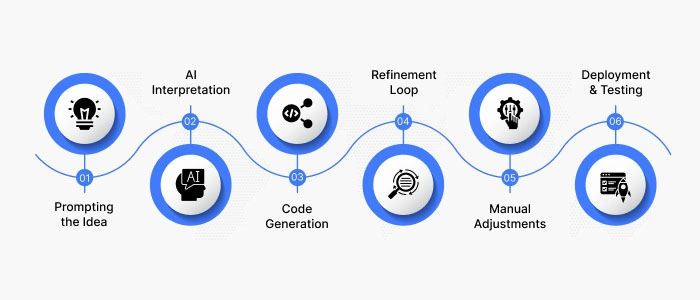
The vibe coding method is intended to make developers the path go from idea to executable code. Developers do not open an editor and write code. They use natural language commands such as “build a user login screen with authentication” or “create a product list page for an e-commerce website”.”
The system uses AI models to understand the instructions and create code, UI designs, and database schemas in a structured manner.
What makes this workflow even more powerful is how iterative it is. Developers can keep refining the output, asking the system to tweak a design, fix bugs, or add specific logic without manually rewriting everything. This makes vibe coding especially helpful for quick prototyping, agile sprints, and early product mockups.
Many teams offering ecommerce development services or working on ecommerce website development use this flow to speed up the first version of product pages, dashboard systems, or checkout flows before shifting to manual optimisation. The mix of natural-language instructions and editable code gives teams the flexibility to experiment while still keeping full control over the final output.
Typical Vibe Coding Workflow:
- Prompting the Idea:
The developer explains the feature or function using simple natural language.
- AI Interpretation:
The system converts the prompt into structured code, UI components, or backend logic.
- Code Generation:
Depending on the project, readable code is generated using languages such as JavaScript, Python, or TypeScript.
- Refinement Loop:
Developers review the code, request changes, and refine the output using further prompts while ensuring Vibe Coding Security through proper validation and testing.
- Manual Adjustments:
Engineers polish performance, structure, and security, ensuring the final product meets real-world standards.
- Deployment & Testing:
Teams can quickly test features, making vibe coding ideal for MVPs, e-commerce development prototypes, or rapid user-flow experiments.
What are the Technical Tools and Technologies Behind Vibe Coding?
Vibe coding is basically the result of several advanced technologies that combine their efforts to convert natural-language directives into actual, executable code. The main components of the whole setup are Large Language Models and Natural Language Processing units that comprehend human guidance and deliver it as programming logic.
These models, which leveraged huge code bases and cabinets in their training, can perform a complete function, API, UI layout, and even a working flow with a high degree of correctness. The prodigious advancements, mainly the e-commerce website developers and the custom software project teams, have already felt the considerable time-saving effect of these technologies in the embryonic stage of their work.
AI-powered coding assistants, IDE extensions, and cloud-based deployment tools are just some of the ways that vibe coding, along with AI models, can function effectively. These are the means by which developers can handle, polish, and put into operation the code that has been generated by prompts. Vibe coding workflows created applications can now be easily tested and made live with the help of platforms such as Replit, GitHub Codespaces, and other cloud environments.
Such a workflow would be a dream for a startup, an agile team, or an e-commerce app development company looking to quickly test new features without the hassle of waiting for the turnaround of a traditional setup. When combined, these technologies open up a way to deliver digital products that is not only quicker but also more imaginative and team-oriented.
- Large Language Models:
Convert human instructions into clean, functional code for frontend, backend, and full-stack applications.
- Natural Language Processing:
Helps the system interpret intent, break down user prompts, and map them to technical logic.
- AI Code Generation Engines:
Create workflows, functions, UI components, and backend logic based on prompts.
- AI Coding Assistants & IDE Integrations:
Such tools, which are built into VS Code, Replit, or browser-based IDEs, make it possible to have live suggestions and debugging.
- Extensions & Plugins:
Extensions that facilitate the user by allowing auto-complete, code correction, and instant refactoring.
- Cloud Deployment Platforms:
Services that allow quick testing and hosting of apps are important for agile teams and e-commerce development services.
- Version Control & Collaboration Tools:
Platforms like Git and GitHub help developers refine AI-generated code with team-wide transparency.
What are the Benefits of Vibe Coding?
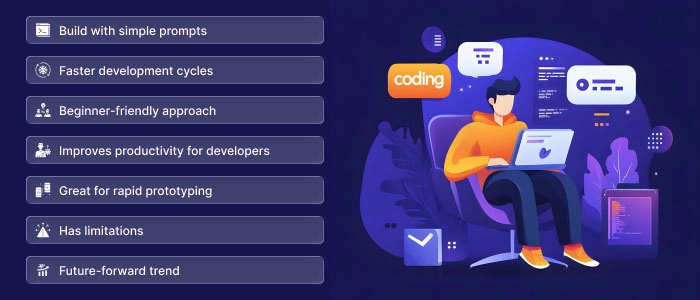
Vibe coding is a new concept in software development that basically means building apps with conversational language rather than using a formal programming language. Put simply, if you were to compare it with traditional coding, you would not have to code extensively but just tell what you need, i.e. features, UI, process, or logic and the AI would create the runnable code based on your instructions. Consequently, the entire development workflow is made faster, accessible to a larger number of people, and very friendly in terms of users’ experience with both novices and pros.
- Build with simple prompts: Apps, websites, and automation workflows can be made just by telling your idea in normal English.
- Faster development cycles: AI handles the repetitive elements of your code, allowing you to jump from concept to prototype in a few minutes.
- Beginner-friendly approach: Creators without technology skills, Entrepreneurs, and Product-thinkers who want to build without the knowledge of deep coding are the ideal users of this.
- Improves productivity for developers: Professionals may resort to Vibe coding to expedite their routine tasks and thus have more time for architecture, logic, and optimisation.
- Great for rapid prototyping: Before fully developing, it is a good way of quickly testing your ideas.
- Has limitations: Complex architectures, heavy integrations, or security-critical systems still require human expertise and manual coding.
- Future-forward trend: As AI evolves, vibe coding is expected to become a major force in democratizing software development.
When Vibe Coding Makes Sense?
Vibe coding becomes extremely beneficial in instances where speed, inventiveness, and experimentation are more important than writing flawless grammar. It allows developers who are new as well as developers who have experience to change their ideas into working prototypes without losing time in repetitive coding activities.
Rapid Prototyping & MVP Building:
If you’re trying to validate an idea fast, vibe coding lets you create early versions of apps or web tools in minutes instead of days. Reports suggest that teams using AI-assisted development cut prototype time by up to 40%, making it ideal for startups, small teams, and founders testing product–market fit.
Side Projects & Hobby Apps:
It’s perfect for small tools, fun experiments, automations, or apps you’ve been planning but never had time to build. You can describe features in natural language and instantly see functional output great for creatives who want to tinker without deep technical setup.
Early-Stage Ecommerce Projects:
For businesses exploring ecommerce development, vibe coding helps generate simple store layouts, product pages, workflows, and dashboards quickly. It’s especially helpful for teams researching what is ecommerce development, or those comparing options before hiring an ecommerce website development company.
Internal Tools & Quick Fixes:
Companies often need dashboards, scripts, calculators, forms, or workflow automations. Vibe coding helps generate these internal tools faster, freeing developers to focus on architecture rather than boilerplate code.
Learning & Experimentation:
Students, new developers, and even non-technical founders use vibe coding to understand how real code is structured. It turns natural-language requests into clean snippets, making learning more intuitive and less intimidating.
Proofs-of-Concept for Web Apps:
When you need to show your team or client “what something might look like,” vibe coding helps you deliver a working proof-of-concept far quicker. This is, in fact, a perfect match with present agile cycles, in which the first visual result is of greater importance than the quality of the code.
Low-Risk, High-Experimentation Scenarios:
It shines when projects don’t involve heavy security, complex integrations, or large-scale systems. That’s why it’s popular for early-stage ecommerce website development, small business apps, or demo versions created before partnering with a full ecommerce development company.
When To Avoid Vibe Coding?
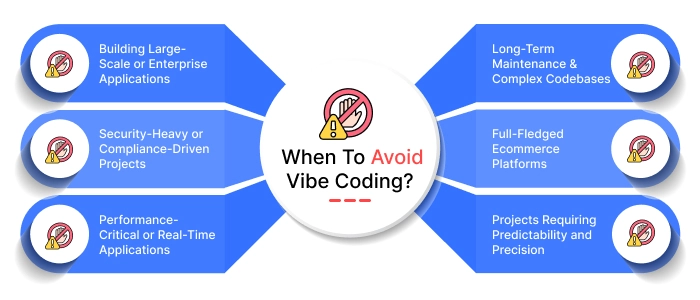
Though vibe coding is perfect for fast work and trying out new things, it isn’t suitable for every type of project. Certain programs need more thorough management, a rigid framework, and foresight for the future, which is beyond the capability of natural language-based coding to some extent. Here are the scenarios where traditional development methods still make more sense:
- Building Large-Scale or Enterprise Applications
Such complex platforms, for instance, enterprise CRM systems, high-traffic ecommerce websites, and multi-module corporate applications, call for a strong architecture as well as thorough performance planning. Enterprise-grade software failures are related to poor architectural decisions, which is why such systems need experienced engineers rather than vibe-based code generation.
- Security-Heavy or Compliance-Driven Projects
Vibe coding is generally not appropriate for organisations that have stringent compliance requirements like the finance sector, healthcare, payments, or government technology. In situations where there is a need to deal with sensitive data or follow regulated processes, the teams must be in full control of the encryption, validation, and code auditing operations. AI-assisted or vibe-driven methods cannot always be in control of such a level of control as is required.
- Performance-Critical or Real-Time Applications
There are applications which have to work with a precision of a millisecond, for example, trading platforms, logistics algorithms, real-time monitoring tools, or big ecommerce engines, and in such cases, the code has to be manually optimised. Automated code often includes redundant logic, which can slow down platforms expecting thousands of concurrent users.
- Long-Term Maintenance & Complex Codebases
Projects that are expected to be around for years, with multiple developers making changes, will benefit from having a clear structure, documentation, and consistent coding standards. Suddenly, vibe-generated snippets can cause fragmentation and make future maintenance more difficult.
- Full-Fledged Ecommerce Platforms
Suppose a company aims to establish a long-lasting online store with such features as custom checkout flows, complex product logic, or global scalability, then it would be more reasonable to hire an expert e-commerce development company to get the job done. Vibe coding can help create prototypes, but stable systems require structured development, especially when companies are exploring what ecommerce development or planning to hire an ecommerce website development company for long-term growth.
- Projects Requiring Predictability and Precision
When every line of code must behave exactly as intended such as embedded systems, IoT firmware, or algorithm-heavy engines manual coding is safer than relying on generated outputs.
How Vibe Coding is Changing Roles?
Vibe coding revolutionises not only how software is written but also the developers’ work processes, their ways of teaming up, and their problem-solving mindset. The developers who used to spend a lot of time writing syntax line by line are now more focused on expressing their goals, managing their workflows, and considering AI tools as co-creators.
- Developers Are Becoming “Intent Designers”
Programmers no longer simply write code. They use AI tools by giving them clear prompts, system flows, and logic explanations. As a result, intent-driven development is starting to be recognised as the way of working. Thus, they can allocate more time to improving user experience, looking at the architecture, or trying out new ideas, which is great for industries like e-commerce website development that need to be able to rapidly iterate.
- Designers Are Stepping Into Technical Territory
With natural language interfaces and visual builders, designers can prototype interactions, automate flows, and build functional mockups without deep coding knowledge. It reduces the dependency on engineers during early product stages and speeds up the handoff process. For companies wondering what e-commerce website development is, vibe coding makes early ideation smoother and faster.
- Teams Are Becoming More Cross-Functional
Vibe coding is a collaborative development style that basically opens up the siloed developers’ world to other marketers, product leads, and even founders, so that these stakeholders can test their ideas directly. Hence, this multidisciplinary teamwork gets facilitated, bottlenecks are minimised, and the development cycle is getting increasingly agile.
- Hiring Trends Are Evolving Toward Hybrid Skill Sets
Firms are gradually locating tech people to fill their positions that have knowledge of AI collaboration, prompt engineering, system design, and iterative development, besides programming languages. The change is quite apparent in the sectors that depend on quick releases, for example, in the case of an e-commerce company, which has to hire developers who are not only technically proficient but can also creatively solve problems.
- Quality Assurance and Code Review Roles Are Becoming More Critical
Due to more AI-generated initial code, the need for checking, refactoring, and validating the results is increasing. Proficient engineers who can keep a clean structure and guarantee a scalable solution over time are sought after more than ever.
- Product Managers Are More Hands-On With Prototyping
PMs can now build small tools, test flows, or simulate user journeys without waiting for full development cycles. This reduces friction in planning and helps teams validate ideas early.
What is the Future of Vibe Coding?

Vibe coding future might be the next big thing in software development after cloud computing. With AI getting better and better at understanding what people mean, writing boilerplate code will be a developer’s task of the past and idea development, logic refining, and UX upgrading will be the new way of working.
Such a trend could not be more beneficial for the kind of industry that moves at lightning speed, like e-commerce development, a sector where companies depend on fast releases, tests, and continuous updates.
- AI-Native Development Will Become the Norm
Vibe coding should move developers to work with the next-level concept where they only explain what they want, and the AI takes care of structure, syntax, and repetitive tasks. Apps of the future, the choice is yours whether e-commerce sites, SaaS platforms, or internal tools will be built faster but also more flexible than ever before.
- Hybrid Workflows Will Dominate
While vibe coding will continue growing, traditional coding will not disappear. Instead, teams will mix both approaches: AI for fast scaffolding and humans for architecture, debugging, and optimisation. This hybrid model is already visible in many e-commerce website development companies that use AI for prototyping but rely on engineers for final performance tuning. It ensures speed without compromising scalability or security.
- Rise of Citizen Developers and Non-Technical Founders
As natural language interfaces keep getting better, more people without having deep programming skills will be able to make apps, automations, and prototypes. Small businesses, early-stage startups, and founders are bound to experiment with more things. Hence, the democratisation of development may become a catalyst for a whole new creative generation to emerge.
- More Specialised AI Tools Across Development Stages
As vibe coding matures, we’ll see advanced AI tools dedicated to code review, testing, deployment, and optimisation. Such instruments will be integrated as a single AI-powered pipeline that will facilitate faster output and less technical debt. The companies providing e-commerce development services will probably be the first movers in implementing these workflows in order to maintain the level of user experience.
- Shift in Skills and Training
The future developers will require advanced skills such as problem-solving, system-thinking, and prompt-design. Knowledge of programming basics will still be necessary, but the skill of working with AI will be equally important. This shift will influence hiring patterns and reshape how teams inside e-commerce development companies and tech firms operate.
Conclusion
Vibe coding is the main reason behind significant changes in software development that have resulted in the process becoming much faster, more user-friendly, and widely accessible. A new way of working has been opened up for developers whereby they can simply describe their ideas in a layman’s language, and the AI does the rest of the work by building the basic framework, logic, and flows.
Basically, this change is enabling each team to come up with a prototype in a short time, have more liberty with their experiments, and cut down their development timelines, which is a very significant advantage for them if they operate in fast-moving industries such as e-commerce development and startup product creation. Besides, it is a perfect fit for those agile cultures where fast iteration and constant progress are the key factors for maintaining competitiveness.
More developers, designers, and non-technical mavericks are vibe coding their way to the real-world application of their ideas, simply because it has become their coolest tool. Meanwhile, a great variety of businesses, from e-commerce website development companies to tech-savvy enterprises, are gradually recognising the worth of combining AI-powered workflows with a human touch.
Traditional coding is still necessary when it comes to scaling and securing products for the long term. However, vibe coding allows for creativity, speed, and the breaking down of barriers for innovation. The emergence of this tool is a signal of a new age when software development is not so much about the actual writing of code but rather about defining purpose, polishing concepts, and creating intelligent digital experiences.
FAQ’s:
1. What is vibe coding?
Vibe coding is a modern development approach where you describe your ideas in natural language, and AI turns them into functional code. It helps speed up prototyping and reduces the need for deep technical expertise.
2. Is vibe coding only for developers?
No, it’s useful for both developers and non-technical creators. Developers use it to accelerate workflows, while beginners use it to build simple tools without learning full programming syntax.
3. Can vibe coding replace traditional programming?
Not entirely. It works well for quick builds, MVPs, and experiments, but large-scale applications still require human-written code, architectural planning, and performance optimization.
4. What tools are commonly used for vibe coding?
Popular tools include AI coding assistants, LLM-powered IDE extensions, and platforms like Replit and cloud-based development environments. These tools help generate, debug, and refine code quickly.
5. Is vibe coding suitable for ecommerce or business applications?
Yes, especially for early-stage features, prototypes, and internal tools. However, for full-scale ecommerce website development, human expertise is still essential for security, scalability, and custom functionality.


 Ajay Wadne