A smart home is where the thermostat is set to begin moderating temperature before the owner gets out of bed, the coffee maker begins preparation, and the car suggests the shortest route to work.
In all the above cases, IoT (Internet of Things) should be presented, along with the vast network of connected devices that allow such tweaks to make our lives easier and businesses more efficient.
The seamless functioning of IoT can only happen with the concerted effort of very large networks of connected devices. However, under effective IoT network management, several connected devices collaborate with real-time data processing and decision-making via their functionalities.
Beyond that, the data are then interpreted and converted into actionable insight, facilitating smarter decision-making while triggering an automated response across industries.
With great connectivity comes great complexity. Just like any well-oiled machine needs regular maintenance, IoT networks also need very good management to keep running smoothly. Network management for a business ensures that it is protected against problems like data breaches, device failings, performance slowness, and system downtimes, which usually cost the organisation fortunes regarding disruption effects.
IoT technology investments are massive in health care, industries, smart cities, and agriculture to improve efficiency, reduce costs, and make informed decisions. IoT is changing all spheres of life, from self-monitoring medical devices to predictive maintenance in factories.
The blog will look into IoT network management, which is fundamental for seamless connectivity, security, and efficiency. Understand how smart devices communicate and process data and how they overcome some of the major challenges.
Why is IoT Network Management Important?
Management of an IoT network is not limited to keeping devices connected. It is all about maintaining secure and efficient data access and flow without interruptions. Billions of real-time communicating IoT devices make a well-managed network a platform for seamless data flow while reducing latency and preventing system failures.
- It ensures reliable connectivity.
- Hardening of security and prevention against cyber threats.
- Growth scalability, performance, and optimisation.
- Optimising real-time data processing.
- Reduced downtime due to prediction of deterioration from monitoring.
Imagine a smart factory with hundreds of monitors embedded in machines, sending signals for measurements done in real time. When the network fails, the machines cannot send the necessary signals; for example, critical alerts that may indicate overheating or mechanical failures would be missing. Hence, costly downtimes or accidents may occur.
Similarly, IoT-enabled pacemakers and remote monitoring equipment in healthcare require a steady network. A delay in data transmission could postpone critical medical decisions, placing patients in danger.
Core Components of IoT Network Management

Understand through examples, such as traffic lights that adjust automatically based on congestion, smart devices that optimise electricity usage, and wearable health devices that send real-time alerts to doctors.
It is all about the power of the Internet of Things (IoT). This great scenario connects everybody and everything to the Internet to collect and share data for a smarter and more efficient life. But managing an IoT network isn’t just a question of setting up a few smart devices.
IoT network management must ensure seamless communication between devices, prevent security breaches, and make everything run smoothly. Let’s examine the constituents making this feasibility available.
Connectivity Management
IoT devices use different communication protocols: Wi-Fi, 5G, LPWAN (Low Power Wide Area Network), and Bluetooth. Management of this large network is important because devices must be sent and received without any disruption or delays.
Smart agriculture systems, for instance, will use LPWAN to transmit soil moisture levels from very far fields, while 5G will be used to monitor traffic in real-time in smart cities.
Without proper coverage management, your devices will suffer from lost signals, sluggish response times, or a much higher power drain, rendering the system less effective. IP address lookup helps identify each device on the network, making it easier to monitor connectivity and troubleshoot issues quickly.
Device Management
With the rising use of IoT, businesses must manage hundreds, if not millions, of distant devices. Device management automates the tracking, updating, and maintenance of IoT devices.
Imagine a fleet of autonomous delivery drones. If one of their software programs becomes outdated or awry, the whole system might fail.
Remote firmware upgrades, automatic diagnostics, and predictive maintenance relate to device reliability and minimise device downtime rather than making them productive. Remote device management is essential for keeping these devices secure, updated, and running smoothly without needing to be physically accessed. In many enterprise setups, this is often achieved through a remote LAN, which enables secure communication and control of IoT devices across distributed locations.
Data Management
By 2025, it is predicted that the Internet of Things will generate up to 79.4 zettabytes of data. If data management were to be ineffective, the firms in question would store data overload, slow processing, and totally lose their ability to extract insights.
For example, hundreds of sensors in a smart factory collect information about machine performance. Efficient data management filters valuable insights from raw data, sending only vital warnings and eliminating needless noise.
Structured data management enables firms to swiftly extract relevant insights, much as a well-organised library makes discovering books easier.
Security Management
A poorly managed IoT network is a hackers’ haven. Security management protects IoT devices and the data they store from cyber-attacks, unauthorised access, and data breaches.
If hacked, it also attacks the whole smart home security system, where criminals can access a surveillance camera or door locks. Control measures for these risks would involve end-to-end encryption, zero-trust security models, and real-time AI threat detection for IoT security management.
Challenges in IoT Network Management
The tremendous increase provides great prospects in IoT but also brings obstacles, particularly in properly operating these networks.
Adding devices adds complexity, and organizations or sectors that rely on IoT grapple with scalability, interoperability challenges, poor network reliability, and many other issues due to the ever-increasing number of devices in their systems.
So, here is one of the major hurdles in IoT network management and why it should be addressed in the future for a connected world.
Scalability Issues
However, as IoT networks continue to expand, they will intake so much data while also providing stable, faultless connectivity, which creates a challenge for traditional networks, as they cannot keep up with the current alarming rate with which data getting bottlenecks, delays, and system failures.
The businesses have to run the risk of failing to control their IoT ecosystem without robust network architectures and automatic scaling solutions.
Interoperability
Where ideal IoT devices will talk only the same “language,” unfortunately, because manufacturers use different communication protocols and standards, there is no smooth connection between devices with other protocols.
For example, a smart thermostat brand may not work with another brand’s security system. Integrating devices into an organization’s network becomes challenging because there is no common IoT framework or middleware solution, thus stifling the organization’s ability to innovate faster.
Latency & Reliability
The Internet of Things thrives on real-time data. Whether autonomous vehicles require split-second choices or healthcare monitoring alerts doctors to crises, even minor delays in data transmission might have catastrophic effects.
Heavy network traffic, low bandwidth, and an older infrastructure can cause excessive latency (sluggishness) or downtime.
Without investment in edge computing and 5G services, businesses would fall behind in IoT networks. For that reason, devices must respond to changes and events without any delay.
Cybersecurity Threats
IoT devices are an easy target for cybercriminals. Hackers, on an IoT network established as a vulnerable one, can gather enough data to steal highly confidential information, bring business operations to a halt, or take control of equipment. Strategies such as bot mitigation in cybersecurity are becoming increasingly important, as automated bot attacks can overwhelm IoT systems, steal data, or exploit weak endpoints. Any business that does not have proper encryption, firewalls, and AI-driven threat detection in place is likely to be faced with the risk of data breaches, unauthorized access, and violations of compliance.
Check Out Related Posts
How AI and Automation Are Transforming IoT Network Management
While connectivity offers infinite benefits, managing such a widespread network of devices is not easy. That is where AI (Artificial Intelligence) and automation come in, reshaping network management by making it smarter, faster, and more competent.
AI and automation exemplify this notion by performing complicated network activities with minimum human participation. AI-driven solutions may identify difficulties before they occur, resolve problems automatically, and optimize performance in real time, eliminating the need for IT professionals to diagnose mistakes manually, provide devices, or analyse data.
Let’s look at how AI and automation are transforming IoT network administration.
AI for Predictive Maintenance & Real-Time Analytics
Traditionally, maintenance of IoT devices is performed on a regular schedule. However, this strategy sometimes leads to unnecessary repairs or unexpected malfunctions.
AI-powered predictive maintenance changes the game by studying real-time data and predicting errors before they happen.
For example:
AI can identify a small vibration pattern in a production robot weeks in advance, indicating a potential problem. This way, firms can plan their maintenance based on need, cutting back on downtime and cost savings.
Automation Simplifies Device Provisioning & Troubleshooting
It is quite daunting to set up and manage thousands of IoT devices manually, just like herding cats. Automation hastens the process, provisioning, debugging, and updating devices automatically.
Instead of manually maintaining thousands of IoT devices, you could employ automation in provisioning, debugging, and updating these devices. It’s somewhat like herding cats-there’s no end to the time it consumes and the disorderliness it entails.
An automated system can authenticate the device, provision network settings, and negotiate for firmware upgrades via remote push for the smart grid’s newly added IoT sensor performance.
Similarly, automation facilitates troubleshooting. Suppose a security camera in a smart city network loses connection instead of waiting for IT workers to investigate manually. In that case, an AI-powered system may discover the root cause, try solutions, and redirect network traffic to keep operations running.
Machine Learning Optimizes Network Performance
IoT networks generate large amounts of data every second, which standard network management methods cannot handle. Machine learning (ML) helps by analysing this data to find patterns, predict network congestion, and dynamically optimize bandwidth distribution.
For example:
In a smart transportation system, AI may analyse real-time traffic camera feeds, GPS data, and sensor inputs to alter traffic lights and avoid bottlenecks.
Similarly, ML algorithms in a corporate IoT network may efficiently allocate bandwidth, prioritizing mission-essential devices (such as medical monitoring systems) over less critical applications.
Developing IoT apps is hindered by security, scalability
Use Our Iot Cost Calculator to See the Benefits for Yourself!
The Future of AI-Driven IoT Network Management
With AI and automation taking over monotonous and complex operations, organizations can concentrate on innovation rather than network problems. As AI technology progresses, we can expect self-healing networks in which IoT systems detect faults, reroute traffic, and resolve difficulties without human interaction.
Keeping IoT networks secure, scalable, and intelligent. The future is more than just linked gadgets; it is about smart, self-managing IoT ecosystems that power industries, cities, and daily life.
Security Measures for Robust IoT Network Management
In fact billions of connected devices exchange very important data every second; hence Cybersecurity for IoT networks is not an option but a necessity.
Gartner says in its recent predictions, by 2025, 75 per cent of all corporate data will be created and processed outside traditional data centres or cloud environments. Cybercriminals are expected to focus their targets on IoT networks.
Poor security can grant hackers the opportunity to collect personal information, disrupt industrial processes, or seize control of smart city infrastructures.
Any connected device in the IoT is a potential avenue for cyber assault. They need protective measures to protect their networks against breaches, data theft, and system failures.
Let us glance at some of the major techs that provide robust IoT security.
End-to-End Encryption:
Sealing secret messages is a more practical affair, making it possible for only those authorized to have access to read data. In an end-to-end encryption scenario, no device sends or receives data until it reaches its destination.
The attackers would obtain all the unauthenticated data, hack patients’ emails, or destroy information in a financial or smart house between devices without applying encryption.
Secure encryption protects personal information over IoT devices with unauthorized access, helps prevent fraud from changing or modifying the information “sent,” and complies with international security data protection legislation such as those from the GDPR and HIPAA.
Modern-day encryption systems, such as AES-256 and TLS 1.3, secure IoT communications so hackers cannot decrypt the data.
Check Out Related Posts
Blockchain
This tamper-resistant data auditing of IoT security is the other side of the blockchain technology coin.
Though storing and running IoT data in traditional networks means that there are many attack points on the centralized server for hackers, they mostly target against these servers. However, blockchain functions as a decentralized ledger, recording, encrypting, and storing IoT transactions across numerous nodes. This makes it almost impossible for hackers to modify or erase data.
- Blockchain technology secures IoT networks by preventing data tampering and decreasing fraud through multiple-node verification. It also complements AI access control by recording verified device identities and permissions on-chain, creating a transparent and immutable access log.
- Improves device authentication: IoT devices can interact securely without intermediaries.
- Decentralized storage eliminates single points of failure, preventing massive data breaches.
For example, blockchain ensures that every step from manufacturing to delivery is validated and unchangeable in smart supply chains, preventing counterfeit items from entering the system.
Zero Trust Architecture
Firewalls and perimeter defences are no longer enough to ensure security. With IoT devices connecting from many locations, a zero-trust security approach is increasingly required.
Instead of automatically granting access to devices within a network, each user, device, and system must constantly authenticate their identity before access is granted.
- Multi-factor authentication (MFA) solution allows only authorized individuals to access crucial IoT systems.
- Micro-segmentation divides the network into tiny zones to prevent unauthorized access.
- Continuous Monitoring: AI-powered security scans for suspicious activity.
Edge Computing and Its Role in IoT Network Optimization

Imagine you have a home assistant to step in and switch on the lights. The command comes and goes to wait for its acknowledgment. Such an interaction goes through the cloud to be processed before executing the command.
What if processing could occur closer to home, at the network’s edge? This is exactly what edge computing does!
IoT devices, such as smart cameras, wearables for health data, and industrial sensors, bring vast amounts of data into the applications. Of course, sending this many data to the cloud would blow up a LAN, promoted by many in the magnitude of firmware latency, real-time decision-making impossibility, etc.
This is where edge computing reshapes the IoT, allowing faster, smarter, and more efficient network performance.
So now, how does edge computing fit into optimizing IoT networks below?
How Edge Computing Reduces Latency and Enhances Performance
Data from the devices goes to far distant computers, processed there, and is waited for its feedback. This process is, however, not lug-less in applications closer to autonomous vehicles, health care, and smart manufacturing.
Edge computing means processing the data shortly after it is originated right on the local devices or at the edge servers or gateways. This dramatically cuts the latency down, speeds up, and frees up for real-time decision-making.
- Edge Computing Benefits
- Faster response times in autonomous cars and industrial automation.
- Improved experience in AR/VR applications and smart gaming.
- Dependable performance in remote places with inadequate cloud connectivity.
Use Cases of Edge AI in IoT Applications
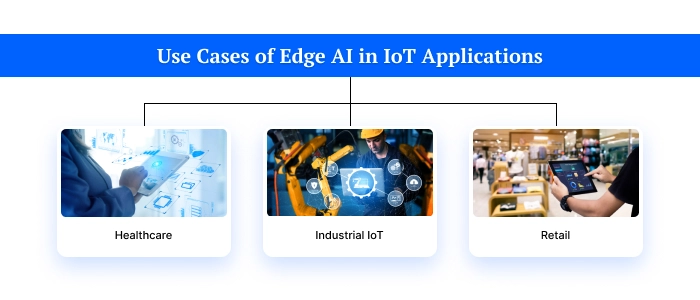
Edge AI, a hybrid of AI and edge computing, is opening new possibilities for the IoT. Devices may now analyse data instantly instead of depending on remote cloud servers.
Healthcare
The Edge AI smartwatches and health monitors can analyze the heart rate pattern in real-time and mark anomalies on detection, including potential early warning signs for a heart attack. Processing on-device will notify users or healthcare professionals instantaneously, thus another chance at saving lives.
Industrial IoT
Edge AI in factories offers monitoring of equipment while sensing pressure, temperature changes, and vibrations. AI can, therefore, predict failure ahead of time, saving millions of dollars due to downtime and repairs rather than waiting for an advanced maintenance schedule.
Retail
Coram’s advanced AI security cameras that analyse video on the edge are becoming popular in retail stores. These systems detect suspicious activity, evaluate client behaviour, and issue real-time alerts without overwhelming cloud networks.
Cloud Computing Vs. Edge Computing in IoT
Although they have diverse uses, cloud and edge computing both have a position in the Internet of Things. Edge computing is superior for real-time processing and low-latency applications, while cloud computing is best for large-scale data storage and analytics.
| Feature | Cloud Computing | Edge Computing |
|---|---|---|
| Latency | High | Low |
| Data Processing | Centralized | Decentralized |
| Bandwidth Usage | High | Low |
| Security | Vulnerable to centralised attacks | More secure with localized processing |
Hybrid Approach: Many businesses are now combining cloud and edge computing, using the cloud for analytics and long-term storage while processing real-time data at the edge.
IoT Network Management Best Practices For Businesses
The Internet of Things (IoT) has revolutionized enterprises in various sectors. It is no longer merely a futuristic idea. IoT increases productivity, enhances consumer experiences, and cuts expenses in multiple applications, from connected cars and retail automation to smart factories and medical equipment.
However, efficiently administering these networks is a major issue, as millions of networked devices exchange data every second.
Companies that adhere to IoT best practices proactively prevent system failures, security breaches, and performance bottlenecks instead of rushing to solve them after they occur.
Implementing a Centralized Network Monitoring System
Other companies may run their IoT ecosystems without centralized oversight, like driving a car without gauges; you wouldn’t know exactly when something went wrong. With centralized monitoring, organizations can see their entire IoT ecosystem in real-time, allowing them to monitor performance and identify problems before intervening to avert total failure.
Why It Matters:
- Monitors instantly for faults and bottlenecks across the devices and the network.
- Automates the troubleshooting, reducing downtime.
- Enhancing productivity with AI-based insights and predictive analytics.
- Regularly upgrading the firmware and software for better protection.
Regular Firmware and Software Updates for Security
Outdated firmware is one of the main threats that turn IoT devices into a prime target for attackers. A report stated that hackers had increased IoT cyberattacks by 87% in one year by exploiting unpatched devices.
Security Update Best Practices:
- To fix vulnerabilities, enable automated firmware and software upgrades.
- Use AI-driven threat detection to identify security threats early.
- Verify boot procedures are secure to prevent unauthorized firmware modifications.
Check Out Related Posts
Choosing the Right IoT Platform for Seamless Integration
Due to the vast number of IoT devices and communication protocols currently in use, choosing the appropriate IoT platform is imperative for successful integration. The carefully selected platform guarantees compatibility, scalability, and secure data exchange among all connected devices.
IoT, or the Internet of Things, supports various devices and has become by far the most used in so many different forms, covering almost all types of networks used by devices. In such situations, many establishments tend to implement an appropriate IoT platform into their systems. Interestingly, this ensures compatibility, scalability, and safe data interchange among all connected devices.
Future Trends in IoT Network Management
Today, with their smart homes, healthcare devices, and beyond, automated industries, and connected cities, IoT has affected how we interact with our surroundings. The change concerning technology will be vastly unlighted by the revolution in handling these large networks.
Rise of 6G Impacting IoT Connectivity

Though still being deployed worldwide, the IT industry is already eyeing 6G, projected to arrive by 2030. If this becomes a reality, 6G will provide data transfer rates 100 times faster than 5G, granting it further possibilities in ultra-low latency and reliability—a must for true IoT proliferation.
How 6G will transform IoT Networks:
- Real-time communication with near-zero lag.
- Massive device capacity – 6G supports 1 million IoT devices per square kilometer.
- Energy efficiency – IoT sensors consume less power, increasing battery life.
Growth of Self-Healing Networks Powered by AI
What if IoT networks could repair themselves without human intervention? Self-healing networks promise to do just that. They use artificial intelligence and automation to identify, diagnose, and resolve network issues in real-time.
Key advantages of AI-powered self-healing networks:
- Predict and resolve failures before they cause disruptions.
- Automatically reroute traffic to reduce network congestion.
- Improve cybersecurity by recognizing and preventing cyber threats immediately.
Increased Adoption of Digital Twins for IoT Monitoring
A digital twin is a virtual counterpart of a physical IoT system, allowing businesses to mimic, monitor, and optimize operations before making shall-we-say real-world changes. The technology has gained widespread acceptance quickly. According to Gartner, 75% of industrial companies are forecast to use digital twins by the year 2027.
Digital twins can be beneficial in IoT monitoring. They can predict system failures, test new tactics in a safe virtual environment, and optimize network performance by imitating real-world events.
Sphinx Solutions – The Right Choice for IoT Network Management
Billions of devices communicate every second, and businesses need a reliable partner to manage their IoT networks efficiently. With over 15 years of experience, the company has completed over 500 successful projects and has a presence in more than 10 countries.
As it is said, “A good foundation gives you a strong future.” Just like a strong foundation supports a house against every battering of the storm, so does an IoT network need strong management to counter the world’s security threats, downtime, and data overload.
However, without the right network management, companies may easily succumb to poor performance, security compromise, and operational failure issues that may be devastatingly expensive setbacks.
Our forte includes AI automation, blockchain security, and real-time analytics, making us the preferred partner to optimize IoT networks.
Conclusion
In the rapidly changing world of IoT, efficient network administration is no longer optional; it is required. Firms must embrace AI-driven automation, edge computing, and strong cybersecurity measures to keep their IoT ecosystems working smoothly.
Organizations prioritizing IoT network management will achieve unprecedented levels of efficiency, innovation, and dependability as we move towards a future driven by 6G, self-healing networks, and even more intelligent automation. The linked world has arrived; handling it intelligently is the key to success.
FAQ’s:
- What is IoT, and how does it work?
The Internet of Things (IoT) is a network of connected devices that collect, share, and analyze data over the Internet. These devices use sensors and software to automate tasks, improve efficiency, and enable smart decision-making.
- What are the benefits of IoT adoption for businesses?
IoT enables businesses to improve efficiency, cut costs, enhance customer experiences, and make data-driven decisions. It also enables automation, predictive maintenance, and real-time monitoring to help streamline operations.
- What are some examples of IoT applications across industries?
IoT is used in healthcare (wearable monitors), manufacturing (smart factories), retail (inventory tracking), agriculture (smart irrigation), and smart cities (traffic management and energy optimization).
- What are the security and privacy concerns associated with IoT?
IoT devices can be vulnerable to cyberattacks, data breaches, and unauthorized access. Businesses must implement strong encryption, regular updates, and access controls to protect sensitive information.
- How can businesses get started with IoT adoption?
Businesses should start by identifying use cases, choosing reliable IoT platforms, ensuring security measures, and working with experienced IoT development partners for smooth integration and scalability.


 Anand Mahajan