The adoption of cryptocurrency is on an exponential rise! With increasing numbers of people venturing into digital money, a pertinent issue arises: Where do you keep your crypto assets? The response to this is found in understanding custodial vs non-custodial wallets and picking one of them with their appropriate advantages and drawbacks.
With the growth of blockchain technology, various industries are experiencing advancements; therefore, more businesses are eager to integrate it into their operations. For business owners, picking the appropriate crypto wallet design does not only involve satisfying the market’s demands; the other hard one is maintaining the security of their assets.
In a report by Chainanalysis, during the first six months of the year 2023 and in recent hacks, more than $1.3 billion worth of digital assets were stolen from retail user’s wallets emphasizing why a sophisticated wallet should be chosen. In 2022, one prominent DeFi framework faced backlash as users could not withdraw funds because the custodial wallet experienced a hack. Additionally, many users have claimed to have lost money from non-custodial wallets after losing a private key.
This blog will discuss the specifics of the custodial and non-custodial crypto wallet debate. It will explore the work, pros and cons, and which crypto wallet is better for which scenarios.
Facing challenges in ensuring secure and transparent digital transactions?
Leverage expert blockchain application development for seamless, secure solutions.
What are Custodial Wallets?
Defining custodial wallets simply refers to a cryptocurrency wallet managed by a third party to hold the private keys and crypto assets. It means that funds can be sent and received in the crypto wallet, but the service provider controls it.
The services of a custodial wallet are similar to that of a bank. As the bank safeguards the funds and provides access when needed, they ultimately control the keys to your account. Examples of some custodial wallets include Coinbase, Binance, or PayPal, which handle the security of private keys.
Going ahead with the features, if the access is lost on a custodial wallet platform, it is easily recoverable with some verification steps, just like resetting a password. This ease involves a trade-off by trusting the third party to keep the funds safe. However, it is an excellent option for beginners but not appealing enough for those who value complete control and decentralization.
Pros and Cons of Custodial Wallets
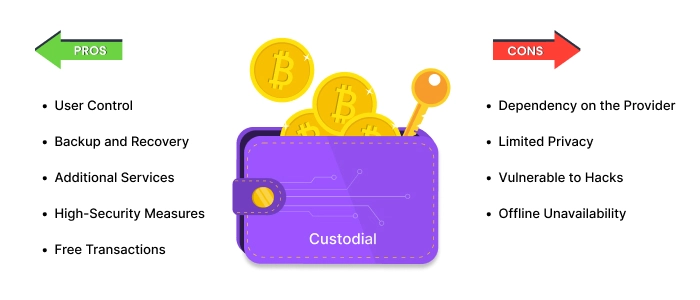
When it comes to cryptocurrencies, they are the most preferred type of wallet, and they are even more so for beginners. Despite that, they, too have their own merits and demerits. Let us explore the advantages and disadvantages of custodial wallets, along with some real-life examples to elaborate further.
Benefits of Custodial Wallets
User Control
Custodial wallets are user-friendly and a good option for beginners in the blockchain industry. The third-party wallet provider handles the private key, security measures, and technical aspects.
Coinbase and Binance are the most used custodial wallets that provide an option for users to contain, purchase, and exchange digital currency at a rapid pace, even for those users who have no experience with cryptocurrency.
Backup and Recovery
The central authority or third-party authority manages the backup facilities. If the password to access the funds is lost, the request for account recovery can be processed. This can restore any previous version and also undo any transactions.
Blockchain.com has a customer support team that can help recover access, offering peace of mind for newcomers unfamiliar with backup phrases or securing private keys.
Check Out Related Posts
Additional Services
Many custodial wallets provide additional services like exchange, staking, and swapping options. Consequently, rather than juggling various platforms, users can perform all their tasks in one interface, making the custodian wallet an all-inclusive solution.
Gemini, for instance, enables you to buy and sell cryptocurrencies and carry out several other crypto-related tasks from a single location without requiring several services.
High-Security Measures
Strong security measures like insurance coverage, multi-factor authentication, and data encryption are safeguards designed to protect assets from hackers and breaches. However, the level of security may not be the same for all custodial wallet providers. Holding a VARA license demonstrates a provider’s compliance with strict regulatory standards, adding an extra layer of trust.
For example, Bitgo offers insurance coverage, but it may not be available for Coinbase. It offers insurance for crypto held in hot wallets and is clear about user coverage.
Free Transactions
Unlike other platforms, custodial wallets allow free transactions without any transaction fee or platform fee. If the transaction is done within the ecosystem. The best example to justify this is Freewallet. It is a custodial wallet that saved approximately $500,000 on networking fees in 2019.
Cons of Custodial Wallets:
Dependency on the Provider
The maximum risk of losing access to funds is when the third-party service provider faces any technical issue, regulatory changes, or shuts its services. According to the norms of decentralization, depending on any other sources already contradicts the dependency factor.
Limited Privacy
Custodial wallets often ask for your personal information. This might involve verifying your identity or going through a KYC process. The following process minimized the privacy compared to that provided in non-custodial wallets.
Vulnerable to Hacks
Hackers often target custodial wallets due to their centralization. The more assets users hold in custodial wallet providers, the more charming it becomes for cybercriminals. Despite building robust security systems by blockchain app developers, hackers get their way, and it remains a concern in blockchain technology.
Offline Unavailability
Internet connectivity is a significant part of the custodial wallet because it doesn’t allow transactions in offline mode. The transaction will fail in an emergency if the internet is not connected, and no processes will be executed.
Managing your crypto assets without secure storage can lead to losses.
Secure your assets with reliable and user-friendly custodial wallets.
What are Non-Custodial Wallets?
Defining custodial wallets simply refers to a decentralized wallet controlled by the owner handling the private keys and the crypto assets. It exemplifies having a personal bank in your pocket without involvement from any third parties.
The private key is the only key to unlock the non-custodial wallet, so it can be accessed without relying on middlemen or needing permissions. As it comes with a lot of responsibility, if the private key is lost, there is no verification process to recover it.
For example, using wallets like MetaMask, Trust Wallet, or Ledger gives you sole ownership of the crypto wallet. The management of funds, like sending bitcoins to a friend or exchanging Ethereum for another token, is managed by the owner.
Another great example of a beginner-friendly non-custodial Bitcoin wallet is Relai, a Swiss-based Bitcoin-only app that lets users buy, sell, and hold BTC while keeping full control of their private keys. Designed for simplicity and security, In Switzerland, the Relai app is ideal for anyone transitioning from custodial platforms to self-custody without needing technical expertise.
Pros and Cons of Non-Custodial Wallets
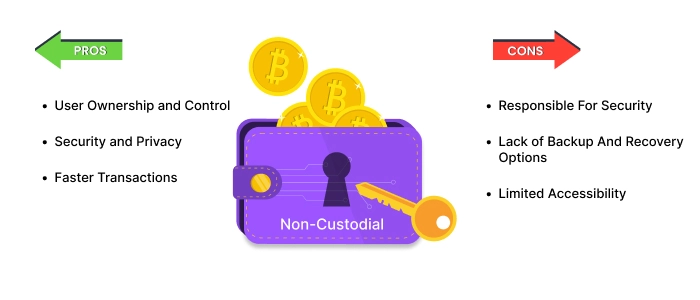
Being in constant demand, non-custodial wallets are most preferred by cryptocurrency users as they provide complete ownership over digital assets. The preferable choice for many cryptocurrency wallet holders, they have their benefits and weaknesses. Here’s a look at the same in detail:
Pros of Non-Custodial Wallets
User Ownership and Control
The owners are solely responsible for their private key, so no third party or service provider can access it. This means the wallet cannot be frozen or tampered with at any cost. It is important in regions with unstable financial systems or restrictive regulations, where cryptocurrency is the primary source of financial independence.
For Example, non-custodial wallets like MetaMask and Trezor ensure that users sign transactions directly without any middlemen.
Security and Privacy
The non-custodial wallet minimizes the risk of centralized storage. As the users manage the private key, they avoid vulnerabilities like exchange hacks or custodial breaches. It depends on the user how to keep their private keys safe.
Faster Transactions
The transaction in the non-custodial wallet can be executed in real-time. This implies that they are used to directly signing and broadcasting them to the blockchain without waiting for approval or verification by a third party.
For example, Trust Wallet is a non-custodial wallet allowing users to swap tokens or transfer funds quickly without delays.
Check Out Related Posts
Cons of Non-Custodial Wallets
Responsible For Security
As the user of a non-custodial wallet is the only owner, losing access to a private key or recovery phrase will permanently damage the accessibility to funds, and there will be no customer support to recover the loss.
A well-known example is a programmer from San Fransico who lost access to 7,002 bitcoins (~$200 million) in the present valuation because he forgot his recovery phrase. Also, it is estimated by Chainanalysis that 20% of all Bitcoin (3.7 million BTC) is lost due to forgotten private keys or lost wallets.
Lack of Backup And Recovery Options
The option to regain access to the cryptocurrency wallets or funds is just to remember the recovery phrase. If the users lose their recovery phrase, they cannot gain access to their funds, and no support team will be there to reset the access.
Limited Accessibility
Not all non-custodial wallets, especially hardware wallets, require physical device access. This may be an inconvenience in case of emergencies when the device is not available at the time.
After getting an overview in our well-drafted blog about custodial vs. non-custodial wallets, we come to a point where we articulate all the points to compare the difference between the two.
Below are the comparisons between the custodial and non-custodial wallets of blockchain technology.
Facing challenges in ensuring secure and transparent digital transactions?
Leverage expert blockchain application development for seamless, secure solutions.
Key Differences: Custodial Vs. Non-Custodial Wallets
With the increasing understanding of cryptocurrencies, selecting the most suitable wallet is important in safeguarding the transactions and the assets involved. The choice depends on the priorities and expectations.
For many users, the growing influence on data privacy and self-sovereignty makes non-custodial wallets a future-proof choice. While some prioritize convenience, customer support, and easy recovery, custodial wallets are their prime choice.
Both custodial and non-custodial wallets are the primary options catering to different needs and user preferences. They have an equal place in the evolving crypto landscape. Let’s break down the key differences between them, followed by examples and throwing some light on industry insights.
Custodian of Private Keys
In custodial wallets, the private keys are managed by third parties like exchange or wallet providers. This means relying on custodians like Binance and Blockchain.com to secure assets. In non-custodial wallets like Ledger Nano X and MetaMask, users independently retain full control over their private keys, providing complete ownership of their funds.
Transaction Type
Transactions are executed differently in custodial and non-custodial wallets.
The custodial wallet, like Freewallet, may delay executing the transaction details as they are processed and verified by the custodian. In contrast, non-custodial wallets like Trezor are reflected on the blockchain in real-time, offering transparency and control.
Security
Security is essential when investing in the emerging cryptocurrency market because security measures are still evolving.
In custodial wallets, users store sensitive data in centralized hot or cold storage, which usually is a target for hackers. For example, the Mt.Gox hack with high-profile breaches highlights the risk with custodial wallets.
In non-custodial wallets, maximum security depends on the user, as the private keys remain unshared with any third party. So, it minimizes the risk of external security breaches. Instead, there is no return if the owner loses the primary key or recovery phrases.
Backup and Recovery
There is a chance to recover the lost funds in custodial wallets. Users can request access in case of forgotten credentials; that is a good option for the beginner-friendly. For example, platforms like Bitgo offer customer support for recovery.
Concerning non-custodial wallets, if the user misplaces their private keys, their only source of recovery would be a copy of the recovery phrase. If that is also lost, then the funds are a lost treasure. For example, wallets like Exodus ensure the storage of the recovery phrase to regain access.
Accessibility and Offline Use
The access to the funds from a crypto wallet is also different for custodial and non-custodial wallets.
Custodial Wallets require internet connectivity and access via a centralized platform that often requires login credentials. Non-custodial wallets are accessible offline with hardware wallets like Ledger or Trezor, offering flexibility and independence.
Future Scope
With the increasing legitimacy of the cryptocurrency marketplace, privacy and security issues play a crucial role in choosing self-storage or non-custodial wallets.
In a recent study, 72% of crypto users preferred a non-custodial wallet for its safety, signifying an increasing acceptance of decentralized solutions. With increasing data breaches and security lapses, users prioritize wallets offering ownership over their funds.
Check Out Related Posts
Transition From Custodial to Non-Custodial Wallets
The demand of the transition among cryptocurrency users is usually due to the ownership of the assets. Both wallet types serve different purposes, so the transition process requires careful planning to ensure security and efficiency.
Here’s a well-navigated guide to make the transition a smooth process.
Purpose of Transitioning
The ownership to control the funds with private keys instead of middlemen is the greediness behind the transition. The privacy of assets doesn’t have to be disclosed to any third party, which aligns well with blockchain’s decentralized philosophy.
Preparation For The Transition
Non-custodial wallets can be based on the needs. They can be Hardware Wallets (e.g., Ledger, Trezor) for maximum security or Software Wallets (e.g., MetaMask, Trust Wallet) for convenience and accessibility.
When setting up a non-custodial wallet, a recovery phrase is assigned to be stored securely offline, such as in a password manager or physical locker, to avoid losing access to your funds.
Last, but not least, check out the compatibility of the wallets that support the type of crypto asset to be stored. For example, MetaMask and Exodus support many coins and tokens.
The Transition Process
Start the transfer process by shifting the funds into chunks. This is valid as instead of transferring a large amount altogether, test the process and ensure that the non-custodial wallet functions well. Once sure about setting up a non-custodial wallet, transfer the significant amount.
Previously, if the transfer of funds of exchanges has taken place, then update the wallet address to reflect the new non-custodial wallet.
Challenges Faced During Transition
For beginners, it can be challenging to manage th private keys, but secure practices like offline backups and encryption are helpful for protection. Understanding blockchain basics, such as gas fees and transaction verification.
As the transactions in non-custodial wallets are not free, users may face transaction fees during low network activity to minimize costs. The best non-custodial wallet that provides knowledge and services is MetaMask.
Benefits of Transition
Non-custodial wallets provide complete relivancy as designed by the blockchain app developers, so there is no requirement for the KYC process to preserve user anonymity. Users gain full access to the assets and funds in the cryptocurrency wallet without any interference, and the wallet is protected from common centralized exchange vulnerabilities.
Consider Keeping Both Wallets?
Both the custodial and non-custodial wallets have their share of benefits. One comes with easy access and customer support, while the latter provides control.
While day-to-day trading and staking on exchanges can work well with custodial wallets, long-term storage and keeping high-value items are better with non-custodial wallets.
It’s a choice and an advantage to keep both active simultaneously, but one should be careful and knowledgeable enough to maintain the two kinds of cryptocurrency wallets simultaneously.
This is an essential move toward financial autonomy but needs to be done on purpose. Users can, however, transition to the full benefits of possessing their assets without incurring any risks in full understanding of the functionalities of the wallets, the way the migration is planned, and, most importantly, the way private keys are guarded. Combining the two types of wallets may also be viable for users with mixed requirements.
Check Out Related Posts
Trends in Cryptocurrency Wallets
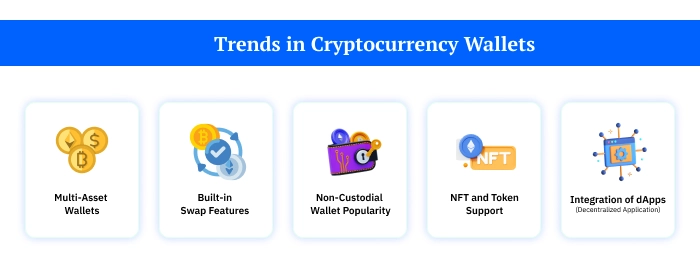
The Blockchain app development company’s task of creating a safe space for cryptocurrency wallets has evolved significantly as adoption grows. With technological innovation, user demand for security, and changing financial landscapes. In this blog, we have curated the latest trends in crypto wallets, reshaping how users manage digital assets.
Multi-Asset Wallets
Gone are the times of single-asset wallets, where only one variety of blockchain assets could be stored. The need for multiple wallets is trending as altcoins, and DeFi tokens users need wallets that can provide all solutions for their assets.
Multi-asset wallets are gaining prominence as they can store, send, and receive various cryptocurrencies and tokens, providing convenience. This reduces the need for multiple applications to be replaced by one. For example, Exodus and Trust Wallet support hundreds of cryptocurrencies, serving investors with diverse portfolios.
Built-in Swap Features
Blockchain app development services in cryptocurrency wallets are now offering exchange services, allowing users to swap cryptocurrencies without exiting the app. This eliminates the need to use other external exchanges. Streamlining transactions for users. For example, Trust Wallet has a built-in swap feature for converting one token to another directly within the wallet. To better track gains from such swaps or trades, users can also leverage a crypto profit calculator to estimate potential profits and losses based on their transaction history.
Non-Custodial Wallet Popularity
The sudden rise of non-custodial wallets is evidence of a growing preference for personal control of users over their assets. In order to ensure data confidentiality and eliminate challenges brought about by centralized services, individuals are now opting for non-custodial wallets.
Due to increasing hacks and data breaches in custodial wallets, there’s a shift of users with self-sovereign solutions. For example, during the FTX collapse, users turned to Ledger and Trust Wallet to secure their assets without any third-party interference.
NFT and Token Support
According to Fortune Business Insights, the global NFT market is projected to reach $211 billion by 2020, demanding NFT-compatible wallets. So, the Blockchain app development solutions support NFTs and other tokenized assets in the digital collectible and decentralized ownership models.
For example, Phantom Wallet for Solana and MataMask for Ethereum provides users with the ability to store, view, and trade NFTs along with cryptocurrencies.
Integration of dApps (Decentralized Application)
Modern-day wallets are more than just storage solutions. The blockchain app development company’s way was to integrate decentralized applications (dApps) into wallets. Now, the wallets allow trading, lending, gaming, shopping, and many more functionalities under one roof.
The trend enhanced wallet functionality, eliminating the need for multiple applications and making way for a broader blockchain ecosystem. A great example of this is MetaMask, which has direct connections to the DeFi platforms, blockchain games, and the NFT market.
Managing your crypto assets without secure storage can lead to losses.
Secure your assets with reliable and user-friendly custodial wallets.
Conclusion
The choice between both the cryptocurrency wallets i.e. custodial and non-custodial wallets is the most appropriate decision a blockchain users makes based on its asset’s requirements. The set of advantages and disadvantages have the choice ultimately depends on the needs and priorities of the user.
The blockchain industry is just like other evolving industries, changing every minute and hour. The users demand secure and user-friendly wallet solutions. By staying informed about the trends in the market and latest advancements, users can take their financial decisions safely.


 Anand Mahajan


 Shivraj Dhaygude