
A few years ago, rolling out a chatbot to handle customer queries or deploying robotic process automation (RPA) to process invoices was enough to earn the label ‘AI-powered.’ Today, that bar has shifted considerably.
In 2026, a new class of intelligent systems collectively referred to as agentic AI is forcing business leaders to rethink the very definition of automation. Unlike the rule-bound tools of the last decade, agentic AI systems can perceive context, reason across multiple steps, take independent action, and even course-correct when something goes wrong. They do not merely execute instructions; they pursue outcomes.
This shift is not incremental. It is architectural. And for businesses that are serious about staying competitive, understanding the difference between traditional AI automation and agentic AI is no longer optional; it is a strategic imperative.
This guide breaks down the key distinctions, explores where each approach fits, and outlines what your organisation should consider before leaping.
First, Let’s Define the Terms!
Traditional AI Automation (Including RPA)

Traditional AI automation refers to systems built around predefined logic, structured rules, and fixed workflows. These include robotic process automation tools, early-generation machine learning pipelines, and scripted bots that execute repetitive, clearly defined tasks, logging entries into an ERP, routing support tickets by keyword, or sending scheduled reports.
The operating principle is if-then logic: when condition X is met, perform action Y. These systems are fast, consistent, and relatively inexpensive to implement in stable environments. They do not surprise you. They also do not adapt.
Traditional automation shines when the process is predictable and the data is structured. Payroll processing, invoice matching, scheduled email campaigns, and factory floor robotics are classic use cases. When the business rules change, however, so does the system, and that usually means a developer, not the machine.
Agentic AI

Agentic AI refers to systems designed to operate with genuine autonomy. Rather than following a script, an agentic AI system accepts a high-level goal and independently figures out how to achieve it, planning its own steps, selecting tools, querying systems, evaluating results, and adjusting course when needed.
These systems are typically built on large language models (LLMs) enhanced with memory layers, reasoning modules, and tool-use capabilities. A single AI agent might autonomously resolve a customer service case by querying a CRM, pulling order history, processing a return, and composing a personalised follow-up email, all without human direction at each stage.
Multi-agent architectures take this further, coordinating multiple specialised agents that work in parallel or sequence to handle end-to-end workflows. Think of it as a capable team rather than a single worker.
Key distinction: Traditional automation executes tasks. Agentic AI pursues outcomes. The difference sounds subtle but has enormous operational consequences.
The 2026 Landscape: What the Numbers Say?
The market signals are unambiguous:
- ~85% of enterprises are expected to have implemented AI agents by the end of 2025
- 40% of enterprise applications projected to feature task-specific AI agents by year-end
- $7.38B global AI agent market size in 2025, up from $3.7B in 2023
- $103.6B projected AI agent market size by 2032
- 66%+ of enterprises already recognise productivity and cost-saving benefits from agentic automation
Despite this momentum, Gartner has flagged that more than 40% of agentic AI projects are at risk of being cancelled by 2027, not because the technology is flawed, but because many organisations rush deployment without clear business cases, governance structures, or integration plans. MIT research similarly suggests that up to 95% of early AI pilot programs struggle to demonstrate meaningful ROI at scale.
The message is agentic AI has real, measurable value, but only when deployed thoughtfully.
Agentic AI vs Traditional Automation
| Dimension | Traditional AI / RPA | Agentic AI |
|---|---|---|
| Decision-Making | Follows fixed, pre-programmed rules | Reasons autonomously from context and goals |
| Adaptability | Requires manual reprogramming for new scenarios | Learns from feedback and adapts in real time |
| Task Scope | Single, narrow, repetitive tasks | Complex, multi-step, cross-system workflows |
| Human Oversight | Constant — fails silently on exceptions | Minimal; escalates only at defined thresholds |
| Data Handling | Structured data only | Structured and unstructured data |
| Integration | Point-to-point, brittle integrations | Orchestrated across enterprise ecosystems |
| Setup Complexity | Lower upfront complexity | Higher initial investment, lower long-term overhead |
| Best Fit | Stable, repetitive processes (payroll, invoicing) | Dynamic workflows (customer service, compliance, R&D) |
Where Each Approach Fits
Stick with traditional automation when:
- Your process is stable and unlikely to change frequently
- Tasks involve structured data and clearly defined rules
- You need predictable, auditable, and explainable outputs
- Budget and implementation timelines are constrained
- You operate in a highly regulated industry requiring deterministic outputs
Examples: Automated payroll runs, invoice OCR and matching, scheduled compliance reports, CRM data deduplication, and form-based data entry.
Move to agentic AI when:
- Your workflows are dynamic, multi-step, and span multiple systems
- Exceptions are frequent, and human escalation is a bottleneck
- You need the system to reason about context, not just match patterns
- You want automation to improve over time rather than require constant reconfiguration
- Your team is losing productivity to coordination overhead across tools
Examples: Autonomous customer support resolution, AI-driven procurement lifecycle management, intelligent fraud detection with contextual reasoning, personalised financial advisory workflows, and complex IT incident response.
The Hybrid Approach
Most mature enterprises in 2026 are not choosing one or the other. They are deploying hybrid architectures where agentic systems handle strategic coordination and exception handling while traditional automation manages specific, well-defined subprocess execution underneath. This approach captures the predictability of RPA where it is most valuable, while enabling the flexibility of agentic reasoning where complexity demands it.
Real-World Applications by Industry
Financial Services
Banks, including JPMorgan Chase, are exploring agentic AI for fraud detection, automated loan approvals, and compliance workflow management. These agents can evaluate case context across customer history, transaction patterns, and regulatory requirements, tasks that traditional rule-based systems handle poorly in dynamic fraud scenarios.
Retail and E-Commerce
Retail giants are deploying LLM-powered agents to personalise shopping experiences at scale, orchestrate complex customer service interactions, and automate merchandise planning. An agent handling a complex return query might simultaneously check inventory, verify warranty policy, process the refund, and draft a customer-facing response, all autonomously.
Healthcare
Agentic systems are being piloted for patient triage support, clinical documentation assistance, and coordinating across scheduling, records, and billing systems. The key benefit is the agent’s ability to reason across unstructured clinical notes and structured EMR data, something traditional automation cannot do.
Manufacturing and Supply Chain
Multi-agent frameworks are being used to monitor supply chain disruptions, autonomously reroute shipments, manage vendor communications, and generate revised procurement plans, collapsing workflows that previously required hours of human coordination into minutes.
Software Development
Agentic coding assistants now go beyond autocomplete. They can accept a feature requirement as a goal, write code, run tests, interpret failure messages, fix bugs, and submit a pull request, completing end-to-end development cycles with minimal intervention.
The Risks Businesses Must Take Seriously
Agentic AI’s autonomy is also its primary risk vector. Organisations that deploy agentic systems without proper governance expose themselves to several categories of risk:
Overprivileged Agents
Research from Obsidian Security found that 90% of AI agents hold significantly more permissions than they require, often up to 10 times the access they actually need. These agents also move far more data than equivalent human users. Least-privilege access controls, scoped API permissions, and regular permission audits are essential.
Security Vulnerabilities Through Indirect Attacks
Agentic systems can be compromised through poisoned data sources, malicious documents or compromised web pages that the agent encounters in the course of its work. Unlike direct prompt injection, these indirect attacks are harder to detect and require robust input validation and sandboxing strategies.
Accountability Gaps
When an agentic system makes an error, over time, the organisation needs to have clearly delineated lines of accountability. Who is responsible when an agent misinterprets a compliance requirement or executes an action with unintended downstream effects?
Compliance and Data Exposure
The average organisation now experiences over 200 data policy violations involving AI applications each month. In regulated industries, agentic systems that handle sensitive customer data must be architected with strict data classification, audit logging, and compliance controls from the ground up. The EU AI Act permits fines up to 35 million euros or 7% of global revenue for serious violations, a consequence that makes proper governance a business-critical investment.
Monitoring should be treated as a permanent operational expense, not a one-time project cost. Agentic systems that work well today can behave unexpectedly when the data environment or business rules shift.
What Businesses Need to Assess Before Deploying Agentic AI?
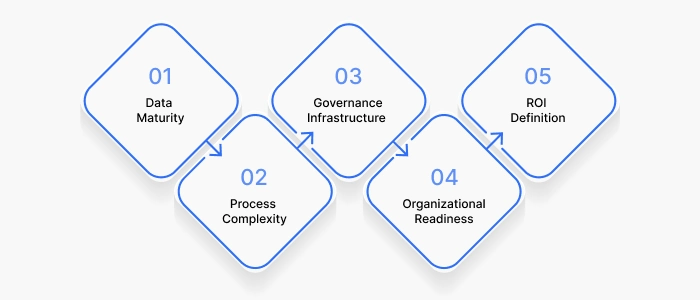
- Data Maturity
Agentic AI is only as capable as the data it can access. If your data is siloed, poorly labelled, or inconsistently formatted across systems, the agent will struggle to reason effectively. Before deployment, assess whether your organisation has clean, accessible, real-time data pipelines and whether the relevant systems expose well-documented APIs that an agent can interact with.
- Process Complexity
Agentic AI delivers the most value in workflows where decision points are frequent, context matters, and exceptions are the norm rather than the exception. If a process is straightforward enough to be fully specified in a decision tree, traditional automation is likely more appropriate and cost-effective.
- Governance Infrastructure
Establish a governance board or oversight function before the first agent goes live. Define clear policies for what the agent is authorised to do, what requires human approval, and how errors will be detected, logged, and remediated. Organisations that skip this step often find themselves reacting to incidents rather than preventing them.
- Organizational Readiness
The shift to agentic AI changes the nature of work rather than simply reducing it. Teams need to develop new skills: understanding how to define agent goals and success metrics, interpreting AI-generated outputs, validating agent decisions, and providing high-quality feedback that improves agent behaviour over time. Reskilling investment is as important as technology investment.
- ROI Definition
Agentic AI projects fail when the success criteria are vague. Before deployment, define specific, measurable outcomes: reduction in resolution time, decrease in exception escalations, improvement in throughput, reduction in error rate. Without these, it becomes impossible to evaluate whether the system is delivering value or simply consuming resources.
The Strategic Lens: Thinking Beyond Efficiency
It is tempting to frame agentic AI purely as an efficiency play: automate more, spend less, move faster. But the more significant strategic implication is what it enables rather than what it replaces.
When AI agents can handle entire end-to-end workflows autonomously, businesses unlock the ability to launch new service models that were previously uneconomical at small margins, respond to market changes in minutes rather than days, and scale operations without proportional headcount growth.
Companies using AI-powered outreach agents have reported conversion rate improvements of up to seven times alongside 60 to 70% reductions in outbound costs. Early movers in sectors from legal services to logistics are already reaping these structural advantages.
This is why 2026 is not the year to wait and see. The organisations that are thoughtfully experimenting and building institutional knowledge around agentic systems now will have an enormous head start over those that begin in 2027 or 2028.
That said, ‘moving fast’ is not synonymous with ‘moving recklessly.’ The organisations delivering the best outcomes from agentic AI are those combining technical deployment with strong governance, clear outcome metrics, and genuine investment in the human capability to work alongside these systems effectively.
Conclusion
The question for most businesses in 2026 is no longer whether to adopt agentic AI; it is how to do so in a way that generates real, measurable value without introducing avoidable risk.
Traditional automation is not going away. For stable, predictable, high-volume processes, it remains the right tool. But for the growing class of complex, dynamic, cross-functional workflows that drive the greatest business value, agentic AI represents a genuine step change in what is possible.
Understanding the architectural differences between these approaches, knowing where each applies, and building the governance infrastructure to deploy agentic systems responsibly, is the practical work that separates organisations that lead from those that scramble to catch up.
At Sphinx Solutions, we help businesses navigate exactly this transition from evaluating where agentic AI fits your current technology landscape to designing the integration architecture, governance framework, and team capabilities needed to make it work at scale. Ready to explore what agentic AI could mean for your organisation?
Sphinx Solutions is a leading digital transformation company with over a decade of experience helping businesses design and implement intelligent, scalable technology solutions. From AI and machine learning to custom software and cloud infrastructure, our teams bring deep technical expertise and a results-driven approach to every engagement.
FAQ’s
Q1. What is traditional automation?
Covers the core concept, if-then logic, RPA as the primary implementation, 7 real-world examples, 5 technology categories (UiPath, BPM, IVR, etc.), and 6 key characteristics, all in plain, readable language.
Q2. What are the Limitations of traditional automation?
There are 8 clearly labelled limitations: rigidity, inability to handle unstructured data, exception handling bottlenecks, no contextual understanding, siloed operation, scalability issues, maintenance/technical debt, and zero self-learning capability.
Q3. What is the difference between Agentic AI vs Traditional AI Automation?
An 11-row comparison table across dimensions like decision-making, data compatibility, adaptability, workflow scope, and technology foundation plus a plain-English explanation of the core philosophical shift.
Q4. Agentic AI vs RPA: Which is better?
A 10-row comparison table, followed by clear guidance on when each is the right choice, and a practical case for the hybrid architecture using a procurement workflow as a concrete example.
Q5. What are the Pros and Cons of Agentic AI vs Automation?
Two colour-coded pros/cons tables (green for advantages, amber for limitations), one for traditional automation, one for agentic AI, followed by an honest synthesis and a practical rule of thumb for decision-making.


