
Imagine waking up to a software product that already knows what your users need before they even ask for it. No, this is not science fiction. This is what AI-powered SaaS products do every single day, and businesses that adopt them are leaving their competitors in the dust.
The global SaaS market is on track to cross $1 trillion by 2030, and a huge chunk of that growth is being driven by artificial intelligence. From intelligent automation to predictive analytics and hyper-personalisation, AI in SaaS applications has stopped being a “nice-to-have” and has become a strategic necessity.
But building an AI SaaS product is not like spinning up a regular web app. It demands careful planning, the right architecture, solid data pipelines, and a clear roadmap across the entire SaaS development lifecycle. Whether you are a startup founder looking to disrupt a niche market or an enterprise team modernising a legacy platform, this guide is for you.
At Sphinx Solutions, we have helped businesses across the globe ideate, architect, and launch AI-powered SaaS solutions that scale. This step-by-step guide distils those hard-earned lessons so you can build smarter and ship faster.
What is an AI-Powered SaaS Product?
A SaaS product is a cloud-hosted application delivered over the internet on a subscription basis. Users do not install anything locally; they simply log in and use the software. Think Salesforce, Slack, Zoom, or HubSpot.
Now add AI to that equation.
An AI-powered SaaS product goes beyond delivering fixed features. It learns from user behaviour, adapts to patterns in data, automates complex decisions, and generates predictions or recommendations, all in real time.
In practical terms, this means your product can:
- Automatically categorise customer support tickets and route them to the right agent
- Predict which leads are most likely to convert, based on historical CRM data
- Personalise the user dashboard so each customer sees what matters most to them
- Detect anomalies in financial transactions before fraud occurs
- Generate content drafts, summarise long documents, or answer queries through natural language
The AI engine behind the product keeps improving over time through continuous training. Unlike static SaaS platforms that are only as good as their last code update, AI-powered SaaS solutions evolve with every new data point.
Why Build AI-Powered SaaS Product?
If your SaaS product does not have AI, your competitors probably already do. And if they do not yet, they will soon. The window to differentiate through AI is open right now, but it is closing quickly.
Consider these numbers:
- More than 80% of enterprises are expected to have deployed AI-enabled applications by 2026, according to Gartner.
- Businesses using AI-integrated SaaS platforms report a 40% reduction in time spent on manual tasks and a 30% decrease in errors.
- PwC data suggests that companies investing in continuous model training see 15-20% better predictive performance within the first year.
Beyond the numbers, the case for AI SaaS development is also deeply practical:
- Competitive differentiation: AI features are hard to replicate quickly. If you build a smart recommendation engine or a predictive analytics layer today, competitors will need months to catch up.
- Stickiness: AI-driven platforms are harder to churn from. When the product understands a user’s workflow and preferences, switching costs go through the roof.
- Operational efficiency: AI handles the heavy lifting, classification, summarisation, and anomaly detection so your team focuses on strategy, not repetitive tasks.
- Premium pricing power: Users are willing to pay more for intelligence. AI features justify higher subscription tiers and unlock new revenue opportunities.
What are the Key Differences Between Traditional SaaS Vs. AI-Powered SaaS
Before diving into the how, let us get clear on what makes AI SaaS fundamentally different from conventional SaaS products.
| Dimension | Traditional SaaS | AI-Powered SaaS |
|---|---|---|
| Core engine | Rule-based logic | Machine learning & predictive models |
| Personalization | Segment-based | Individual, real-time, context-aware |
| Data role | Stored and queried | Learned from, continuously |
| Automation | Workflow automation | Intelligent decision automation |
| Improvement cycle | Manual code updates | Continuous model retraining |
| Pricing justification | Features and uptime | Outcomes and intelligence |
The table above makes it clear: traditional SaaS is built around features, while AI SaaS is built around intelligence. That is a fundamentally different product philosophy and it requires a fundamentally different development process.
What are the Core Components of an AI Saas Platform?
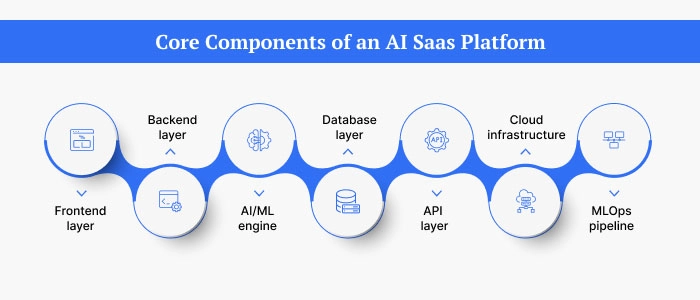
Before you write a single line of code, you need to understand what you are building. A fully functional AI-powered SaaS platform is made up of several interconnected layers:
- Frontend layer: The interface your users see and interact with. Built with frameworks like React, Angular, or Vue, this layer must handle dashboards, real-time updates, AI-generated recommendations, and notifications — without feeling heavy or slow.
- Backend layer: The brain of your product. It manages business logic, API endpoints, user authentication, billing, and the integration of your AI models. Python, Node.js, and Go are popular choices here.
- AI/ML engine: The intelligence core. This includes your trained machine learning models, inference services, data pipelines, and feature engineering logic. This layer is what makes your product “smart.”
- Database layer: Both transactional databases (like PostgreSQL) for structured user data and vector databases or data lakes for AI training datasets and embeddings.
- API layer: A clean interface between your SaaS features and your AI models. RESTful or gRPC APIs allow models to be updated or swapped out without disrupting the rest of the product.
- Cloud infrastructure: AWS, Azure, or GCP provide the compute power, GPU instances, storage, and managed services that an AI SaaS platform needs to run reliably at scale.
- MLOps pipeline: The system that monitors model performance, triggers retraining, manages versioning, and ensures your AI stays accurate over time.
Think of these layers as the floors of a building. Each one needs to be solidly built and properly connected to the others for the whole structure to stand.
What are the Step-by-Step AI SaaS Development Process?
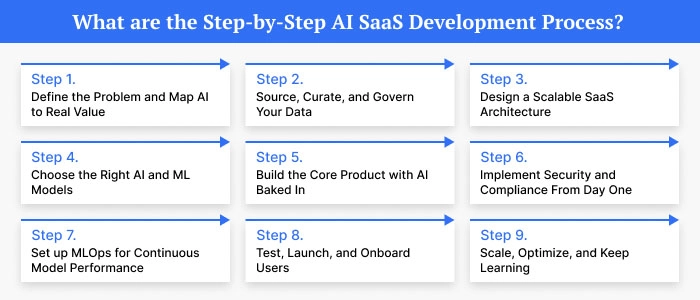
Now let us get into the actual AI SaaS development process the part you came here for. Every step below is specifically tailored to the realities of building a product where AI is a first-class citizen.
Step 1: Define the Problem and Map AI to Real Value
The single biggest mistake companies make in AI saas product development is starting with the technology rather than the problem. They want to use AI, so they bolt it onto a feature roadmap. The result is a product that feels smart but solves nothing.
Start instead by asking: what specific, painful, high-frequency problem does my target customer face? Go beyond surface-level answers. Interview 10 to 15 real users. Shadow their workflows. Document where delays, errors, and frustration occur.
And then ask, what AI capability maps to this pain point?
- A Natural Language Processing (NLP) model can categorize and route support tickets, reducing first-response time dramatically.
- A regression model can forecast inventory demand, helping retailers avoid stockouts or overstocking.
- A recommendation engine can surface the most relevant product features for each user, increasing engagement and reducing churn.
Also define success metrics before you build anything. Precision, recall, F1 score, latency, user satisfaction, agree on what “good” looks like so you can measure it later.
Step 2: Source, Curate, and Govern Your Data
Quality data for AI means data that is structured, labeled, relevant, recent, and representative of the real-world scenarios your model will encounter.
Here is where to find it:
- Internal sources: User behavior logs, CRM records, support ticket histories, ERP transaction data, anything your existing systems are already capturing.
- Public datasets: Government open data portals, academic repositories, and industry-specific public datasets can supplement gaps in your internal data.
- Third-party APIs: Market data providers, demographic enrichment services, weather APIs, or social media feeds, depending on your use case.
- Synthetic data: When real data is scarce or privacy-sensitive, synthetic data generation tools can create statistically representative training sets.
Once collected, your data needs to be cleaned, normalized, labeled, and split into training, validation, and test sets. Invest heavily in this step. Rushed or sloppy data preparation is the leading cause of AI models that fail in production.
Data governance is equally important. Depending on your industry and geography, you may need to comply with GDPR, HIPAA, CCPA, or other privacy regulations. Establish clear policies around data collection, storage, access control, and retention before you build your pipelines.
Step 3: Design a Scalable SaaS Architecture
For AI-powered SaaS solutions, a cloud-native, microservices-based architecture is the gold standard. Here is what that means in practice:
- Multi-tenancy: Your platform serves multiple customers (tenants) from a shared infrastructure. Each tenant’s data must be logically isolated for security and compliance.
- Microservices: Break your application into small, independently deployable services, one for user management, one for billing, one for the recommendation engine, one for notifications. This makes it easy to scale individual components without touching the rest.
- Containerization: Docker containers package each microservice with its dependencies, making deployments consistent across environments.
- Orchestration: Kubernetes manages the scheduling, scaling, and health of your containers across cloud infrastructure.
- AI model isolation: Treat each AI model as its own microservice with a clean REST or gRPC API. This lets you update or retrain a model without disrupting core product features.
- Real-time data pipelines: Tools like Apache Kafka or AWS Kinesis handle the streaming of data between your SaaS features and your AI inference services crucial for low-latency predictions.
Your choice of cloud provider matters too. AWS offers SageMaker for ML deployment and Bedrock for foundation models. Azure has Azure ML and OpenAI integrations. GCP brings Vertex AI. All three provide GPU instances, managed databases, and auto-scaling. Pick the one that best aligns with your team’s existing skills and your regulatory requirements.
Step 4: Choose the Right AI and ML Models
With your architecture planned, it is time to select the machine learning models that will power your AI features. The key word here is “right”, the ones that best match your use case, your data, and your team’s ability to maintain them.
| Model Type | Typical Use Case | Strength | Key Consideration |
|---|---|---|---|
| Classification | Ticket routing, fraud detection | Fast and interpretable | Requires labeled training data |
| Regression | Sales forecasting, churn prediction | Clear numeric outputs | Sensitive to data outliers |
| Clustering | Customer segmentation, anomaly detection | Works with unlabeled data | Results can be harder to explain |
| NLP / LLMs | Chatbots, document summarization, search | Handles unstructured text | Needs significant preprocessing |
| Recommendation | Personalized dashboards, upselling | Drives engagement | Needs continuous retraining |
| Computer Vision | Document parsing, quality inspection | Handles image/video data | Computationally expensive |
A practical tip for teams starting out: resist the urge to deploy a complex deep learning model when a simpler approach will do. Simpler models are easier to debug, faster to retrain, and cheaper to run. Start simple, prove the concept, and graduate to complexity only when the business case demands it. Also consider whether you will train models from scratch, fine-tune open-source foundation model, or call third-party AI APIs (like OpenAI, Anthropic, or Google Gemini). Each approach involves different tradeoffs in cost, control, and performance.
Step 5: Build the Core Product with AI Baked In
Plan your AI features alongside your core SaaS features from the very first sprint. Follow agile development practices. Break your work into two-week sprints. Prioritize a MVP that includes at least one working AI feature.
Key product features to build first in an AI SaaS product:
- Smart onboarding: Use AI to personalize the onboarding experience. Show new users the features most relevant to their industry or use case based on their sign-up information.
- Intelligent dashboards: Do not just show raw data. Use AI to surface the most actionable insights, highlight anomalies, and suggest next steps.
- Automated workflows: Let AI handle repetitive decisions ticket routing, report generation, lead scoring so users can focus on work that requires human judgment.
- Contextual recommendations: Whether it is suggesting a next action, a relevant integration, or a product upsell, AI recommendations should feel helpful, not intrusive.
- Natural language interfaces: A chat-based interface or a natural language query engine lets users ask questions in plain English and get intelligent, structured answers.
Throughout development, run usability tests early and often. Invite real users to complete key tasks and watch where they get confused. Use explainability frameworks like LIME or SHAP to help your team understand model behavior and debug edge cases. Add an in-app feedback widget so users can flag issues as they work.
Step 6: Implement Security and Compliance From Day One
Security is not a feature you add at the end of the development sprint. In AI saas development, it is a foundational requirement that must be designed into every layer of the system.
For AI-powered SaaS solutions handling sensitive data, the compliance requirements are significant for GDPR, HIPAA and SOC 2.
Beyond compliance, consider AI-specific security risks:
- Model poisoning: An attacker injects malicious data into your training pipeline to compromise model outputs. Implement strict access controls on your data ingestion pipelines.
- Adversarial inputs: Carefully crafted inputs can fool AI models into producing incorrect or harmful outputs. Test your models against adversarial examples.
- Data leakage: Models trained on sensitive data can inadvertently memorize and expose private information. Use differential privacy techniques and avoid training on raw PII where possible.
- Prompt injection: For products built on LLMs, malicious users may craft prompts that manipulate the model’s behavior. Implement robust input validation and output filtering.
Implement role-based access control (RBAC) so users only see what they are authorized to see. Encrypt data at rest and in transit. Log and audit all data access events. These are table-stakes requirements for any enterprise-grade AI SaaS product.
Step 7: Set up MLOps for Continuous Model Performance
Without a structured approach to monitoring and maintaining your models, performance will degrade silently while user trust erodes loudly. According to McKinsey, poor productionization practices contribute to the failure of ML models 90% of the time after initial deployment.
MLOps, the practice of applying DevOps principles to machine learning is your solution.
A mature MLOps pipeline includes:
- Model monitoring: Track key performance metrics like precision, recall, F1 score, and inference latency in real time. Set automated alerts when metrics fall below defined thresholds.
- Data drift detection: Use statistical tests to detect when the statistical properties of incoming data diverge significantly from your training data.
- Automated retraining: When drift is detected or performance degrades, trigger an automated retraining pipeline that pulls fresh data, retrains the model, validates it, and deploys the new version ideally with zero downtime.
- Model versioning: Use tools like MLflow or DVC to version your models, datasets, and experiments. This lets you roll back to a previous version if a new deployment causes issues.
- A/B testing for models: Deploy new model versions alongside existing ones and route a percentage of traffic to each. Measure performance differences before fully rolling out the new version.
Schedule a quarterly “model audit” with your team. Review performance trends, re-examine feature importance, and decide whether the model needs a full retraining or just parameter tuning. This discipline is what separates AI SaaS products that get better over time from those that quietly become obsolete.
Step 8: Test, Launch, and Onboard Users
Testing an AI-powered SaaS product is more complex than testing a traditional web application. You have two things to validate: the software itself, and the AI behavior embedded in it.
On the software side, use the standard toolkit: unit tests for individual functions, integration tests for service interactions, end-to-end tests for full user flows, and performance tests for load and latency. Implement CI/CD pipelines so every code change is automatically tested before it reaches production.
On the AI side, your testing needs to go deeper:
- Functional AI testing: Does the model produce the right output for a given input? Run your model against a held-out test dataset and measure accuracy, precision, and recall.
- Edge case testing: What happens when the model encounters rare or unusual inputs? Test deliberately with adversarial examples, null inputs, and out-of-distribution data.
- Bias and fairness testing: Does your model produce systematically different outputs for different demographic groups? This is especially critical for products in hiring, lending, healthcare, or law enforcement.
- User acceptance testing: Invite a beta group of real users to test the product. Measure task completion rates, time-on-task, and NPS (Net Promoter Score). Pay close attention to feedback on AI features users are often quick to notice when AI outputs feel wrong.
For launch, develop a go-to-market strategy that clearly communicates your AI value proposition. Write API documentation. Create onboarding templates. Offer a guided setup wizard. The easier it is for users to experience the AI’s value in their first session, the higher your activation rate will be.
Step 9: Scale, Optimize, and Keep Learning
Congratulations, now as your product is live. Now the real work begins.
Scaling an AI-powered SaaS platform is different from scaling a conventional web app. As user numbers grow, so do the demands on your AI infrastructure. Model inference requests multiply. Training datasets get larger. Latency expectations become stricter as enterprise customers arrive.
Scalability strategies for AI SaaS:
- Horizontal scaling: Add more instances of your AI inference services behind a load balancer. Kubernetes makes this straightforward with autoscaling rules.
- Model optimization: Techniques like model quantization, pruning, and distillation can significantly reduce model size and inference time without meaningful accuracy loss.
- GPU/TPU acceleration: For deep learning models, GPU-based inference is dramatically faster than CPU-based. Cloud providers offer on-demand GPU instances for inference and training.
- Caching: Cache the results of common or repeated AI inference calls. If 40% of your users are asking the same question, there is no need to run the model 40 times.
- Subscription and billing optimization: Implement usage-based billing tiers that align pricing with the compute cost of AI features. Monitor per-tenant AI consumption and set rate limits to prevent runaway costs.
Beyond infrastructure, keep learning from your users. Analyze how AI features are being used. Look at the queries where the model underperforms. Collect explicit feedback through thumbs up/down mechanisms.
Use this intelligence to prioritize the next model improvement cycle. The best AI SaaS products treat every production interaction as a training opportunity.
What are the Common Challenges in AI SaaS Product Development & How to Solve Them?
No honest guide to AI saas product development would be complete without a frank look at what can go wrong. Here are the most common challenges and practical solutions for each.
- Challenge: Data scarcity. Your AI needs training data, but you do not have enough. Solution: Start with transfer learning, use a pre-trained model and fine-tune it on your smaller dataset. Explore public datasets and synthetic data generation. Run a beta program to collect real user data before full launch.
- Challenge: Model accuracy is not good enough. The model keeps making predictions that feel wrong to users. Solution: Re-examine your feature engineering. Gather more and better labeled data. Try different model architectures. Run systematic hyperparameter tuning. Consult a domain expert to validate that your features actually capture the right signals.
- Challenge: AI features feel disconnected from the product. Users do not engage with AI recommendations or outputs. Solution: Embed AI where users are already working, not on a separate “AI tab.” Use progressive disclosure, show AI suggestions inline, let users accept or dismiss with one click. Explain why the AI is making a suggestion, not just what it is recommending.
- Challenge: High inference costs. Your AI is expensive to run at scale. Solution: Optimize your model using quantization or distillation. Cache frequent predictions. Move from real-time inference to batch inference for non-time-sensitive features. Evaluate whether a smaller, cheaper model can achieve 90% of the accuracy at 10% of the cost.
- Challenge: Compliance and regulatory uncertainty
You are not sure what data you can use or how to handle user privacy. Solution: Engage a legal or compliance advisor early. Document your data flows. Implement data minimization principles collect only what you need. Build consent management and data deletion capabilities before you launch, not after.
How To Choose the Right AI SaaS Development Company?
Not all development partners are created equal. Building an AI-powered SaaS product is a complex, multi-disciplinary undertaking. You need a team with capabilities spanning product design, software engineering, data science, cloud architecture, DevOps, and security. Finding all of that in one partner is rare, but it exists.
Here is what to look for when evaluating an AI SaaS development company:
- Full-stack AI expertise:
Can they handle the entire stack, from frontend development to ML model training to cloud infrastructure? Or will they hand off AI work to a subcontractor?
- Relevant portfolio:
Have they built AI-powered SaaS products before, ideally in your industry? Ask for case studies and references. Look for specific metrics like “we reduced customer support ticket resolution time by 42%.”
- Data governance maturity:
How do they handle data privacy? Do they have experience with GDPR, HIPAA, or SOC 2 compliance? Can they operate within your organization’s IAM policies?
- MLOps capability:
Building the model is only half the job. Can they set up monitoring, retraining pipelines, and CI/CD for ML? A partner who cannot manage the model post-deployment is a liability.
- Communication and transparency:
Do they provide regular updates? Are they honest about risks and timelines? The best partners are the ones who tell you what you need to hear, not just what you want to hear.
- Outcome orientation:
Are they focused on shipping features, or on achieving measurable business outcomes? The best AI SaaS development companies align their work to your KPIs.
Why Sphinx Solutions is your Best Partner for AI SaaS Development?
At Sphinx Solutions, we are not just a best ai saas development company in the generic sense, We are a team that has walked this exact journey with clients across healthcare, fintech, retail, and education, delivering AI-powered SaaS solutions that actually move the needle.
What sets us apart:
- 15+ years of product engineering experience. We have built over 1,500 products for clients ranging from early-stage startups to Fortune 500 enterprises. We know the difference between a product that demos well and a product that scales in the real world.
- End-to-end AI capability, from data strategy and model selection to MLOps setup and post-launch support, we handle every phase of the AI SaaS development process under one roof.
- Cloud-native architecture expertise, whether you are on AWS, Azure, or GCP, our architects design systems built for elasticity, security, and cost efficiency from day one.
- Agile, transparent delivery, as we work in sprints, ship working software regularly, and keep you informed at every step. No black boxes. No surprise invoices.
- Cost-effective global team, as our India-based team delivers world-class engineering at competitive rates, with structured communication designed to fit your time zone.
Our clients get a strategic partner invested in their success. If you are ready to build an AI-powered SaaS product that stands apart in a crowded market, let us talk.
Conclusion
Building an AI-powered SaaS product is one of the most exciting and high-impact things a software team can do today. The market opportunity is enormous. The technology is mature enough to ship reliably. And the demand from businesses desperate to automate, personalize, and predict is only growing.
But it is not simple. The AI SaaS development process spans problem definition, data strategy, architecture design, model selection, product development, security, MLOps, launch, and continuous improvement. Each phase is its own discipline. Each carries its own risks. And the cost of getting core decisions wrong especially around data and architecture compounds over time.
That is why the partner you choose matters enormously. Whether you are building from scratch or infusing AI into an existing SaaS platform, you need a team that has done this before, can anticipate the pitfalls, and has the breadth to deliver every layer of the solution.
Sphinx Solutions is that partner. Reach out today and let us build something intelligent together.
FAQ’s:
What is the difference between AI SaaS and traditional SaaS?
Traditional SaaS delivers fixed features based on rule-based logic. AI-powered SaaS learns continuously from data, personalizes experiences for each user, and automates complex decisions that previously required human judgment.
How long does it take to develop an AI SaaS product?
A well-scoped MVP with one or two core AI features typically takes three to six months to ship. A full-featured platform with multiple models, enterprise compliance, and mature MLOps can take nine to eighteen months or more. The timeline depends heavily on data availability, team size, and how clearly the problem is defined at the outset.
What AI technologies are commonly used in SaaS applications?
Common technologies include:
- Natural Language Processing (NLP) for text understanding
- machine learning frameworks like TensorFlow and PyTorch
- large language models (LLMs) for generation and reasoning
- computer vision for image and document processing
- MLOps tools like MLflow, Kubeflow, and SageMaker for model lifecycle management.
How do you ensure that an AI model stays accurate over time?
Through MLOps practices: continuous monitoring of model performance metrics, automated detection of data drift, regular retraining on fresh data, and rigorous A/B testing of new model versions before full deployment. Scheduling periodic model audits at least quarterly is also essential.
Is AI SaaS development suitable for small and medium businesses?
Absolutely. In fact, AI gives SMBs the ability to punch above their weight class. Automation means they can scale operations without proportionally increasing headcount. Personalization means they can compete with larger players on user experience. The key is starting with a focused, high-impact use case rather than trying to build everything at once.


 Ajay Wadne
 Shaili Gupta